 |
|
 |

| special advertising sections |
 |
|
 |
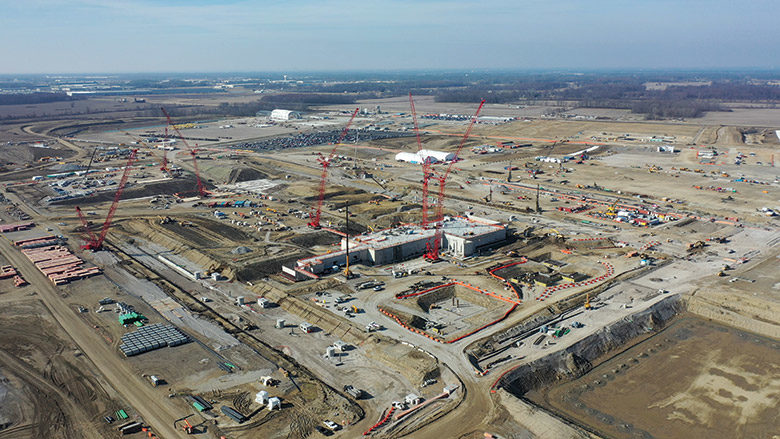
| The Tampa Bay Water
Master Program project, which includes massive
Reservoir. Courtesy of CDG. |
Owners see urgent need
for leadership in constructionand
look to Construction Managers to fill it
Of all the building professionals we work
with, construction managers are the ones we work
with most closely, says Robert Fraga, manager,
facilities portfolio, for the U.S. Postal Service.
What we do is a collaborative effort,
with many parties involved, says Fraga.
As a project moves along, the need for leadership
changes. I see the construction manager taking
leadership in helping the owner manage the entire
construction process.
The Construction Management Association of America
increasingly has focused on leadership as the
key value its members can deliver to the nations
ever-more-complex construction industry. Presentations
by owners (both public and private) at CMAA conferences
have called attention to the need for sound, consistent
project leadership, and CMAA programs put growing
emphasis on meeting this owner need.
Fraga presides over a huge national construction
program at the Postal Service, and says USPS increasingly
needs professional construction managers to augment
its own staff. Our industry has gotten more
and more complicated, he says. It
has been segmented and specialized. In the future,
owners are going to need more help rather than
less, and theyre less willing to staff up
themselves.
Embracing responsibility is a key to the value
of professional CM, Fraga says. A great
part of the growth of CM in the 1960s and 1970s
came about because other professions were shedding
responsibilities, he observes.
 |
| Tacoma
Light Rail. Courtesy of URS |
Linda Phillips, CCM, project management officer
with the U.S. General Services Administration
in Kansas City, MO, expresses a similar view.
The architect is obviously the leader in
design, but the architectural community has stepped
away from the plate when it comes to the risks
associated with the construction process,
Phillips says.
As a result, once we had the CM come in
during construction and then during the design
phase. Now, we have the construction manager coming
in even earlier, says Phillips.
Involving the CM at such an early stage is key
to getting project goals and business goals
aligned, Phillips says. You want to
be sure your buildings are designed efficiently,
built efficiently, are efficient to occupy and
efficient to maintain.
Relying on a good construction manager goes hand-in-hand
with having strong relationships with contractors,
Phillips says. As much as we love our contractors,
at the same time you have to be responsible as
a business person, and you may not have the means
within your organization to maintain oversight.
GSAs 11 regions share a capital budget of
$1.6 billion in fiscal year 2004, yet our
staff has gone down significantly in the last
20 years, Phillips says.
Thomas Gormley, vice president/design and construction
at HCA The Healthcare Co. in Nashville, TN, oversees
a construction budget that can top $600 million
annually. He identifies clear gains his company
has realized by developing strong relationships
with architects, contractors and professional
construction managers who lead collaborative project
efforts.
We know who were working with,
Gormley says. Weve saved literally
millions of dollars over the years just by not
bonding.
Still, Gormley sees some areas in which the process
needs improvement and the CM is the logical player
to deliver. Commissioning is one example.
Nobody wants to step up and take the lead
on commissioning, and making sure the building
works efficiently when we open it, Gormley
says. This is an area in which the construction
manager can and should take a leadership role.
Last fall, a survey by CMAA found that owners
are paying much more attention to project closeout
or commissioning issues. Managing the post-construction
phase of the project is a key process that must
be handled well to achieve customer satisfaction,
says Don Basham of the U.S. Army Corps of Engineers,
a member of the owners panel that discussed
the survey findings at the CMAA National Conference.
A big part of the solution to these issues is
to have proj-ect turnover planning already under
way during the earliest stages of design. Another
key is to vest full responsibility for the process
in a single qualified participant.
Seeking responsibility rather than shifting it
and focusing on total project success rather than
separate niches are two ways todays professional
construction managers are becoming indispensable
to owners. Moreover, many predict that the professions
contributions are just beginning.
Program management is really the next wave,
and theres nobody better to assume the program
management responsibility than the construction
manager, says Fraga. The CM is placed
perfectly to fill that role.
Ethics issues tainting
industry, CMAA survey finds
Within the last 12 months, more than 80% of the
construction managers, contractors, specialty
contractors, architects and other construction
industry participants responding to a recent CMAA
survey personally experienced, encountered or
observed acts or transactions they considered
unethical. That is one finding of a major new
study conducted by CMAA and FMI and made public
in May. The study generally found that unethical
and/or illegal acts are perceived as commonplace
in the construction industry and are tainting
the industrys image and business success.
Of nearly 300 company executives responding to
the survey, nearly 80% said they are sometimes
or often concerned about the ethics or integrity
of contractors they work with. Still, only slightly
less than 40% said they would never work with
a contractor or subcontractor they suspected of
being unethical. Other respondents said they would
work with such firms with great reservations,
or sometimes would, if circumstances dictate,
or even that they often worked with such suspect
companies.
In a related question, more than 60% of respondents
said they would hire a contractor with a reputation
for unethical practices, although most of these
respondents indicated this choice would be driven
by compelling circumstances.
About 65% of respondents agreed or strongly agreed
that the construction industry is tainted
by prevalent acts that are considered unethical,
such as mis-reporting of costs or time and misuse
of equipment and supplies.
About half agreed or strongly agreed that the
construction industry is tainted by prevalent
illegal acts like bribery, harassment, and alcohol
use during work hours.
Costs of these unethical and illegal activities
were estimated to be substantial by survey respondents.
More than a third believed these costs exceeded
2% of total job costs. Nearly 70% estimated the
cost of unethical and illegal activities at more
than 0.5% of total job costs.
Necessary initiatives to address this widespread
problem include more ethics training in university
and college curricula, and a great role for national
associations and professional organizations in
promoting ethics and delivering ethics training.
Development of an industry standard code of ethics
was supported by about 94% of all respondents.
In contrast, within their own organizations these
respondents tend to have few, if any, formal ethics
programs. Only about 30% said they have an ethics
program that is formal, well-known throughout
the company and enforced by top management.
As to whether companies they work with have ethics
programs, 40% of the respondents said they did
not know or have never asked.
CMAA backs qualification-based
selection, warns against reverse auctions
However
popular they may be for buying raw materials,
office supplies and other commodities, Internet-based
reverse auctions present some serious
risks when applied to professional services in
the construction industry, CMAA warns.
CMAA has adopted a policy statement warning that
reverse auctions could threaten the quality
of a proj-ect, safety, and even may lead to an
increase in overall project costs.
Reverse auctions use the Internet to solicit construction
price quotes from a wide variety of suppliers
in a short time, making the current low bid known
to all other potential bidders. This environment
can create pressure to beat that quoted
price rather than base a new quote on a thoughtful
and complete analysis of client needs.
The result, CMAA says, can be imprudent bidding
in which bidders assume unrealistic levels of
risk that can jeopardize the success, or even
the completion, of the project.
Moreover, as an organization dedicated to improving
professional practice and promoting its benefits
throughout the construction industry, CMAA strongly
supports qualification-based selection (QBS).
The use of reverse auctions essentially
removes QBS from the procurement process. QBS
ensures that the qualifications and past experience
of a bidder are considered in order for an owner
to make the best informed choice when negotiating
a contract, says the CMAA board of directors.
When price is the principal consideration
and all other factors are essentially equal and
known, reverse auctions may often be an effective
manner in which to procure goods and materials,
notes CMAA. Unfortunately, this is rarely
the case in construction, where a multitude of
factors including the quality of construction
documents, schedule, weather, different site conditions,
subcontracting, labor availability, etc. create
significant risk...
CMAA strongly believes that due to the increasing
complexity of all phases and types of construction,
the best method to price and acquire construction
and construction-related services, when possible,
is through a QBS process with a negotiated procurement,
the policy statement concludes.
Building on excellence...Surpassing
expectations is theme of CMAA 2004 National Conference
CMAAs 2004 National Conference and Trade
Show will take place September 12-14 at the Hyatt
Regency Riverwalk in San Antonio, TX, exploring
the theme, Building on excellence...Surpassing
expectations.
Participation in the conference has been growing
dramatically in recent years as its programs have
become stronger and CMAA membership has expanded.
Highlights of the
conference in 2004 include:
Keynote speaker D. Michael Abrashoff, former
U.S. Navy Captain and author of Its Your
Ship: Management Techniques from the Best Damn
Ship in the Navy.
An Owners Panel discussion in which both
public and private project owners will express
their concerns and needs for leadership in the
construction process.
Nearly 30 breakout educational sessions
on technical, operational, and business issues.
The annual Industry Recognition Dinner,
which will feature presentation of CMAAs
Person of the Year and Project Achievement
Awards.
Information about the Conference can be found
at CMAAs website, www.cmaanet.org.
|
|
Project Synopsis |
|
During the summer of 2001, PMA Consultants LLC
(PMA) was engaged to assist the Visteon Corporation
(Visteon) with combining various non-manufacturing
facilities in Southeast Michigan into one corporate
village.
PMAs primary responsibilities
assisting Visteon with this $250-million project
include:
- Planning - Finalization
of project strategy, site acquisition and financial
modeling
- Time Management - Developing program schedule,
requirements in A/E and contractor contracts,
schedule review and monitoring
- Cost Management - Cost targeting and program
budgeting value analysis, pricing of change negotiations
- Procurement - A/E and contractor model documents,
Request for Qualifications and Proposals, interviews,
evaluations and negotiations
- Design Oversight - A/E scope definition,
contract administration, and errors and omissions
tracking
- Construction - Management oversight, contractor
scope, contractor procurement and administration,
changes and claims resolution, and quality control
- Risk Management - Owner-controlled insurance,
property insurance, and claims avoidance
- Administration - Program Management Systems,
project meetings, and records
- Occupancy - Commissioning oversight, completion
inspections, move-in planning, contract close-out,
and correction period assistance
PROJECT STATUS
Ongoing

|
|
A Conversation
with Christine Keville |
 |
Christine
Keville,
President & CEO,
Keville Enterprises, Inc. |
President of the Construction Management Association
of America
Q CMAA
portrays the construction manager as the leader
of the construction process. With so many highly
qualified professionals involved in a typical
project, how does CM leadership arise and what
does it achieve?
A The profession
of construction management has only existed for
about 30 years now, but it came into being precisely
because project owners felt that construction
was becoming so segmented and specialized that
no one player really could direct the entire process
and take responsibility for its success.
CM has proven to be extremely effective for owners
in controlling time, cost and quality on their
projects. General contractors, architects, owners
and construction managers must all communicate
effectively and work collaboratively to ensure
success, but the CMs special claim to leadership
is that the CM is the owners ultimate advocate.
The CM, in other words, is the one person who
says, I am responsible for the success of
this project in its entirety. By acting
as an innovative problem solver, the CM demonstrates
the leadership skills necessary to bring out the
most effective management processes in all project
stakeholders.
Q How
is CMAA changing during your year as president?
A CMAA has
been growing very quickly, but recently weve
been working to grow differently as well as rapidly.
For instance, were concentrating on increasing
membership of small, minority and woman-owned
businesses. We restructured our membership committee
into two bodies, one focusing on large and mid-sized
companies and the other reaching out to these
smaller firms.
Were also working to increase owner membership
and participation. Currently, 22% of CMAAs
membership is owners. Weve also reorganized
our owners committee to have two co-chairs,
one public owner and one private owner. Programs
at CMAA national events, and those offered by
CMAA throughout the year, address owner concerns
and issues in depth.
Part of the challenge of increasing owner support
of CMAA is, of course, the same challenge the
profession is tackling in the marketplacethat
is, to educate owners on the value of construction
management.
Q
Is owner understanding of CM improving?
A We see a
clear trend in that direction. Owners are becoming
CMAA members in greater numbers. More and more
owners see the value added to a project when construction
management is applied effectively. It is important
that CMs be involved at the inception of projects
in order to ensure that the best delivery system
is utilized. However, CMAA still has a great deal
of work ahead of us to quantify the benefits of
construction management and convey this persuasive
information to owners.
Q What
growth targets have you set?
A CMAAs
five-year strategic plan calls for membership
to grow from 24 regional chapters and 2,300 members
to 35 regional chapters and 5,000 members. This
is a very aggressive but achievable goal, particularly
when you look back five years and see that we
had fewer than 10 regional chapters and 1,000
members.
The momentum for growth is there. Now we must
maintain a concentrated effort to recruit a diverse
membership throughout the country.
Q
Is the CM certification program experiencing similar
growth?
A We now have
more than 450 certified construction managers
in the U.S., more than double what we had just
a few years ago, and another 290 applicants are
moving through the qualification and certification
process. We continue to receive significant numbers
of inquiries and applications every week.
CMAA specifically encourages public sector involvement
in certification and were pleased to see
that these professional development opportunities
have been well received among public owners.
Q What
other initiatives is CMAA undertaking this year?
A Weve
set out to evaluate our entire publication library
and look for opportunities to update and improve
individual publications. For example, weve
launched a review of the widely used Construction
Management Standards of Practice.
Weve also set up a Research and Development
Committee whose objectives include researching
the best mechanisms for conducting CM research
and quantifying the benefits of utilizing professional
construction management on projects.
We have a new Government Affairs Committee, as
well as a Past Presidents Advisory Council that
will serve as an informal think tank, giving us
their knowledge and experience for the benefit
of the association.
The Board of the CMAA Foundation has also been
expanded from eight members to 11, so that well
have the energy resources necessary to accomplish
the foundations many research and scholarship
initiatives.
Our outreach to other professions has also continued
and expanded this year. In addition to our ever-stronger
links to architects, engineers, contractors, subs
and others, weve formed new connections
to organizations representing the design-build
specialty, and weve become a member of the
U.S. Conference of Mayors.
With all of this activity, we also are trying
hard not to forget one other goal: To keep CMAA
fun. We are learning, networking, and improving
our businesses, but we also want to have time
to laugh.
|
|
Construction
Manager Certification Continues To Grow |
|
More than 200 construction managers have been
certified by the Construction Manager Certification
Institute (CMCI) this past year, thanks to several
major federal owner requests for proposals that
provided extra points for CM Certification.
Owners have really
given the program a boast this year, says
CMCI chairman, Joe McAtee. Employers and
clients around the world are using the CCM designation
as a standard for measuring competency and integrity
in the construction management profession.
The prestige of holding the
CCM designation is accompanied by the responsibility
to uphold ethical standards. The CMCI's professional
conduct requirements demand that certified construction
managers adhere to the highest standards of ethical
responsibility. Adherence to these standards fosters
confidence and trust among clients, employers
and other participants in the construction process.
Awarded only to a small percentage
of construction managers, the CCM designation
requires its candidates to have mastered a rigorous
standard of practice that covers a broad range
of construction project management and leadership
skills. Candidates then must demonstrate their
knowledge by passing a comprehensive exam.
The CCM designation has been
earned by more than 450 professionals; there are
more than 300 candidates in the program preparing
for the exam.
|
| CMAA
Directory |
ARIZONA
Adaptive CM, LLC
120 N. 44th St., Suite 400
Phoenix, AZ 85034
Phone: (602) 923-4000
Fax: (602) 923-1002
Contact: Paul Nelson
Title: Managing Member
E-mail |
CALIFORNIA
Analytical Planning
Services, Inc.
8885 Research
Irvine, CA 92618
Phone: (949) 679-0202
Fax: (949) 679-0212
www.apsi-pm.com
Contact: Ashok Apte
Title: President
E-mail |
CALIFORNIA
APM, Inc.
314 W. Arrow Highway
San Dimas, CA 91773
Phone: (909) 305-2332
Fax: (909) 305-2180
www.apm-inc.com
Contact: Atta Alsaleh
Title: CCM
E-mail |
CALIFORNIA
MacDonald-Bedford
2900 Main Street, Ste. 206
Alameda, CA 94501
Phone: (510) 521-4020
Fax: (510) 521-8712
www.macdonaldbedford.com
Contact: J. Zachary Bedford
Title: President/CEO
E-mail |
FLORIDA
Odebrecht Construction,
Inc.
201 Alhambra Cir., Ste. 1400
Coral Gables, FL 33134
Phone: (305) 341-8800
Fax: (305) 569-1500
www.odebrecht.com
Contact: Claudio Almeida
Title: VP Corporate Contract Admin.
E-mail |
ILLINOIS
dEscoto,
Inc.
One East Erie, Suite 520
Chicago, IL 60611
Phone: (312) 787-0707
Fax: (312) 787-7322
www.descotoinc.com
Contact: Federico dEscoto
Title: President
E-mail |
MINNESOTA
Bossardt Corporation
8585 West 78th Street
Minneapolis, MN 55438
Phone: (952) 831-5408
Fax: (952) 831-1268
www.bossardt.com
Contact: John Bossardt
Title: President
E-mail |
TENNESSEE
Construction Plus,
Inc.
10651 Coward Mill Road
Knoxville, TN 37931
Phone: (865) 693-2200
Fax: (865) 693-2229
www.constructionplus.com
Contact: Sanford C. Loy
Title: President
E-mail
|
TEXAS
Foster CM Group,
Inc.
8620 N. New Braunfels, Ste. 406
San Antonio, TX 78217
Phone: (210) 804-1004
SBA B(a), MBE
www.fostercmgroup.com
Contact: Paul W. Foster
Title: President
E-mail |
TEXAS
Huitt-Zollars,
Inc.
3131 McKinney Ave, Ste. 600
Dallas, TX 75204
Phone: (214) 871-3311
Fax: (214) 871-0757
www.huitt-zollars.com
Contact: James E. Bud Brown, Jr.,
PE
Title: Vice President
E-mail
|
VIETNAM
Delta Equipment
& Construction Company
46 Nguyen Du Street
Hanoi, Vietnam 10000
Phone: 011 84-4 943 3077
Fax: 011 84-4 943-3076
Contact: Alfonso L. Dematteis
Title: General Manager
E-mail |
VIRGINIA
CMDR Associates,
Inc.
7921 Jones Branch Drive, Ste. 401
McLean, VA 22102
Phone: (703) 288-0657
Fax: (703) 288-0638
www.cmdrassociates.com
Contact: Jamshid Malakouti, PE
Title: President, CEO
E-mail |
|
|
|
| special advertising sections |
|
|