Search
ENR Content Purchase Questions View Cart My ENR Content My ENR Account
RESOURCES
Workforce Solutions
Continuing Education
ENR Store
Construction Schools
Civil Engineering Schools
Pulse
Industry Calendar
Regional Directory
Industry Links
Bids & Legal Notices
Special Advertising Section


special advertising sections
Demolition

Having the Diversity to Respond:
The Demolition Industry in the 21st Century

In 2004, in response to the growing diversity of demolition services, from structural dismantlement and recycling to the wide range of facilities decontamination, asbestos, lead & PCB abatement, hazardous materials handling, soils remediation, specialized rigging, industrial recovery and a whole host of other services offered by the industry, the National Association of Demolition Contractors realized it was time to broaden the scope of the organization. Consequently, the organization has changed its name to the National Demolition Association and is interested in attracting everyone involved with the “demolition process” from architects and structural engineers to general contractors and landfill operators.

The NEW National Demolition Association is THE knowledge source for demolition. If you need to know about safe work practices, environmental regulations, marketing opportunities, market size, demolition debris recycling, project planning, salvage & scrap, Superfund & Brownfields, the National Demolition Association is the place to come. The projects that you read about in this Special Demolition Section are but a small example of the skills and technical expertise that the modern demolition company brings to their work. These companies are proud members of the National Demolition Association. Come join our organization and grow with us.

Brandenburg Aids First Response Efforts

Brandenburg is a premier provider of turnkey demolition, environmental remediation, and site preparation services. They also play an essential role in emergency response situations and have assisted first-responders in many emergency situations including structural collapses, fires, and other disasters. Some of these projects include the crane collapse at Milwaukee’s Miller Park Stadium, a parking garage collapse in Atlantic City, and several large fires in Chicago.

Some of the emergency services provided by Brandenburg include consultation, providing specialized equipment, using skilled labor, and providing expert structural engineering. The combination of owning large specialized equipment and having employees that are experienced in working with compromised structures proves to be especially valuable when dealing with situations that require rescuing and protecting people.

One of the most recent emergency response projects for Brandenburg involved a bridge collapse on an Interstate highway in south suburban Chicago. During the erection of a new elevated ramp section, the structure failed and the resulting collapse caused a fatality and several injuries. A portion of the structure trapped the deceased construction worker while the majority of the structural steel was left precariously cantilevered over one of the concrete piers leaving a dangerous situation for the other workers on the project. Brandenburg was called in to develop and execute a plan to safely remove the unstable structure and to provide access to the deceased construction worker for emergency recovery crews. The job was completed in less than 24 hours without incident.

Most emergency agencies have not previously realized that demolition contractors can be a valuable asset in emergency situations. It is now being recognized that demolition contractors have the equipment, skilled laborers, and experience that can be of great value during emergency situations. The equipment that demolition contractors provide can quickly remove debris and damaged structures with precision much faster and effectively than emergency crews are capable of. Demolition contractors are also experienced and knowledgeable when dealing with unstable structures and environmental hazards.

Brandenburg has made an active effort to inform emergency agencies of how they, as well as other demolition contractors, can assist in emergency situations. Brandenburg actively participates in the preparation, training, and awareness for emergency situations. Brandenburg has donated several of their project sites to emergency response agencies for training exercises. Brandenburg has also conducted presentations at various first-responder seminars to make them aware of the services demolition contractors can provide to assist first responders in emergency situations.

Brandenburg’s dedication to safety is unparalleled. Personnel are trained in all aspects of health and safety including OSHA 1910.120 hazardous waste operations and emergency response training. Brandenburg is the first demolition contractor to be invited into OSHA’s Challenge Program. In addition, their worker’s compensation experience modification is an extremely low 0.60 and their accident frequency rate is less than 1/4 of the national average.

Brandenburg is committed to providing a safe work environment for their employees and customers.

R.J. Equipment is Exclusive Importer
of Hydro Kahn Hammers

Clearwater, FL,-based R. J. Equipment is the exclusive importers of Hydro Kahn Hammers for the U.S. construction market. Hydro Kahn, located in South Korea, is one of the world’s largest manufacturers of hydraulic hammers. They now make 11 hammer sizes that fit a range of machines from mini-excavators and skid steer loaders to 100,000 lb excavators.

R.J. Equipment has moved quickly to setup distributorships in key market areas across the country and is looking for more. Currently selling Hydro Kahn’s line of hammers as their exclusive importer, R.J. Equipment President Ron Johnson expects to sell the complete line through their rapidly expanding distributor network in the near future.

R.J. Equipment moved to an expanded Florida facility two years ago. It markets most brands of hammers as well as providing full parts support. Johnson expects to open a rebuild center for their hammers in the near future.

No Problems—Just Solutions

Brock Rentals Inc. (BRI) prides itself on helping their customers finish projects on time in a cost-effective manner. Featuring over 30 machines in 5 different models, these powerful, remote-controlled, electric-driven machines are made for breaking. Weighing just 2,300 lb and only 31 in. wide, these machines are capable of breaking at rates equal to machines 3 times their size in places other machines can’t even enter. Interior breaking or excavating problems are everyday solutions at Brock Rentals.

Quadra Industrial Services, based in Edmonton, Alberta, Canada, has partnered with Brock Rentals on many occasions to solve unique problems during critical path outages often involved with industrial processing shutdowns. Whether it’s suspending machines from a crane inside a cat cracker to tear out refractory with the operator out of harms way or custom building a unit that will fit through a 18-in. round opening, Quadra Industrial and Brock Rentals have the answer.

Terry Kipper, vice president and chief estimator at Quadra Industrial asked for a machine that could hold itself in position and work in a round or square vessel while suspended in the air. “We asked Brock Rentals to help us find a solution that would do the job while keeping our operator as safe as possible,” said Kipper. “Quadra Industrial now has the only remote-controlled “Spider” in the world capable of working in vessels from 3 ft to 31 ft in diameter. Our partnership with Brock Rentals has helped us perform many “firsts” in industrial services,” Kipper concluded.

A Surgical Challenge

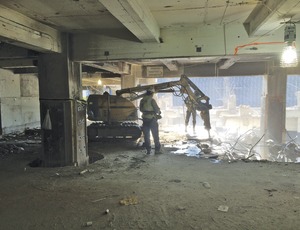
In the construction of the University of New Mexico (UNM) Children’s Hospital and Critical Care Pavilion in Albuquerque, New Mexico, virtually in the shadow of the existing hospital, Coronado Wrecking has been executing a contract to demolish existing structures to prepare the site for the new wings, adding 456,000 sq ft to the existing hospital. This project is expected to take nearly three years to complete, at a cost of $238 million dollars. Construction Notice to Proceed was received in October of 2004.

Jaynes/J E Dunn, a Joint Venture, is the general contractor for this project, working with the contract administrator for UNM, Jacobs Engineering. This project is a combined effort of union and non-union contractors, using a project labor agreement. Working in a very congested, tight space, the work is challenging, requiring schedule coordination with multiple other trades working in the same area, and sharing the space with the continuing hospital emergency room traffic, including helicopters arriving at and leaving from the existing rooftop heliport.

The mass excavation work, also contracted to Coronado Wrecking, was coordinated with shoring issues regarding the existing building foundation, new foundation forming and cement pours. Approximately 60,000 cu yd of removal, bounded by the existing parking structure on the west, a main boulevard on the south, the existing hospital on the east, and the existing Telecommunication Building (housing the fiber-optics supplying the University of New Mexico and the existing hospital needs) on the north. This required well coordinated efforts by all parties.

Two other related projects were accomplished in the same time frame—the extension of an existing box culvert (requiring removal of the existing concrete lined arroyo) under a portion of adjoining property that is to be incorporated into the hospital project, and demolition of a portion of the telecommunications center. All of the hard material removed from this project was removed to Coronado’s recycling plant, and turned into base course material.

Once the new construction has progressed to the point that it is to be joined to the existing hospital structure, more selective demolition will be required. A portion of the existing hospital scheduled to be abandoned which entails two three story wings will have to be demolished to prepare for the final phase of the project, building a new entrance to the hospital complex, scheduled for 2007.

Cherry Demolition Aids Gulf Coast Recovery

Cherry Demolition had the opportunity to provide assistance to the U.S. Gulf Coast during the aftermath of recent catastrophic events. Cherry, owning one of the largest heavy equipment fleet’s in the Texas Gulf Coast area, was able to mobilize heavy equipment, qualified operators, and the needed experience to assist in the emergency response, clean-up, and recovery.

Cherry’s emergency response team assisted in the removal of heavy debris from residential streets and neighborhoods in Beaumont, TX, removing debris that was blocking streets, driveways, and doorways to allow medical assistance to get to those who had been trapped in their homes. Wesley Guidry, Cherry Portable Crushing Manager recounts the events as an experience that was difficult but an immense feeling of satisfaction to assist citizens to shelter at the near by Ford Center. Cherry crew’s worked 24/7 and having the proper equipment were able to cover a large area in a short time. The largest obstacle was the lack of lighting and electricity.

Post-Katrina and Rita- evacuated areas that did not get hit still suffered the consequences of power outages and therefore many restraunts and grocery stores perishables were left in ruins. Cherry Industrial Services was ready to assist these stores by providing roll-off boxes for mass disposal of foods that were no longer suitable for sale or consumption.

One major retail store suffered a collapsed roof due to the heavy rains and the collecting of rain water. Cherry Demolition was able to remove the damaged roof area. Cherry Demolition Manager Aaron Palvowhich says: “Our goal was to complete the project rapidly by removing the damaged area of the roof and leaving the undamaged area of the roof intact. Due to Cherry Demolition’s experience and equipment we were able to complete this job effectively and efficiently. Running our own trucking and using our skills, we were able to complete the project on schedule and without incident.”

During the recent storms several Gulf Coast regional industrial tank farms, oil rigs, and crude oil plants suffered damage. Cherry Industrial Demolition was able to assist in the clean up of several different plant facilities quickly.

Cherry has also responded to the aggregate shortage caused by Katrina and Rita. Our Portable Crushing Division currently operating in the Golden Triangle Area is turning concrete slabs or concrete rubble into usable aggregate. This turnkey concept saves money, the environment, and speeds recovery.

Cherry Demolition stands ready to assist in the recovery of U.S. disasters today and tomorrow.

Nuprecon on Waikiki

In January of 2001, Nuprecon was selected by Pankow Builders and Thompson Matheny, representing the project ownership, to be their demolition and abatement contractor for the Waikiki BeachWalk project for Outrigger Enterprises. This significant project, spanning several blocks in the busy tourist district of Waikiki, called for the demolition of four existing hotels and multiple retail structures prior to construction of a new hotel, retail and parking complex, which when completed, will occupy the eight acre site.

Nuprecon worked with the project team for four years prior to the beginning of demolition to develop an approach that would be the most cost-effective while at the same time minimizing the impact on the surrounding hotel and retail enterprises. As a result of this value engineering and partnering approach, Nuprecon was able to reduce the schedule for demolition and abatement of the site from six months to just three months.

During this time, Nuprecon also proposed the concept of processing the concrete materials onsite for use as backfill. Since only about 5% of the proposed material contained lead-based paint, Nuprecon engineered a solution whereby this material was selectively removed thus allowing the balance of the concrete to be crushed for backfill.

Due to the close proximity of more than 10,000 occupied hotel rooms, Nuprecon brought in an 80 ft LongReach trackhoe with a Genesis concrete processor attachment to literally “munch” the building from top to bottom. This process resulted in a far more controlled and quieter approach than a traditional trackhoe with a hydraulic hammer.

Nuprecon was proud to report that all work was performed with no damage to adjacent structures, no noise or dust complaints, and not so much as a single band aid required by any of the workers.

“Nuprecon has done a masterful job on our Waikiki Beach Walk project. This was no ordinary demolition project. It involved taking down a block and a half of mid-rise structures within shouting distance of 10,000 operating hotel rooms in the densest portion of the Waikiki resort district. The demolition was executed with surgical precision—on time and on budget—with nary a complaint from adjacent businesses and hotel guests during the entire 3-month process,” said Eric Masutomi, vice president of planning for Outrigger Enterprises.

Surgical Demolition Cuts Million Sq Ft Plant In Half

MCM Management Corp, under contract to Daimler Chrysler, mobilized in July 2004 to DCX’s former New Castle Forge facility in New Castle, IN. This historic plant, a community fixture for 100 years, employed many residents for multiple generations. The performance of industrial demolition in congested commercial/residential settings in a safe, clean, and respectable manner is a hallmark of MCM operations.

Work-scope items included asbestos abatement, environmental cleaning, structural and interior demolition, and construction of a 1,200-linear-ft wall to serve as the new exterior wall for the remaining operating facility.

MCM began environmental cleaning operations immediately. This work was performed by a team consisting of MCM, AU Technologies [Taylor, MI], and other area firms. Materials removed included: oil-filled light ballasts, fluorescent light tubes, chemicals used in the manufacturing process, sludge, oils, and contaminated liquids. All removal processes were executed under control and without release into the facility or the environment in general. Several hundred thousand gallons of product were removed in aggregate. Contaminated water was treated onsite; other materials were sent to licensed disposal facilities. The Indiana Dept. of the Environment [IDEM] inspected parts of the work to ensure safety and compliance.

The New Castle Forge facility operates on a 24/7 schedule by owner Metaldyne. MCM’s first task was to install a temporary weatherproof wall to separate the owner’s operations from construction and demolition operations. Once the temporary wall was installed, demolition and construction work began. MCM’s CAT 345B Ultra High Demolition platform coupled with a CAT MP20 Multi Processor performed surgical removal of two bays of the structure totaling approximately 50 ft wide and 1,200 ft long. The area was so congested that structural elements from the demolition had to be stacked on the roofs of the remaining structures that were to be demolished later in the project. Roof-loading capacities were strictly observed. The separation was completed in 5 working days, without incident.

A major concern for the project and community was the abundance of wood used in the plant. A fire during demolition operations could have created devastating consequences for all stakeholders. MCM’s work plan excluded all use of torch cutting and included constant wetting of materials and structures, and near-instant removal of combustibles from the site. Water runoff was collected and discharged through filtered sanitary sewers and into the site water treatment facility.

In early October 2004, MCM removed the cornerstone and time capsule from the original administration building. This stone was installed in 1906 by the Maxwell-Briscoe Corp. MCM presented the stone and its contents to Metaldyne, who incorporated it into an historical monument commemorating the work this plant produced over the course of a hundred years of production. To create this monument, MCM saved a corner of the original 1906 structure.

The project reached substantial completion on Nov. 26, 2004. MCM routinely recycles 95% of our projects by weight. Although this project had a far larger percentage of wood and debris than do most comparable plants, MCM was still able to recycle more than 75% of the project by weight.

Logan Garage Comes Down Safely

As part of the ongoing process to expand and modernize Boston’s Logan International Airport, the Massachusetts Port Authority and Turner Construction began work on extensive modifications to Logan’s Central Parking Garage in 2004. Hailed as one of the most technically challenging and high-risk construction/demolition projects in New England, the scope of work calls for the selective demolition of the bottom two floors of the garage, replacement of those two floors with pre-cast deck members, and the construction of three additional parking levels above the existing structure—while maintaining essential active parking in the airport’s main facility. The demolition segment of this undertaking is administered by Costello Dismantling of Massachusetts, which has crafted innovative approaches to conduct the demolition activities in an efficient and safe manner with a one hundred percent debris recycling rate.

Middleboro, MA,-based Costello Dismantling took a team approach to the engineering planning of the central parking demolition, utilizing the expertise of Turner, MassPort and Costello’s in-house, peer-reviewed engineering staff to develop and constantly refine the engineering and demolition plans to meet and exceed the parameters of each unique demolition challenge. These tasks include the development of a shoring system capable of supporting the load of a full garage while structural decks and girders are removed and replaced, saw cutting holes through five levels to support new decks, removal of structurally deficient decks on the lower levels with an emphasis on maximizing the available parking areas to meet the demands of one of the country’s busiest airports, and the surgical demolition of stair and elevator towers within three feet of newly constructed, active pedestrian walkways and elevators.

The exterior stair tower demolition utilized an 85-ft high-boom excavator with rotating concrete pulverizer and demolition attachments, while the demolition of the decks and girders inside the garage was accomplished by a host of specialized machines. To remove the decks, concrete pulverizers are mounted second member to achieve the most efficient angle of operation and reduce the operating height of the boom in close quarters. The structural girders and other concrete features are removed through a combination of a small, zero-tailspin excavator mounted with a pivoting concrete cracker and Brokk robotic hammers.

Costello’s creative engineering and planning work on this proj-ect allowed the company to promote a culture of safety awareness on the job through increased utilization of mechanical solutions to demolition, reducing worker exposure to the many hazards presented by working in a congested, busy environment. In coordination with Turner Construction, Costello has tailor-fit their health and safety plan around the specific hazards of this project, providing the vital site-specific training and documentation needed on a job this size.

Founded in 1985, Costello Dismantling Co. Inc., has developed a diversified background across virtually all disciplines of commercial, industrial and municipal demolition.

Coming Full Circle

In late 2004, CST Environmental Inc., an ENR Top 10-ranked demolition and environmental services contractor, began the process of dismantling the Geneva Steel Plant in Vineyard, Utah. This former U.S. Steel facility operated for over 60 years as a fully-integrated steel and pipe mill and now is being scrapped and salvaged piece by piece. Major components of the manufacturing processes are being dismantled and marketed to locations both domestic and international for integration into facilities utilizing similar technology. The plant’s buildings, site facilities and infrastructure are being dismantled, separated, sized, and shipped to various destinations in both Asia and the U.S. as scrap metal for recycling.

In its heyday, the Geneva facility boasted a four-battery/256 oven Coke Plant, three 26-ft diameter blast furnaces, each with three hot blast stoves, two 235-ton QBOP vessels, ten 245-ton open hearth vessels, a 235-ton caster, a rolling mill complete with soaking pits, reheat furnaces and six finishing stands. The plant also had a full maintenance area, machine shop, carpenter shop, electric shop, fire station, and its own 50 MW power plant, in addition to hundreds of pieces of rolling stock.

Traditionally a demolition and environmental services company, CST expanded and upgraded its scrap operations and capabilities when it took possession of the 1,800-acre site. Not only does CST’s scope of work include complete above-ground hazardous materials abatement and dismantling of buildings totaling 4.5 million sq ft, but processing and shipping of all scrap and salvage on site. The Geneva site contains 126 buildings, 90 miles of rail, 462 railcars and 12 locomotives in addition to steel molds, trucks and heavy equipment, motors, and miscellaneous scrap left on the site.

The three to four-year project has been divided into 12 work zones for purposes of cost control, production tracking, scheduling needs and scrap market conditions. Each specific zone includes buildings and facilities of similar type and construction. This approach allows CST to focus its efforts on either abatement, hazardous waste removal, building demolition, scrap processing, or loading railcars and trucks for shipping or relocation within the site. The majority of scrap is shipped by rail and most salvaged components are shipped by truck. CST estimates the project will yield approximately 230,000 tons of scrap, in addition to the many salvaged items that have been dismantled and sold for re-use at other industrial facilities.

To perform the work, CST is utilizing over 25 major pieces of heavy demolition equipment, with an assortment of attachments. This inventory of equipment included an assortment of 75,000 to 100,000 lb excavators with shears, grapples and magnets for processing and handling of scrap. The work force includes approximately 40 demolition laborers and operators; 20 HAZWOPER, asbestos abatement and salvage personnel; 20 scrap burners; and a full-time project management staff of six.

With very real similarities to the immense effort used in the last century to mine ore from the earth and produce domestic steel, CST’s efforts today on this milestone project provide for the same steel to be recycled and used again in building structures, automobiles, major household appliances and other industrial and commercial products both nationally and internationally.

Old Cooper River Bridge Coming Down

Testa Corp. headquartered in Lynnfield, MA, is currently dismantling and disposing of the two Cooper River Bridges located in Charleston, SC. The bridges that are being demolished are the Grace Memorial Bridge, which was built in 1929, and the Silas Pearman Bridge, which was built in 1966. The bridges that are each 2.7 miles long were considered functionally obsolete. They were replaced by the Arthur Ravenal Bridge, which is considered to be the longest cable stay bridge in North America. The new bridge has a vertical clearance of 180 ft above water level compared to 150 ft for the Grace and Pearman, which are being demolished.

Photo courtesy C.Frank Starmer.

As part of their scope of work Testa Corp. and joint-venture partner Jay Cashman Inc. will transport all of the 125,000 cu yd of concrete out to sea by barge. This concrete will be dumped at designated locations in the ocean to construct artificial reefs. These reefs are expected to increase the fish population in years to come.

The concrete approach sections of the bridges that were located over land in Charleston and Mt. Pleasant, SC, were quickly demolished and removed at the beginning of the project. Testa utilized numerous NPK 240 hammers, which were mounted on Caterpillar excavators. The broken concrete was then loaded into dump trailers and into off road Cat D350 articulating dumps. Testa used a temporary steel trestle that was located at the river’s edge to allow loading of the demolished concrete into the barge scows, which when loaded will be transported out to sea.

Vermeer T-555 concrete saws were used by Testa to precut the concrete bridge deck surfaces of the two bridges. At that point, hydraulic excavators equipped with grapples lifted and removed the concrete segments. The crew then utilizes Testa’s barge- mounted 300 ton Manitowoc 2250 crawler crane to pick and lower the concrete and steel beams onto a barge. Any bridge beams, that are located over land will be lifted by Testa’s Grove 7550 hydraulic crane. This 550 ton Grove crane easily lifts the beams, which average more than 180 ft in length.

More than 20 excavators were mobilized by Testa for this project. They range in size from a 1250 Komatsu weighing more than 218,000 lb down to a Caterpillar 320, which weighs 42,000 lb. The Komatsu is equipped with a Jewell boom that reaches up over 100 ft high. The excavators are equipped with grapples, shears, universal processors, hammers and concrete pulverizers. Only on a rare moment will an excavator have a standard digging bucket mounted on it. When faced with the task of removing the massive bridge piers, Testa contracted La Bounty Manufacturing to design an HDR 900 grapple, which will be mounted on Jay Cashman’s 995 Liebherr excavator. The grapple is the world’s largest in size. When mounted on the Liebherr, the grapple has a digging depth of almost 65 ft. This allows Testa to break up and remove the subaqueous concrete from all of the massive bridge piers. Explosives will be utilized to fracture the concrete piers, but only to the extent that there is no risk of damaging the abutting bridge piers from the new $300 million Ravenal Bridge.

The four center spans of the bridges will be dropped into the water on separate occasions. Linear shape charges will cut the steel trusses into numerous panels, which will be retrieved from the water using the 300-ton Manitowoc crane. This allows the navigation channels of the river to be re-opened to ship traffic within 24 hours of the explosive blast.

Located at the approach of the bridges, The Port of Charleston is amongst the busiest in the nation and the new bridge was built partially to accommodate the taller container ships that travel under the bridge.

All of the 22,000 tons of steel generated from the demolition will be cut to size by the hydraulic shears and smelted into new steel. Testa is using ten of its La Bounty hydraulic shears for the steel and for the concrete decks.

Testa Corp., which traces its roots back to 1967, specializes in the demolition of heavy industrial, commercial, marine and bridge structures. The company owns more than 200 pieces of specialized demolition equipment. It recently completed demolition of Boston’s Central Artery as part of the Big Dig and currently have projects extending from Maine to Miami, FL.

Fay Struts Its Stuff

In August 2005, the Joseph B. Fay Co., along with multiple other subcontractors, completed a $13-milllion river chamber demolition project at Charleroi Lock and Dam located on the Monongehala River near Pittsburgh. The project was Phase 1 of a multi-phased construction project implemented by the Army Corps of Engineers in an effort to increase the lock size.

As the major subcontractor on the project, Joseph B. Fay Co. assisted in stabilizing and preparing the lock chamber for dewatering so that the demolition could begin. Forty-one, 60-ft-long, 36-in.-diameter steel struts had to be installed before the existing concrete struts with 1 million lb of water pressure pressing against them could be removed. Struts had to be installed in a predetermined sequence in conjunction with the concrete strut removal to avoid wall failure.

Once the initial 9 million gallons of water were removed from the chamber, the pumps were relied upon to overcome 5,000 gpm of water leakage through the walls while demolition progressed. Gate, strut and sill removal as well as demolition of the chamber floor were completed under an accelerated schedule to try and avoid emergency equipment evacuations as a result of common flooding. Vertical clearances of less than 1 ft below the struts forced operators to use surgical skills while removing approximately 7,000 cu yd of concrete, soil and timbers using excavators with various attachments. Material was transported via loaders one bucket at a time to the end of the 682 linear ft lock where it was clammed and loaded onto awaiting barges for disposal.

Demolition of a Cement Plant

Envirocon Inc. has recently completed the demolition of a one-million-ton-per-year cement plant for Holcim (US) Inc., in Holly Hill, SC. The plant was removed when Holcim brought a new two-million-ton-per-year dry-process plant online that made the old plant obsolete.

The demolition required the use of a wide range of demolition techniques and equipment to safely accomplish this project. Major components of the work included removing two large rotary kilns, one 17.5 ft in diameter and 500 ft long, and one that was 19.5 ft in diameter by 580 ft long, seven large storage silos, one 2,000,000 gallon fuel storage tank, 13 slurry tanks and five large ball mills as well as the Ball Mill and Clinker Cooler buildings.

The proximity of the project to adjacent occupied process buildings and a 4,160 Volt power line that crossed under the kilns and passed directly through the buildings being demolished presented unique challenges to the Envirocon demolition team. Careful planning and engineering of each activity was necessary to successfully complete this complex project. Chris Schillesci, project director, said “I have worked in the demolition field for 25 years and have been involved in other cement plant demolition projects, but the size and complexity of this one was somewhat intimidating initially. You can’t appreciate its magnitude unless you stand under the 19-1/2-ft-diameter rotary kiln mounted on the top of 30-ft-tall foundations and try to visualize how you are going to bring it down safely. The most valuable tool I use is gravity. Get it safely to the ground where it can then be prepared for scrap.”

Engineered drop designs were developed to undermine and drop buildings and structures up to 125 ft tall and weighing up to 800 tons. Three precipitator boxes weighing 400 tons were mounted on top of a 25-ft tall steel support structures. These were dropped by removing the outside row of columns allowing the heavy box to rotate 90° on the center row of columns, dropping it flat on its side, where it was demolished using excavators equipped with hydraulic shears. Steel silos were undermined and successfully dropped, passing within inches of an asbestos sided building.

Envirocon developed engineered lifting plans for each major lift operation. A 300-ton hydraulic crane was used to lift six 65-ton sections of the kilns from above the live power line and other structures designated for preservation. Remaining sections of the kiln were torch cut from a man-lift and dropped in sections. Explosive shape charges were then used to drop the last two kiln sections off their 30-ft-tall foundations. The design called for a 17-ft-by-65-ft, 300-ton section to drop horizontally down between the foundations, while the two 17-ft-by-30-ft, 200-ton end sections rotated 90° off the foundation landing, in a vertical position next to the foundation. The sections dropped exactly as planned within 15 ft of the live 4,160 volt power line.

Envirocon removed and recycled approximately 12,000 tons of steel during the project. Approximately 25,000 tons of concrete was crushed and used as granular fill on a bank stabilization project on the site.

Farewell to the Cooper River Bridges

The Arthur Ravenel Jr. Bridge was constructed over the top of existing bridges, which remained open to traffic while the new bridge was built.
Photography by Vince Streano

What goes up must come down, and not long after the Arthur Ravenel Jr. Bridge opened to traffic in Charleston, SC, on July 16, 2005, work began on removal of the 39-year-old Silas N. Pearman Bridge and the 76-year-old John P. Grace Memorial Bridge.

The fact that this 18-month, $59.6-million design-bid contract followed construction of the new bridge is not typical of a demolition project. Normally, demolition takes place in the early stages of a construction project, as the old structure is removed to make way for the new one. In this instance, the Ravenel Bridge was constructed right over the top of the old ones, which remained open to traffic while it was built.

Who’s Who
The design-build, team consists of the Jay Cashman Inc./Testa Corp. joint venture as the contractor and Weidlinger Associates, Inc. as the engineer of record. The owner’s representative for the South Carolina Dept. of Transportation is a joint venture of T.Y. Lin International and HDR, responsible for administering the contract and payments and conducting field inspections.

Deconstructing the Bridges
The demolition process is following the construction process in reverse—first the deck is removed, then the rest of the superstructure, followed by the substructure. As the roadbed and girders are dismantled, the concrete is being hauled to the Navy pier by truck, loaded onto barges, and then taken off-shore to the 12 permitted artificial reef sites. The steel from the project is being recycled.

Issues surrounding bridge removal were similar to those of bridge construction—namely, how do you safely dismantle two very large structures in the nation’s fourth busiest container shipping port, that also includes sensitive wetlands?

The two old bridges consist of four cantilevered truss structures, two over Town Creek and two over the Cooper River, which flows into the Atlantic Ocean. Since it is not an active shipping channel, Town Creek is providing an opportunity to test demolition and recovery methods. The first truss sections to be removed came from the Pearman Bridge over Town Creek. The suspended section of the truss was first to be removed because it can be dropped without causing the rest of the bridge to come down; the anchored and cantilevered sections remain intact.

Unlike the Cooper River shipping channel, which may only be closed for 24 hours, Town Creek has no time requirements for removing debris. Both the U.S. Coast Guard and the U.S. Army Corps of Engineers have to approve closing the Cooper River shipping channel, and their approval is based in part on the success of the demolition tests in Town Creek.

Two Types of Explosives
Two explosives methods are being used on the project—shape charges on the steel trusses and more conventional explosives using a series of drilled holes on the concrete substructure. Linear shape charges are designed more to cut through steel like a torch than to blow it up. They are strategically placed on the structure and sized based on the thickness and grade of steel.

More conventional explosives were used on one set of columns and a cap on Drum Island, testing them to see what amount of explosives would be needed on some of the larger water piers. Holes are drilled up the column and across the cap and filled with explosives, using enough to turn the concrete into rubble. This conventional method was also used to tip some of the columns over on Drum Island, blowing out a wedge shape similar to cutting into a tree to bring it down. This made it safer for crews to get at the tall columns and caps with their conventional demolition equipment.

Environmental Concerns
The owner’s team includes an environmental manager, who is working closely with permitting agencies to make sure issues are addressed, just as they were during construction of the Ravenel Bridge.

Two of the endangered species that either live in or visit the area include loggerhead sea turtles and manatees. Crew boats will go out and look for them before any explosives are discharged, to make sure if any are present they are a safe distance away.

Temporary access roads across Drum Island, and work trestles used to support equipment, are being mitigated. One permanent mitigation site in Mount Pleasant will involve removing the causeway to the Grace Memorial Bridge and restoring wetlands in this area.

From the community standpoint, one of the larger concerns is dust control. Any time you break up thousands of tons of concrete you’re bound to raise some dust. The contractors are using hoses and water trucks to control problems caused by dust.

What’s Next
At present, demolition is approximately 25% complete. A few construction items also are included in the contract. When the bridges are removed, some formerly severed roads on the Charleston side of the harbor will be reconnected. The contractor is responsible for building a segment of the pedestrian-bike crossing that was left out because it was in conflict with a substructure on the Grace Bridge. A temporary wooden walkway has been used until the demolition is complete. The contractor also is responsible for building an observation pier in Mount Pleasant, which will use footings from the Pearman Bridge. The pier will be a key feature of a new waterfront park, using 27 acres at the former site of the Pearman Bridge. SCDOT and the Town of Mount Pleasant worked together to get optimum use of this public land.

Mazzocchi Demolishes Philadelphia Convention Center

Coming from their efforts at the World Trade Center site in downtown Manhattan, Mazzocchi Wrecking of East Hanover, NJ, has been very busy. The northern New Jersey firm has recently completed large projects for Consolidated Edison, the Atlantic City Convention Center, Newark Airport and the Resorts Casino.

Recently, Mazzocchi completed the demolition of Philadelphia’s Convention Center located in the University City section of West Philadelphia next to the University of Pennsylvania campus. The old convention center was the site of numerous political conventions, concerts and sporting events. For a time it was the home of the NBA’s Philadelphia ‘76ers professional basketball team.

With the development of the new Pennsylvania Convention Center on the city’s east side, the old center lost it usefulness and the university decided to use the site for a new structure that would be part of the university’s growing medical complex.

The convention center had a 200-ft lateral center height and a huge interior expanse. Mazzocchi’s management team studied how best to bring the massive structure down in its crowd location, next to the university campus and Philadelphia’s famous Children’s Hospital. They developed a unique “hinging” process whereby they would gently “snip” and dismantle the vast center span supports of the center. Then, demolition of the 200-ft high stage and main entrance foyer could safely follow.

Mazzocchi’s team was conscious of the university’s desire to salvage many of the historic architectural treasures that adorned the structure. They used their custom LRD 750 with its 160-ft boom, near-tool mounted water cannon for dust suppression, and a mounted video camera to monitor demolition details for the ground. The massive pieces of steel removed by the LRD were cut to size for scrap and sorted along with limestone and other recyclables from the structure.

Mazzocchi was able to salvage and recycle the vast majority of this historic structure with minimum disruption to the surrounding busy neighborhood.

Bierlein Cos. Continues Strong Presence in the Power Industry Bierlein Companies Demolish Powerhouse and 500-Ft Smoke Stack

Port Washington, WI.

The Bierlein Cos., a nationwide demolition and environmental contractor, recently completed demolition activities at the Port Washington Generating Station located at the historic fishing harbor in Port Washington, WI. The coal-fired powerplant, commissioned in 1935, was once the most efficient generating station in the world. The five coal-fired boilers are in the process of being replaced with two 545 MW gas-fired units. Port Washington Generating Station is an intermediate load plant, supplying electricity during periods of heavy demand. The rebuilt plant will provide the state of Wisconsin with new capacity to meet growing demand for power in the northern Milwaukee area.

Bierlein Cos. was contracted in August of 2004 to perform the demolition, asbestos and lead abatement, as well as site remediation to the existing powerplant. Bierlein responsibilities included demolishing three large remaining boilers and associated turbines, cleaning up the coal handling areas and abating and removing a 500-ft smoke stack.

Historical preservation was one of the mandatory requirements of WE Energies on this high-profile project. The historical significance of the 1930’s architectural style needed to be maintained since the Port Washington Generating Station is the first site that greets pleasure boaters and fishermen as they enter the harbor. The northern and western portions of the 70-year-old facade of the station were left intact and untouched. The interior portions of the facility, including the 160-ft-high boilers, turbines, and precipitators, were carved out with surgical precision. Once all construction activities are completed in 2008, the powerhouse will appear nearly identical to the way it looked upon its original completion in 1935.

The demolition of the 500-ft smoke stack was another challenging aspect of the project. Since the stack was within 50 ft of new construction activities, the use of explosives was not an option. The stack was dismantled by hand, first by removing the 3,000-ton inner liner—one brick at a time. Once the inner liner was removed, the solid concrete outer shell was broken into pieces utilizing hand-operated jackhammers. All materials were dropped into the interior of the stack and removed on a daily basis through an access cut into the base. In all, over 8,000 tons of brick and concrete was handled during the stack demolition.

Environmental stewardship was another prerequisite of WE Energies on the Port Washington Generating Station project. Extensive pre-cleaning, material segregation and tedious attention to detail were performed throughout the project to ensure that a minimum of the demolition materials generated was sent to landfills. Upon completion of the project, over 30,000 tons of metal and 45,000 tons of concrete were processed and recycled. In addition, over 35,000 tons of soil was handled. The remainder, which comprised less than 10% of the demolition materials, was landfilled—a record for waste minimization on a Bierlein powerhouse project.

After the complete removal and excavation of the foundations, the power company will rebuild another 545-MW, natural gas unit, which is expected to be operational in 2008. Bierlein will recycle a 100% of the materials hauled off site and wrap up the project with an on-time completion date in late December 2005.

Louisiana Chemical Dismantling Helps Expand LSU’s Tiger Stadium

Louisiana Chemical Dismantling Co. Inc., of Kenner, LA, was contracted by Yates Construction this past fall to remove the entire upper west side seating area and suite section from LSU’s Tiger Stadium in Baton Rouge.

Their goal was simple. Complete the project on schedule, within budget and without an injury or accident. However, achieving that goal was not so simple, given the number of difficult challenges. Tasks included the removal of the upper west side general seating bleachers and suites, stadium lighting poles, press box and portions of the outer stadium access ramps and stairways. The press elevator and suite access elevators were shut down early in the project and completely removed in conjunction with the upper stadium removal. Demolition work started immediately following the final home football game of the 2004 season.

The various stadium components had to be dismantled from the top of the stadium in manageable-sized sections by various methods such as wire-saw cutting, jack-hammering, torch-cutting, mechanical concrete breaking and a lot of basic hard work. Once the various materials were separated from the stadium, they had to be rigged with a crane, lifted, and placed on the ground for further preparation and handling.

About 35,000 tons of concrete and another several thousand tons of miscellaneous material such as stadium seats, metal structures, HVAC equipment, masonry, wood items, elevator cars, motors, and cables had to be dismantled and removed and transported off the site in less than 9 weeks.

Knowing in advance that time would be of the essence, Louisiana Chemical Dismantling pooled manpower and heavy equipment resources from other projects around the country to help meet the challenge of the aggressive work schedule. They used primarily experienced demolition personnel and minimized the number of new employees hired.

To further meet the challenges posed by the fast-track schedule, two 300-ton cranes and a 1,500-ton capacity crane were selected to perform the bulk of the lifts. By utilizing a large 1,500-ton capacity crane, each of the raker beams that supported the bleacher “plank” sections were able to be lifted in one piece along with a good portion of the attached support columns underneath. Other associated concrete structural sections, weighing up to 650,000 lb, were removed safely with the crane during the course of demolition work.

Additionally, the raker beams and raker-support beams were constructed of prestressed and/or post-tensioned high-strength concrete. The tensioning cables or “tendons” that ran through the beams posed a safety concern as to how the “tensioned” beams would react when cut or broken during separations. To assist with the decision on how best to “de-tension” the beam tendons, Lousiana Chemical Dismantling retained the engineering services of FBA Structural Engineers, a leading expert in the field of demolition of post-tensioned concrete structures. The upper stadium structural data was entered into FBA’s computer program that would provide critical information detailing the safest method to de-tension select structural elements.

If demolition and removal of the upper structure had proceeded and gone past the point of structural load equilibrium on the transfer girder without de-tensioning, the girder would almost certainly have “bowed” or deflected upward as the weight was removed from the other components above. The uncontrolled upward deflection of the girder would subsequently have caused the girder to break apart and throw concrete in all directions, most likely causing a serious accident.

The engineering necessary to safely removed these structural components require the cooperation of every member of the demolition team from the structural engineers to the projects managers and equipment operators. Prior planning assured that the demolition phase of the Tiger stadium project was a huge success, completed ahead of schedule, within budget and without incident.

New Millennium Rentals Responds
to the Needs of the Demolition Industry

When Persico Contracting and Trucking took on the demolition and reconstruction of the Dykeman Street Bridge deck in Manhattan, they needed equipment that could demolish the bridge decking without damaging the delicate concrete arch work attached. The bridge decking was to be demolished and reconstructed one section at a time. Accessing the bridge deck required a massive amount of scaffolding. As with most bridge work in Manhattan, crews must work in a very constricted space. All work is confined strictly to the bridge area.

Using a hammer to break up the deck was not an option because the vibration and compaction might disturb the sensitive bridge arches. It was determined that using a hydraulic multi-processor attached to an excavator would be an ideal solution. However, the company did not want the additional expense of purchasing the equipment. Instead it rented the solution from New Millennium Rentals Inc., a company dedicated to providing affordable solutions in demolition, reconstruction, environmental and recycling situations.

Founded in 2000, New Millennium Rentals, Inc. was conceived by Peter E. Menner, who recognized a need in the industry for rental as well as purchase of excavators with specialized attachments. In the industry for 15+ years, Peter observed many instances where companies were excluded from bids through lack of the right equipment and/or the inability to afford the purchase. In addition to renting excavators with standard attachments, New Millennium Rentals Inc. does its best to accommodate unique attachments on long term rentals. Building the machine and transporting it to the worksite are just part of the service available. Using only quality attachment manufacturers, New Millennium Rentals offers excavators ranging from 35,000 lb to 180,000 lb with high-reach demolition units, hammers (3,000 lb - 13,500 lb), rotating shears, universal processors, hydraulic pulverizers, and grapples. Now renting nationwide, New Millennium continues to grow adding larger excavators and more specialized attachments, such as the high-reach demo front with an 85-ft reach for those hard to reach places where a wrecking ball just won’t do. If renting isn’t enough, companies are always welcome to purchase. NMR, inc. is an authorized distributor for many of the attachments as well as for LBX Company, LLC Link-Belt excavators.

Seattle Building Comes Down

R.W. Rhine, Inc. was tasked with demolishing Seattle’s 78-year-old Arcade building, a seven story, limestone-clad concrete and steel office structure to make way for a new Washington Mutual high-rise building.

Rhine has established themselves as a demolition contractor that will tackle most any job. At seven