Search
ENR Content Purchase Questions View Cart My ENR Content My ENR Account
RESOURCES
Workforce Solutions
Continuing Education
ENR Store
Construction Schools
Civil Engineering Schools
Pulse
Industry Calendar
Regional Directory
Industry Links
Bids & Legal Notices
Special Advertising Section


special advertising sections
Steel 2

Photo courtesy of Centex Construction and John Wong Photography"

Steel’s Role in Construction

After the hurricane damage to the Gulf Coast, we are going to see a huge rebuilding effort in the South, and have to wonder not only how steel can most effectively be used there, but also how the price and supply of steel will be affected.

Ham Lott, executive vice president of Nucor, assessed the possibilities this way: “Katrina certainly had some impact on commercial buildings that use steel joist and steel deck. The storm also damaged some industrial sites, which will require roof work and other repairs that will have a small impact on steel demand. But the majority of the damage was to residential structures, which will have more of a minor impact on steel demand.”

Here’s how Gary Higbee, director of Industry Development for The Steel Institute of New York, responded: “There is still uncertainty over the extent of damage from Katrina and how long it will take to recover. It’s also early in the hurricane season. But projects under way in New York City—and there are major ones—are generally not affected by supply disruptions suffered by inland steel producers. Pricing and availability problems were resolved before Katrina’s devastating impact on markets, and softness in demand over recent months increased scrap inventories. As a result, unlike some other materials, there is capacity in the market to build in structural steel.”

According to Steve Collins, president of Desana Partners, “The destruction and devastation in the Gulf Coast were greater than anyone would have imagined. Americans, both individually and corporately, have risen to the challenge of aiding and rebuilding the stricken areas. Each company is doing whatever it can to ease the strain and do its part. Steel companies are making cash donations to the American Red Cross and providing aid to suffering families. In some cases, employees with special talents are cooperating directly with FEMA to provide assistance.

In a most revealing case, Kelly Ginn, president and COO of MBCI, the largest supplier of metal roofs and walls in North America, isays, “Our concern is for the people of the Gulf Coast who have suffered so greatly. To that end, we are making a humanitarian donation of a million dollars’ worth of products to help rebuild vital shelters and structures and are sending in representatives from different parts of the country who can help local construction professionals in the rebuilding process.” Fabral, another leading supplier of metal roofs and walls, has made a cash donation to the relief efforts in the wake of Katrina.

This special section identifies what peer review has identified as some of the most interesting steel projects of the year, and also offers commentary on steel construction in general.

Project Spotlight
A 10-to-Watch Closeup

Fastening a Bridge
The Ravenel Bridge connects the city of Charleston, SC with the town of Mount Pleasant, SC. It is the longest cable stay span in North America and was a 38,000 ton steel job. Of that, High Steel supplied 28,000 tons, Carolina Steel 9,000 tons and Augusta Steel 1,000 tons.

Nucor Fastener of Indiana manufactured approximately one million mechanically galvanized bolts and nuts for this project, primarily in 7/8-in. and 1-in. dia.

10 to Watch

U.S. Census Bureau Headquarters
Suitland, MD
Under construction

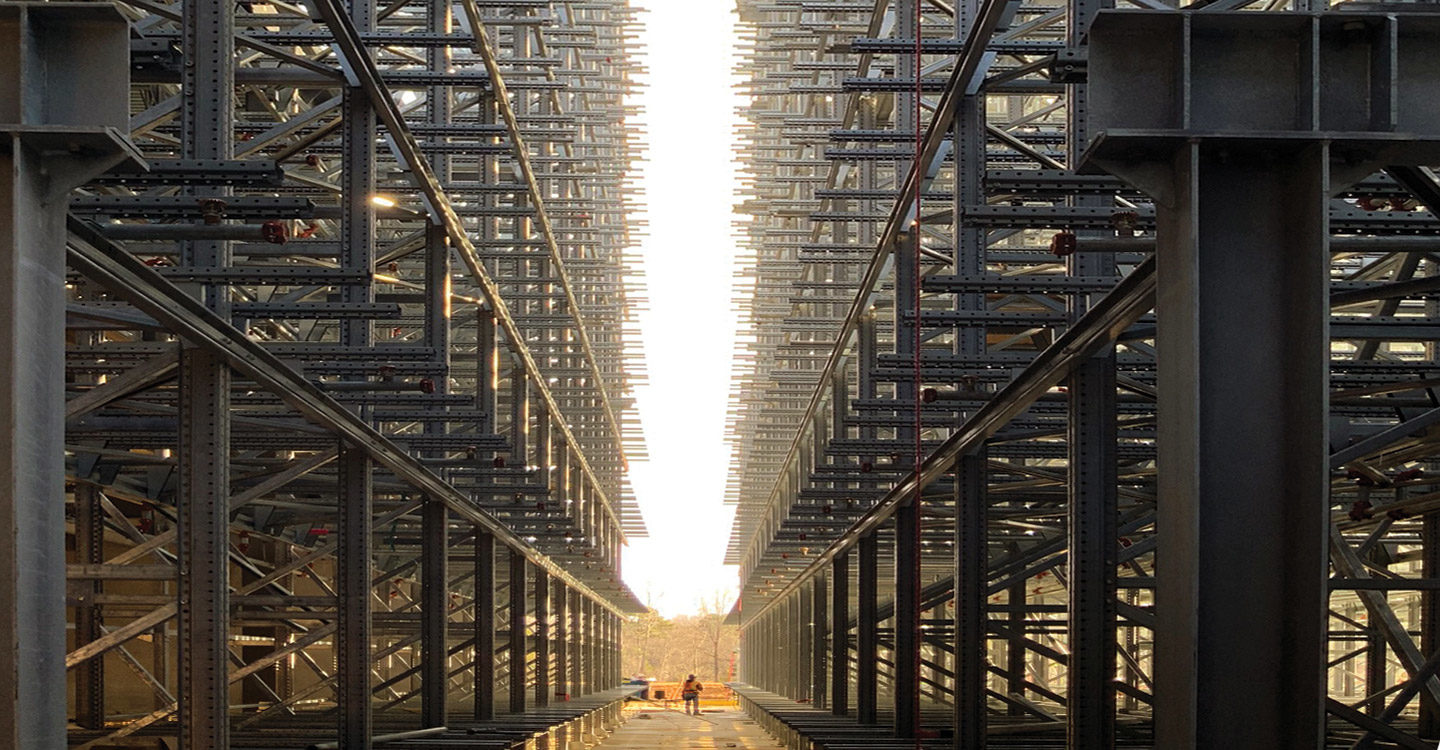
This new 1.5-million-sq-ft building is using 10,000 tons of steel. It is laid out on an 800-plus-ft radius with 8 floors of office space plus a mechanicals floor under the roof, for a total 10 floors of steel framing. A design-build project, it is designed to resist progressive collapse and is LEED certified.


by Frank Starmer

Ravenel Bridge
Charleston, SC
Opened in July 2005

This $632 million design-build project replaced two existing bridges in South Carolina. With a length of 2.5 miles, this bridge has the longest cable stay span in North America—1,546 ft over the river. The structural-steel girders and precast-concrete deck panels are suspended from two 573-ft-tall towers by 128 cable stays.


U.S. Marine Corps Semper Fit Fieldhouse
Camp Pendleton, CA
Recently completed

The 65,000-sq-ft structure is prominently topped by a red standing-seam 22-gauge steel roof coated to reduce heat absorbance. Though the location in southern California is near the ocean, it is nevertheless in a hot climate.


Nuclear Waste Vessels
Hanford, WA
Completed November 2004

The Steel Tank Institute/Steel Plate Fabricators Association named this the “Fabricated Product of The Year” in the Pressure Vessel category for the primary containment vessels at the U.S. Dept. of Energy’s waste-treatment facility. The four vessels are for the primary storage, mixing, and treatment of 525,000 gallons of radioactive liquid waste. The material for the vessels is U.S.-made 1-to-1.75-in.-thick 316L stainless steel, contributing to a net weight of 270 tons each. This is a highly critical steel application.

   
Hearst Magazine Tower
New York, NY
Under construction

The tower was topped out on February 11, 2005 and construction continues into 2006. About 90% of the 10,480 tons of steel used in construction comes from recycled material. As it will consume much less energy than an average office building in the city, the tower is set to become the first office building in New York City to achieve a ‘Gold Rating’ under the US Green Buildings Council’s Leadership in Energy and Environmental Design (LEED) Program. The building is to be naturally ventilated for up to three quarters of the year. Its triangular steel frame uses 21% less steel than a traditionally framed building.


Five-Million-Gallon Reservoir Tank
Huntsville, AL
Began operation January 2005

The Steel Tank Institute gave this project its Reservoir Tank award. It comprises an all-welded radial-cone roof, on a 32-ft-high, 164-ft-dia. tank. It required a solid-slab concrete foundation to carry the tank’s weight over potential sinkholes.

   
Steel-Framed Houses
Juarez, Mexico
Under construction

Building more than 330 single-family houses in Juarez with steel framing is transforming the culture and industry of this city. They replace the traditional concrete-block houses that required little skill. But with steel framing, the area is able to retain its skilled workers who would otherwise go across the border for work. And working from plans generated by sophisticated design software and with framing members from Texas, the workers are further enhancing their skills.

   
Dallas High-Five Panelized Steel
Housing Project

Hayward CA
Recently completed

This 14-building complex of panelized light-gauge steel three-story houses is on a confined site less than 1.5 miles from a Type-A fault within Seismic Zone 4 with high-plasticity soils. The unusually high seismic load and restricted construction staging required imaginative steelwork.

   
Surge-Arresting Structure
Base of Mt. Saint Helens, WA.
Nearing completion

As one part of the repair of Cowlitz PUD’s Swift No. 2 hydroelectric plant, damaged by a power-canal embankment failure in 2001, a steel surge-arresting structure is being built next to the intake structure. This includes 200 ft of 16-ft-diameter penstock splitting into two runs of 11-ft via a bifurcation with a 2-in.-thick crotch plate. What makes this noteworthy are the size and complex curves and bifurcation.

   
Inn of the Mountain Gods Hotel & Casino
Mescalero, NM
Completed summer 2005

This project comprises a 273-guest-room hotel, a casino, and a 1,500-space subterranean parking garage. The hotel towers used beam-in-wall, conventional composite-steel construction to achieve low floor-to-floor heights. The subterranean parking garage utilized long-span SmartBeam spanning 60 ft, creating a clear open span for parking. The fire protection for the parking was achieved by using an intumescent paint. The steel alternative saved six months of construction time over the concrete, allowing the owner to generate revenue sooner.

Another Way

The new University of Medicine and Dentistry structure in Newark, NJ, is incorporating the girder-slab system. Girder-slab is an alternative to cast-in-place concrete or masonry bearing systems. This non-proprietary system has been used in more than 3 million sq ft of construction. The D-beam girder projects below the floor slab 9/16 in. Low floor-to-floor heights are easily achieved and no shoring is required. A lighter frame often results in foundation savings, and installation is not delayed by freezing temperatures. Nine elevations of the girder-slab system are being erected above a concrete parking deck. Involved are architect Kitchen & Associates, structural engineer Timothy Haahs & Associates, builder Joseph Jingoli and Son Inc. Contractors; Berlin Steel Co., J L Erectors.

Project Spotlight
A 10-to-Watch Closeup

U.S.Census Bureau Topped Off

The final piece of A992 structural steel was attached on July 19. That accounts for 10,000 tons of steel in this $292-million project in Suitland, MD. As 20% of the steel had to come from within a 500-miles radius to satisfy requirements for Leadership in Energy & Environmental Design certification, it was fabricated in Virginia. The other 80% came from Alabama.

The two-phased, 1.5-million-sq-ft complex will house 6,000 employees and contain offices, a conference area, cafeteria, credit union, fitness center, library, and a mechanical floor, resulting in a total of 10 levels of steel framing. And there are two 500,000-sq-ft parking garages for more than 3,000 vehicles.

The first phase will be completed in May 2006. The second phase is scheduled for completion October 2006.

Most of the steel came from Nucor-Yamato, was fabricated and shipped by SteelFab Inc., and erected by Memco Inc. The architect of record is HKS Inc., the design architect is SOM LLP, the engineer is Walter P. Moore and the design-build contractor is Skanska USA Building Inc.

To Hot Dip Galvanize or Paint Steel

Using data collected in nationwide surveys of the hot-dip galvanizing industry (conducted by the American Galvanizers Association) and the paint industry (conducted by the National Association of Corrosion Engineers), an economic analysis of original and life-cycle costs provides an interesting comparison.

Original Costs
Although not recommended as reflecting the true cost of a corrosion protection system, original costs are sometimes the primary determinant for selection. Hot-dip galvanizing is more economical from an initial cost standpoint for all but the one-coat zinc-rich paint and the two-coat acrylic waterborne paint. This is the case when galvanizing is compared to many of the commonly used industrial paint systems. Additionally, hot-dip galvanizing may be even more economical when the project calls for small-weight-per-beam-length structural steel and/or assemblies, because of the efficient handling of many pieces in the galvanizing process.

Life-cycle Costs
Because of the long life of the hot-dip galvanized coating and its virtually maintenance-free performance, galvanizing is consistently a better value than paint over a structure’s life. Galvanizing durability and lifetime performance make it the logical choice when it is the lowest original cost system.


special advertising sections
terms of use | privacy policy | advertise | about us | site map

© 2008 The McGraw-Hill Companies, Inc.
All Rights Reserved
Content Map