Exactly one day after President Obama announced a new plan to clean up gas-guzzlers and carbon emissions in the transportation sector, General Motors on May 20 said it is working to combine the advantages of gasoline and clean-diesel technology to meet those goals.
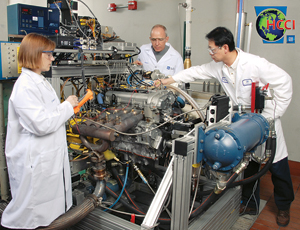
Tested so far on midsize cars and in the lab, GM says that homogeneous-charge compression ignition (HCCI) engines produce 15% greater fuel economy and equally less carbon using regular gasoline, without the expensive tailpipe scrubbers that today’s clean diesels require. The experimental motors use a spark to start cold but later switch to auto-ignition after warm-up, GM says. Traditional diesels, which are more fuel efficient than gasoline engines while producing more low-end torque, also use compression heat to ignite the air-fuel mixture.
While it is still unclear whether HCCI can match the power and torque curve of a diesel—making it the engine of choice for construction on and off the road—GM says it could be used along with gas-electric hybrids as a “double-green” operating system for cars and trucks.
HCCI is just one of several options automakers are exploring to meet Obama’s schedule, which, starting in 2012, will for the first time regulate fuel economy and carbon-dioxide emissions together.


Post a comment to this article
Report Abusive Comment