|
Angelle Bergeron
"It's been a gift from God, the weather we have had here," says Ted Kettlewell, OCCI, Inc. executive vice president.
|
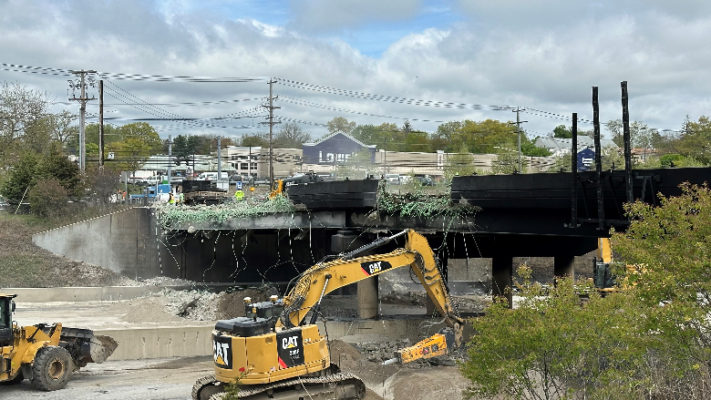
Take one piece of aging infrastructure, 22 men, 18 days and an infinite amount of ingenuity. Stir in some bold hydraulics, huge slabs of concrete, massive chunks of steel and unstoppable egos and you've got a formula for a brash balancing act that may be the gutsiest, most practical way to prop up a bridge and keep trains running on time.
The clock started ticking on the $7-million contract to rehabilitate a Kansas City Southern rail bridge over the Ouachita River in Monroe, La., on July 1. But the pressure is really on between Oct. 30 and Nov. 16 when the contractor, OCCI, Inc. of Fulton, Mo., has an 18-day allowable navigational channel restriction to perform critical portions of the project.
|
Angelle Bergeron
Tom Smith, OCCI president (left) and Ted Kettlewell, exec. vice pres. (right) check on progress of the pull. OR Smith (left), an early bird, arrives about 5:30 a.m. to relieve Kettlewell from the night shift.
|
Although Eugene German, project manager for TransSystems Corp of Kansas City, engineer of record, dubbed the project extraordinary, OCCI performed a similar feat in 1987 on a double-decker rail and automotive bridge in Rock Island, Illinois on the U.S. Army Corps of Engineers' Lock and Dam Number 15. "We do this kind of weird work all the time, rehabbing old structures that involve millwright work and steel," says Ted Kettlewell, executive vice president. "We like to say that the difficult we do immediately; the impossible takes a little longer. I like beating the odds, doing things nobody else does. There aren't a lot of people who would do this insane schedule."
Although the 18-day stretch working around the clock is rough on a small company with a core of about 30 well-trained employees, the actual work is easy, says Tom Smith, a civil engineer and president of OCCI. "We've got four or five other jobs going on now and every one is unique. We hardly ever do the same type of job twice," Smith says. "When there's something else to do, other people don't bid on the hard ones. Ted and I like these. We like the challenges."
On November 4, a Sunday evening when others were settling into TV football games or family dinners, Kettlewell was gearing up for a critical portion of the project, moving the pivot gear assembly into place under the bridge. He was sporting second-degree burns on his forearm from the first night of the 18-day work window, and describing his intense concentration and high pain threshold. "A bunch of welding slag came down on it, got inside my glove and I didn't know it was so bad until it was too late," Kettlewell says. "We have no titles out here," he says of the welding. "Everybody just does what they have to do because you have to make every single hour out here count."
During the pre-shift talk with the night crew, both Kettlewell and Smith emphasized the proper use of fall protection, which is critical when working 28 ft above the surface of the river, especially in the dark. "There are a lot of open holes and shadows out there, so put your harnesses on and plan on keeping them on all night and tied off," Kettlewell says. "We've actually had a couple guys have to use the lifeline. You go home in pain in those special areas for a couple days, but at least you're still alive."
"Watch what you're doing out there. Stay safe. Stay tied off," Kettlewell tells the crew before it heads out to the bridge on a temporary walkway that OCCI erected to access the work area. "We use this walkway because it's a safe way to get people to and fro instead of walking down that steep hill and getting on a boat," Kettlewell says. "Tom is afraid of heights, which means any scaffolding and walkway we build has got to be stable enough for him to walk on. Actually, a lot of the wider, more stable scaffold systems help you get the work done faster and incredibly safe."
|
Angelle Bergeron
Kettlewell (right) briefs the night crew.
|
OCCI maintains a small, close-knit group of employees who work 12-hour shifts on critical projects like this and are flown around the country to work sites on two company-owned planes. "We have the 421 Cessna, which my wife calls the mini van because it holds seven, and the King Air 200, which holds 10," Kettlewell says. Flying saves time and energy better spent on projects like this one, he explains. Most employees live in Missouri, are highly specialized and they're all non-union. OCCI pays high wages and good benefits to employees so they can deliver for their clients.
Kettlewell and Smith have been in business for 24 years, and the two men work well together. "He's six months older than me, and I'm married to his cousin," Kettlewell says. "My weaknesses are his strengths and his weaknesses are my strengths. It's a real complementary marriage."
Kettlewell has three business degrees, is a night owl, and loves mechanics, hydraulics and wheelwrights. He builds fine wood furniture, restores old cars (currently, a '69 Corvette and a '36 Chevrolet) and describes himself as a "typical, ego-centric male" who is fretting somewhat over his upcoming 50th birthday.
Smith is a civil engineer, prefers the day shift and gets excited about the steel and concrete aspects of a project. "Ted does all the work I don't want to, talking to politicians and reporters and working the night shift," he says. "I started doing this when I was 17 years old, and I've been an engineer since I got out of college. I just like challenges."
The two men started out their business with two pickup trucks, a 20-by-20 ft office and a couple of marine cargo boxes filled with carpenter tools. "We were going to build small, county bridges," Kettlewell says. "The bottom fell out of that and we wanted to do something that would make more money and have some risk associated with it." Today, OCCI has its own 50,000-sq-ft steel fabrication facility, owns most of its equipment and performs work in six states in the central United States. "There are not a lot of people who do everything in-house, and we do all our own hydraulic, steel fabrication, design and concrete work," Kettlewell says. Koontz Electric of Morrilton, Ark., which is performing the electrical on the KCS Monroe rail bridge, has been following OCCI around for about 15 years, doing all of the contractor's electrical systems integration.
OCCI does a lot of jacking up bridges, lock and dam rehabilitation, gate and hydraulic installations and will likely be doing more railroad jobs. It's a good niche, especially since many rail lines are spending money on improvements, Kettlewell says. "They are private companies, so you have to be invited," he says. "It's all negotiated bid, so if they don't like what you do, you just never hear from them again."
Please email press releases of executive appointments or promotions only to ENR's People Editor: ENR_people@mcgraw-hill.com
. Please include color photographs where possible.
|