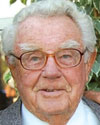
George W. Housner, an earthquake engineering pioneer, died of natural causes on November 10. He was 97.
Housner, the Braun professor emeritus of engineering at the California Institute of Technology (Caltech) in Long Beach, was responsible for developing the most complete mathematical system to analyze the effects of ground shaking on structures. Engineers previously only considered the quake force pushing upon a building. Housner realized that an earthquake isn't static but rather sets off vibrations throughout the entire structure that could bring it down. His mathematical framework helped understand those vibrations and led to the implementation of more rigorous nationwide building standards.

Born in Saginaw, Mich., Housner earned a bachelor's degree in structural engineering at the University of Michigan. His interest in seismic engineering began after the Long Beach quake of 1933. He later received master's and doctorate degrees from Caltech then went to work for the Army Corps of Engineers. After the war, he returned to Caltech as an assistant professor of applied mechanics. Housner continued his interest in seismic engineering after the war, chairing a National Academies of Sciences committee looking into the damage from the 1964 Alaska earthquake. He later became the Braun professor before retiring in 1981.
"George really has to be considered one of the most original and clearest thinkers ever within the entire engineering profession," said John Hall, professor of civil engineering and dean of students at Caltech. His earthquake engineering techniques were instrumental in the design of California's water storage and transportation system as well as strengthening dozens of dams and aqueducts statewide. After the 1989 Loma Prieta quake in Northern California, Gov. George Deukmejian asked Housner to chair the board investigating the collapse of freeways and bridges. Housner was elected to the National Academy of Sciences in 1972, and was a founding member of the Earthquake Engineering Research Institute.