The U.S. Dept. of Energy’s Jeffrey M. Baker is an agent of change. Thanks to his vision and leadership, building teams across the U.S. can avail themselves of the first field-tested, replicable performance-based design-build model for affordable, ultra-energy-efficient buildings.
“We think we have defined a new standard for performance in office buildings, schools, hospitals and labs,” says Baker, an environmental engineer who is director of laboratory operations in the field office of DOE’s Office of Energy Efficiency and Renewable Energy (EERE) in Golden, Colo.
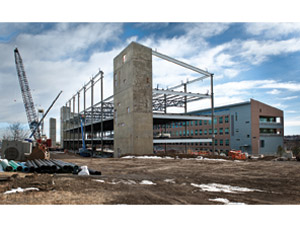
Proof of process is the 220,000-sq-ft Research Support Facility (RSF) at the National Renewable Energy Laboratory (NREL), which opened on schedule in June. The facility is chockful of energy-saving systems and designed to reach net-zero energy use (NZEU) after it is fully occupied next month. It is on course to be the world’s largest NZEU building.
“The performance-based design-build process allowed us to tap into the creativity of the private sector” and marry it with DOE expertise to demonstrate that ultra-high-energy-efficient buildings can be done affordably with standard materials and techniques, says Baker. The RSF cost $260 per sq ft, which is on par with the cost of conventional buildings, he adds.
“The building is a showcase,” says John Sullivan, former assistant secretary for business administration in EERE. Sullivan, who is currently an energy consultant with Decker, Garman & Sullivan LLC, Alexandria, Va., is Baker’s former boss.
Baker started on his quest to create the $57.4-million RSF in 1995. “If not for Jeff’s vision and perseverance, that building would not be sitting there now,” says Sullivan. “He overcame many obstacles that would have caused most people to throw in the towel.”
Philip Macey, division manager for high-performance buildings for the RSL’s design-build contractor, Haselden Construction, Centennial, Colo., calls Baker’s accomplishment “practically impossible” because the project at once changed how the government buys buildings and how much energy is consumed.
The project is creating a stir and the how-to manual isn’t even out yet. Well over 800 visitors have toured the building. Representatives of the U.S. Army Corps of Engineers, the Dept. of Homeland Security and the U.S. Coast Guard have attended workshops.
Baker and his team already are applying the RSF model, which relies on team collaboration, at four other NREL projects. “Our energy future requires that we take advantage of all the savings we can,” he says.



Post a comment to this article
Report Abusive Comment