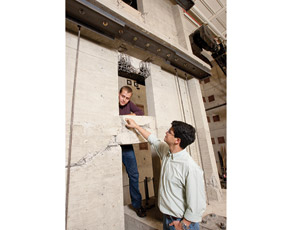
Gustavo J. Parra-Montesinos is coming to the rescue of concrete-frame designers and contractors in earthquake country, long bedeviled by rebar-congested coupling beams that span openings in seismic shear walls. By testing concrete mixes rich with steel fiber, the structural engineer-researcher has demonstrated that designers can slash the amount of diagonal rebar in the beams. The innovation could make work simpler, faster and less costly.
“Gustavo’s steel-fiber research led to a practical solution,” says Cary Kopczynski, president of the Bellevue, Wash.-based structural firm that bears his name. “He showed that, with sufficient quantities of steel fibers added to coupling-beam concrete, rebar can be reduced by upwards of 40%.”
Tests at the University of Michigan, Ann Arbor, where Parra-Montesinos is a professor of civil engineering, also show that coupling-beam diagonal bars, which are so difficult to build, can exit beams horizontally at the ends. “This is huge,” says Kopczynski.
“Gustavo is clearly the leader in developing structural applications for high-performance, steel-fiber-reinforced concrete,” says James K. Wight, a professor of civil and environmental engineering at the university. Wight was Parra-Montesinos’s Ph.D. adviser and is part of the fiber research.
Introduction of steel-fiber reinforcement into building codes is likely in about eight years. But that hasn’t stopped Kopczynski. He has received approval to use the material on two 40-story buildings in Seattle, until recently on hold. “As Gustavo’s research matures and once we get the Seattle buildings under construction, moving the material into the codes should be fairly straightforward,” says Kopczynski.
Parra-Montesinos has been on a “high-fiber diet” since earning his Ph.D. “Using fiber reinforcement… seemed natural, given the need for heavy amounts of diagonal and transverse reinforcement to ensure adequate seismic behavior,” he says.
Tests on beams with span-to-overall-depth ratios of 1.0 to 3.3 eliminated 70% of diagonal rebar in coupling beams and used only special column-type confinement at the beam ends.
Better yet, results of more recent tests on slender beams—with aspect ratios of 2.75 to 3.3—indicate complete elimination of diagonal reinforcement is possible and suggest the same may be true for beams with lower aspect ratios. The research team currently is seeking funds from the National Science Foundation to conduct tests to determine “how low we can go in beam span-to-depth ratio without diagonal reinforcement,” says Parra-Montesinos.
Other tests on punching shear behavior of slab-column connections with shear-stud reinforcing, under gravity and quake loads, offer strong evidence for changes in shear stud design practice, he says.



Post a comment to this article
Report Abusive Comment