Contractors do not usually ask regulators to impose more restrictions, but a trend in fatal crane accidents last year prompted one industry insider to act swiftly to clean up safety lapses.
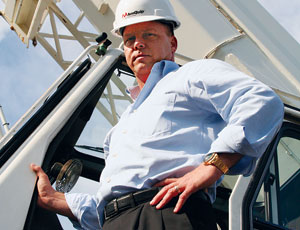
In Philadelphia, where no cranes collapsed last year, city managers did not want to wait for tragedy to strike in their town, so they quickly drafted a regulation that would restrict permitting for tower-crane operations. Those initial rules were not broad enough for Frank Bardonaro Jr., president and COO of AmQuip, a large crane contractor in Bensalem, Pa. When he first caught wind of the proposal, Bardonaro immediately assembled industry groups, including a local steel erector, labor unions and a rigging outfit to help the city craft a more intelligent policy.
Bardonaro, 44, started out years ago sweeping the shop floor of his uncle’s crane firm in his hometown of Cincinnati. The family company was acquired by rental giant Maxim Crane. At Maxim, Bardonaro helped train local firefighters on safe lifting, which attracted the attention of the Federal Emergency Management Agency, making him a federal adviser on crane and rigging. Bardonaro was deployed to Ground Zero in 2001 to help with recovery and later that year moved to the East Coast to work at AmQuip. He serves as the chairman of Fairfax, Va.-based Specialized Carriers & Rigging Association’s tower-crane committee and is working on an international effort to standardize rules.
This hoisting expert spearheaded a local standard for tower cranes, and it is serving as a safe model for other jurisdictions.
The Philadelphia tower-crane standard, signed into law on Dec. 10, had unanimous support. “We wanted this to be safe first and enforceable second,” Bardonaro says. It is the most comprehensive crane regulation in the U.S., addressing safe operations, rigging, signaling and inspections, and may be amended later to include mobile cranes. Other cities and states are looking at it as a model. “This is the first place in the country that has addressed the entire hoisting scenario,” explains George Young, who owns a 140-year-old, Philadelphia-based rigging outfit that helped push the rule. “It’s a chain, and if one link in the chain breaks, we are potentially in trouble.”



Post a comment to this article
Report Abusive Comment