Under intense scrutiny from engineers, politicians and the public, Bruce A. Magladry, director of the National Transportation Safety Board office of highway safety, oversaw a 15-month probe of the 2007 I-35W bridge collapse in Minneapolis, in which 13 people died and 145 were injured. Early on, it became clear to the NTSB team that underdesigned gussets, which NTSB said were half as thick as required, were a key factor in the accident. Magladry urged the board to take the unusual step of issuing a safety recommendation before the investigation was finished, and the board agreed.
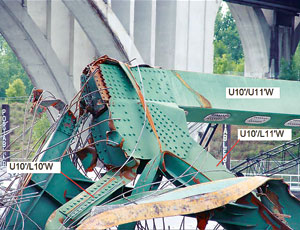
On Jan. 15, 2008, NTSB called on the Federal Highway Administration to require states planning changes to non-load-path-redundant steel truss bridges to do load calculations to verify that stress levels in gussets and other structural elements were within requirements. It was only the second interim recommendation in the past 10 years stemming from a NTSB highway safety office probe.
With the early notice, NTSB’s final report, approved on Nov. 14, wasn’t a surprise. It said the collapse’s probable cause was gusset failure due to design error and increased bridge weight from earlier upgrades, plus materials, equipment and traffic when it fell. NTSB also issued nine safety recommendations. FHWA and states have started to act on some of them.
Magladry, 60, says it would have been “irresponsible” and “unconscionable” to delay the recommendation. He cites two reasons: “One, I don’t want another bridge to collapse while I’m still looking at this one. And two, I don’t want state DOTs, with limited resources, to waste those resources.”

Head of NTSB Office of Highway Safety oversaw 15-month investigation and successfully sought interim safety recommendation on gussets.
Ed Lutgen, Minnesota DOT engineering principal, says, “I thought it was an excellent decision. What it did was refocus the energy on the inspections that were ongoing around the nation on the appropriate things.”
Before joining NTSB in 1988, Magladry spent 13 years with the Baltimore County Police Dept., 10 as a detective. He led the unit that investigated criminal aspects of a 1987 railroad crash in Chase, Md., which killed 16 people. His work led to a job offer from NTSB, which also was probing the accident.
“One of the things I really like about my job is it’s a whodunit,” Magladry says. “These are mysteries to me with real-world consequences.”




Post a comment to this article
Report Abusive Comment