|
Officials in Cary,
N.C., a fast-growing town in the heart of the state's Research
Triangle, had been searching for a way to reduce traffic delays
and air pollution. Kimley-Horn and Associates Inc. engineer,
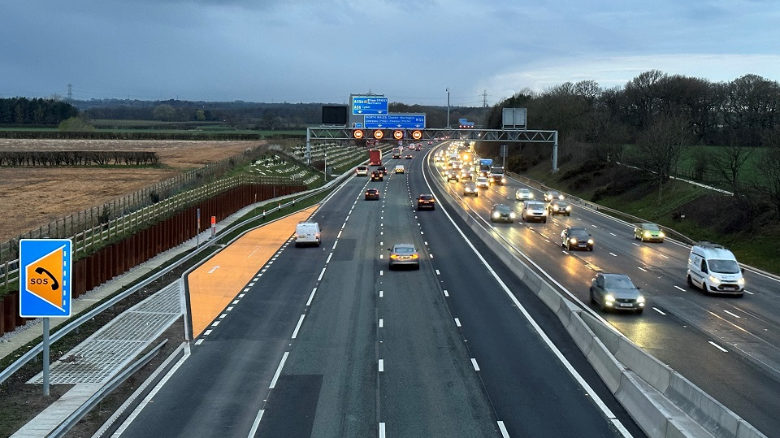
Mark Dunzo had the answer: an intelligent transportation design
that self manages traffic flow and decreases vehicle travel
time by 15 %.
A graduate of the
Massachusetts Institute of Technology, Dunzo, 34, chose to
be an engineer at the age of 12. "Growing up in Los Angeles,
I always had a love of urban issues and I felt that the planning
degree would broaden my horizons and allow me to explore some
of the big picture issues affecting how we live and how we
function as a society," he says.
In 1995, Dunzo
left the West Coast and joined the Cary office of Kimley-Horn,
an engineering and land development firm, where he designs
intelligent transportation systems to assist clients in tackling
future urban transportation issues.
Located near Raleigh,
Cary has quadrupled since 1970, causing town officials to
take action against current traffic congestion and projected
population increases. "The town of Cary is, and has been
for many years, the largest municipality in the state with
no proper traffic signal coordination," says town traffic
engineer, Dale Privett. "With a population topping
106,000 now, many highways and streets in town are at capacity,
air quality is steadily diminishing, and user costs in terms
of delays and crashes are increasing."
Cary residents
first asked the North Carolina Dept. of Transportation to
install a traffic signal system to attempt to improve congestion
at many intersections in the mid-1990s. However, a lack of
state funding thwarted locals plans. Struggling to ease
the towns growing pains, the city council in 1999 conducted
a feasibility study and began raising funds to revamp the
local transportation infrastructure.
This year Cary
secured additional funding from the state and the $9-million
project is now funded jointly by Cary and a Federal Highway
Administration Congestion Mitigation and Air Quality grant
from the states transportation department. The federal
share will total $4.85 million from a Federal Highway Administration
program aimed at reducing traffic congestion and improving
air quality, while the rest will come from street bonds approved
by Cary voters.
Last March, Dunzo
completed design on a state-of-the-art computerized traffic
control system for Cary that includes traffic signal controllers
capable of more versatile timing plans and implementation
of traffic signal controllers that automatically retime themselves
on selected corridors.
Intelligent transportation
systems incorporate various information systems technologies
such as surveillance cameras and self-automated signals
- to mitigate traffic jams and shorten motorists time
on the road.
Major cities have
been rapidly adapting high-tech hardware to increase the capacity
of existing roads and highways. London deployed 688 cameras
at 203 sites across an 8-square mile area to photograph the
license plates of approximately 25,000 cars. The area has
been designated as an anticongestion area and marked by a
red C logo painted on signs and streets. The cameras help
enforce daily tolls for cars driving in the marked off region.
In the U.S., M.I.T
operates a simulation-based laboratory called MITISMLab under
the universitys intelligent transportation systems program
that partners with cities worldwide to help reduce traffic.
As a freshman at
M.I.T., Dunzo had researched transportation issues and enjoyed
the field, but he "was determined to go into structures."
After taking a full course load of structure classes he grew
disenchanted with building "big things" and abandoned
structures for urban transportation. "My dad is a civil
engineer. I started investigating what civil engineers did
and liked the idea that civil engineers built big things like
bridges and water systems," he says.
In 1991, he received
his B.S. degree in civil engineering from M.I.T. Two and a
half years later, Dunzo completed his masters in civil engineering
with an emphasis in transportation and the majority of the
coursework and requirements for the masters in city planning,
both from the University of California at Berkley. In 1994,
he landed a position with transportation engineering firm
DKS Associates headquarters office in Oakland. While
working for DKS, Dunzo completed his masters in city planning.
Now at Kimley-Horn,
Dunzo recently accepted an offer of employee ownership. The
privately held firm, is owned by approximately 12% of its
employees.
Dunzo fills his
non-working hours by participating in several professional
organizations including: the North Carolina Section of the
Institute of Transportation Engineers where he serves as chairperson
of the sections Traffic Engineering Council; the International
Institute of Transportation Engineers where he participates
on the ITS council; and the Transportation Research Board,
where he advocates for the Signal System Committee.
For now, however, Dunzo and his
colleagues will keep busy supporting Cary's new intelligent
transportation project to ensure the design is implemented
smoothly. Construction on the new system began in August and
will be completed in 2006. Next on Dunzos to-do list
is the redesign of the entrance road to Chicagos OHare
International Airport in conjunction with the airport's $300-million
capital improvement program.
|