subscribe to ENR magazine subscribe
contact us
advertise
careers careers
events events
FAQ
subscriber login subscriber service
ENR Logo
Subscribe to ENR Magazine for only
$82 a year (includes full web access)


viewpoint
EDUCATION
Clarifying Welder Certifications
McNew
The ever-increasing demands from customer specifications, building codes and governmental regulations mean that weld quality is being scrutinized now more than ever. To bring today's complex engineered structures to completion, qualified welders, their skills and resulting welds must be of unsurpassed quality. To ensure that quality, what key credentials should you be looking for when hiring a welder? Many of these craftsmen claim they are "certified." But certification can be a complex and confusing term. What does this statement really mean? Is certification transferable to all types of welded structures? For how long is it valid? Is there a master test to use?

Technically, welders are qualified by successfully passing the required weld tests as outlined in the applicable code. When reviewing performance test requirements, most codes list this section as "qualification," not "certification." Additionally, the subsequent forms used to document a welder's successful test are generally titled "qualification." Weld inspection personnel, however, are noted as being "certified," as in the case of a certified welding inspector (CWI).

Philip L. Mcnew
Philip L. Mcnew
Philip L. Mcnew
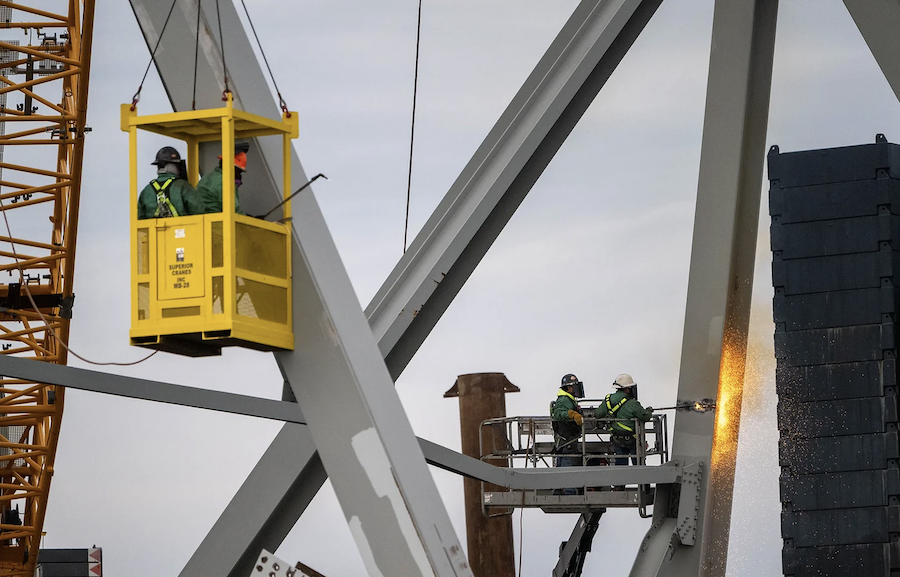
Student Welders Face The Heat Working To Meet Performance Tests.

Welding codes are the benchmark. These codes are a guide for many segments of the project including the structure's weldment design, fabrication, inspection and qualification of personnel. There are numerous associations and societies that publish and maintain welding codes. These codes describe the specific tests welders must pass to become "qualified/ certified" to work on a structure. One of the first decisions to be made when contract documents state that welding is to be performed per applicable code is which code to use? The American Welding Society (AWS), based in Miami (www.aws.org), produces several welding codes including the AWS D1.1 Structural Welding Code - Steel. It generally is the code used for welding most structural steel connections. If pressure piping or pressure vessels are involved, then the New York City-based American Society of Mechanical Engineers (www.asme.org) produces the American Society of Mechanical Engineers Section IX Boiler & Pressure Vessel Code. The list of codes goes on.

Are there similarities in weld tests between these codes? Basically, yes. Many codes have similar pipe- and plate-performance tests. Can you accept a welder's ASME test credentials when performing D1.1 type work? Most codes have provisions concerning this. The D1.1 states that "the acceptability of properly documented welder qualification to other standards is the Engineer's responsibility," so it could be interpreted that a welder who has passed a comparable ASME weld test could be deemed qualified by the engineer-of- record to weld on an AWS D1.1 project.

But performance weld tests are quite specific in their nature and qualify the welder only to perform a very narrow scope of on-the-job welds. Many erroneous conclusions have been made by project officials lacking this knowledge, including the assumption that after passing a single weld test a welder is certified to make any weld on the entire project. In reality a multitude of "limitation of variables" are imposed upon a welder's individual qualification. Some are easy to comprehend, such as the requirement that a welder be qualified for each welding process to be used. The example of progression of vertical welding however, sets the tone for the issue's complexity. Specifically, a welder who successfully completes a vertical weld test in the uphill progression but now is required to make vertical welds in the downhill mode is not qualified to make that weld without testing in the downhill progression.

The position and type of grooves a welder is qualified to weld is another common area of misconception. The AWS D1.1 classifies plate-weld tests into fillet (F) and grooves (G) with a simple 1-4 number to designate the position. Thus, a welder required to take a 3G test will be making a butt weld in the vertical position. Again the limitation of variables comes into play. If a welder is qualified with a 3G test, the D1.1 limits the qualified welding positions to flat, horizontal and vertical. Would a 4G overhead test qualify this welder for all position welding? No. As per the D1.1, a 4G test will only qualify the welder to make flat and overhead welds.

A welder who passes a horizontal fillet weld test (2F) is qualified to make fillet welds in the flat (1F) and horizontal (2F) positions but is not qualified to make butt welds. Conversely, a welder who has passed a horizontal groove test (2G) is qualified to make flat and horizontal 1G, 1F, 2G and 2F fillet and groove welds. Interpreting plate-thickness qualifications is a bit more straightforward in the D1.1 because only test thicknesses of 3/8 in. and 1 in. generally are used. If a welder passes the 3G test using 3/8-in.-thick material, he is qualified to weld on thickness ranges from 1/8 in. up to 3/4 in. A test plate on 1-in. qualifies the welder from 1/8 in. to an unlimited thickness. So it is misleading to imply that a welder who has passed a single test is "qualified/certified" to make any weld on the project.

And how long are welder qualifications valid? Per the D1.1 "they are in effect indefinitely as long as the welder is actively engaged in the process in which they have tested."

Several of these test examples also have additional provisions not mentioned. Sound confusing? It certainly can be. Your project requires a code-educated, qualified individual to interpret these welding codes and their intricate specifics. The American Welding Society maintains the Certified Welding Inspector (CWI) credential. The CWI is the person generally called upon to interpret the welding code, perform visual weld inspection and administer welder qualification tests. To achieve CWI status, the applicant must first meet the established requirements for education and work experience, followed by a three-part exam administered by AWS. With this person on staff as your code resource, errors in welder qualifications and misinformation about being "certified" can be held to a minimum.


----- Advertising -----
Reader Photos
Photos from ENR Jobsite Photo Showcase
Events: ENR/CURT Construction Business Forum
Embracing Change: The Impact of the New Administration on Construction
The 3rd Annual ENR-CURT Construction Business Forum brings together leading general contractors, specialty contractors, engineers, architects, owners, and building product manufacturers to discuss how current market forces—economic uncertainties; the changing regulatory landscape; workforce issues; global events and more—are affecting how they run their businesses today and plan for the future.