UPS delivery drivers, rental car staff and parking meter maids all use mobile field devices to eliminate paper, improve accuracy and increase productivity. Yet, why is it that a $5 package can be tracked and delivered with this technology, whereas those on a $50 million construction site rely on paper and a clipboard? Ironically, while construction remains one of the world’s largest industries at roughly $4.3 trillion – and though members of the AECO (architects, engineers, contractors and owners) community routinely leverage powerful back-office software such as CAD and now BIM for design – the industry has lagged behind in the adoption of field software.
The fact is, few mobile field products for construction have made it to the marketplace, with fewer performing reliably under the rigors of a jobsite. Typical PDA-based solutions utilized screens too small to view a drawing. Laptop products have proven frustrating to users who have enough difficulty finding a place to comfortably type, never mind being plagued by issues including inadequate “battery life” and poor visibility outdoors. Considering that construction personnel have long been “workers without desks,” it’s understandable they would hesitate to abandon the tried-and-true pen for taking notes and annotating plans and drawings in the field.
Josh Kanner
Now, hardware and software has evolved to the point where construction can gain the same field capabilities as other industries. Across the world, from Las Vegas to Miami to Dubai, AECO leaders are embracing field software and Tablet PCs on thousands of projects to accelerate time-to-market, save money, increase productivity, control quality, and ensure audit-ability – ultimately resulting in the a higher quality project in less time.
Why now? Hardware and software technologies have finally evolved to the point that they meet the needs of AECO companies. In the past few years, more powerful Tablet PCs have come to market with features including screens that can be viewed outdoors, long battery life, and reliable handwriting recognition. Field software is now available that is specifically targeted to the needs of construction personnel. Programs are more user-friendly, even “pen-based,” a combination allowing construction personnel to interact with a Tablet PC just as they would a paper drawing.
Products now specifically address the daily processes construction workers engage in, from punch lists and field reports to safety, schedule updates, and materials tracking. Most importantly, recent advances in field software allow use without any internet connectivity at all, a barrier which prevents many technologies from being utilized on a jobsite. When a user gets back to their trailer or office, or to a wireless “hotspot”, information is synchronized with a central database for instant updates.
Field software and Tablet PCs are routinely saving 10 work hours per week per user and accelerating project delivery, with companies reporting projects saving 30 days or more on the schedule. Managers are gaining real-time visibility into jobsite quality and resulting cash flow risk. Safety inspection information can be immediately used for jobsite and subcontractor accountability; field software helps to save lives and reduce injury rates. Contractors, owners, architects and engineers are all benefiting as field software ensures consistent processes across many jobs, thus mitigating risk.
For example, on a condominium and hotel project at a golf course, a developer/contractor is using field software and Tablet PCs to streamline field operations and maintain work lists and punch lists. Each issue is captured, automatically assigned a “cost” and aggregated into a single, centralized list, which acts as an immensely valuable leverage point with subcontractors. The exact status of subcontractor work is tracked and visible to all parties, ensuring all tasks are completed per contract -- before payment is released. The developer/contractor has already gained a month of time on the project from time savings in communicating issues from the field to the subcontractors.
In addition, Building Information Modeling (BIM) software, heralds a new era for design and coordination, and when combined with mobile field administration software, for construction as well. This combination, called Field BIM is used to incorporate near real-time materials tracking information from the jobsite into a computer model. As a result, designers, owners and field personnel can understand the current status of each component of a structure at a glance, using a color coding scheme to represent a wide variety of conditions and qualities.
This brings the BIM model into the construction process as a powerful tool for management of what is actually occurring on the jobsite. Owners and developers can track materials all along the supply chain; designers can understand how real world site conditions are affecting their models; personnel in the field can visually understand the status of the project as a whole. The end result is a higher quality project, delivered faster for less money.
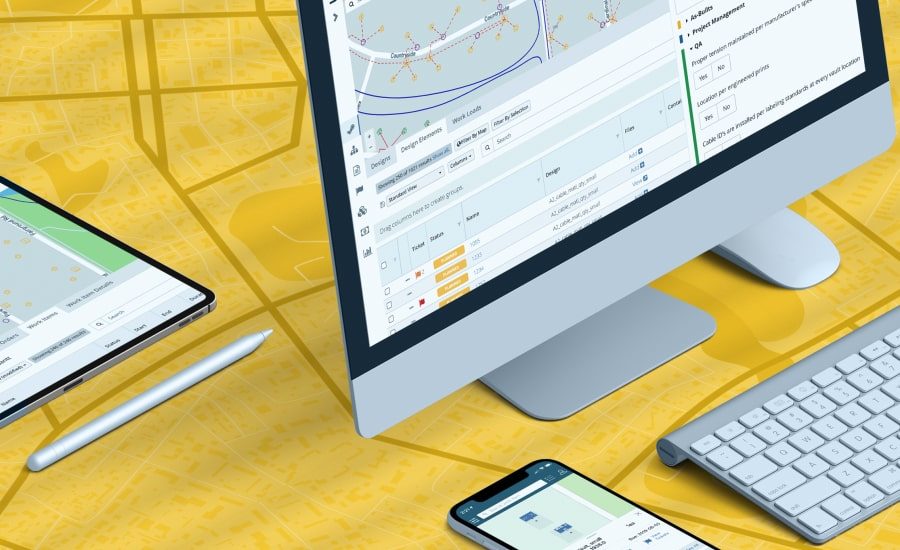
Field software and Tablet PCs have also been used to deliver complex transportation and military projects. And at a convention center/hotel project, field software and Tablet-PCs are enabling the team to deliver the project according to plan and schedule, without having to walk the site with tubes of drawings. The software acts like Google maps for the worksite, where users create digital "smart pushpins" on plans instead of marking up paper copies. By eliminating the need to transcribe pencil notations and automatically distributing field information to the project team, the firm is saving eight to 12 hours of time each week per user and generating a more accurate and auditable record.
When the first package delivery company introduced field software to its drivers, the productivity and customer satisfaction benefits were significant. In order to compete, other package delivery companies were quick to follow. Now, field software and Tablet PCs have finally evolved to meet the demands of construction. Leading architects, contractors and owners are reaping the rewards of these technologies. At long last, those responsible for $50 million projects have the same control and visibility as drivers delivering a $5 package.
Adam Omansky and Josh Kanner co-founded Vela Systems, a producer of mobile field software based in Burlington, Mass. Adam Omansky can be reached at aomansky@velasystems.com or 888-835-2797 x301. Josh Kanner can be reached at jkanner@velasystems.com or 888-835-2797 x 302.
If you have an idea for a column, please
contact Viewpoint editor William J. Angelo at william_angelo@mcgraw-hill.com or 781-937-9265.