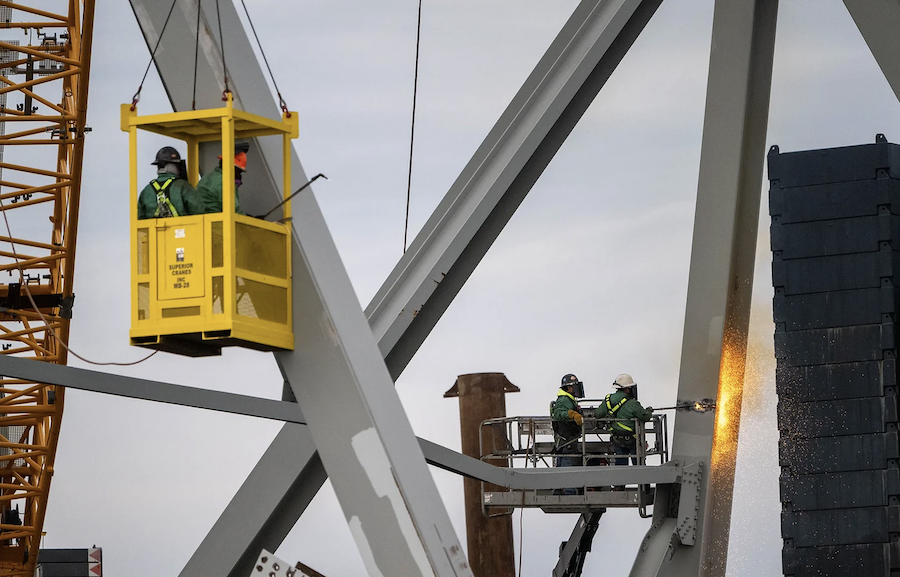
Jersey barriers on the eastbound span of Maryland’s 4.3-mile-long Chesapeake Bay Bridge are undergoing up to $3 million in emergency repairs following an investigation into a fatal accident that uncovered flaws in its parapets. Additional reconstruction could follow.
Several parapets on the eastbound half of the 56-year-old bridge were damaged during an Aug. 10 accident that involved an 18-wheeler and two cars. The truck struck a parapet, knocking a portion of it off the bridge. The truck then skidded more than 100 ft along the wall before rolling into the bay, killing the driver.
Radar inspections revealed small voids near the cores of the broken parapets, says Geoffrey Kolberg, chief engineer with the Maryland Transportation Authority. “The front faces looked great, and about 4 in. in, there was dense solid concrete. But when you got about 12 in. toward the center, there was not good consolidation [of] the concrete.” The slip-formed parapets were built during a 1986 reconstruction project. Kolberg says the slip-form process is “one of the elements we’re looking really closely at.”
The discovery led to radar inspection of similar parapets that line about 9,000 ft of the bridge’s two beam-span sections, located closest to each shore. Following test results of the southeast and southwest walls, MdTA is retrofitting those portions. Tests of the northeast and northwest walls are ongoing.
The retrofit plan calls for adding new steel brackets that bolt each parapet to the bridge deck along the edge that faces traffic. A double W-shaped beam guardrail will be added as well. The existing system uses U-bolts to attach the bottom of each parapet through the concrete bridge deck to a steel plate below the deck. “We’re going belt and suspenders on this,” Kolberg says.
The project, using MdTA emergency funds, could cost up to $3 million and take 10 weeks, if every parapet needs to be retrofitted. The Six-M Co., Delta, Pa., MdTA’s on-call contractor for emergency repairs, is the lead contractor. Wilton Corp., Finksburg, Md., is fabricating the steel brackets. L.S. Lee, York, Pa., is installing the guardrail.
In the meantime, MdTA, with the local offices of consultants Amman & Whitney, New York City and URS Corp., San Francisco, are looking into permanent solutions. Kolberg says the agency is exploring designs that would core into each barrier and reattach it through the deck, as well as a load distribution system—possibly a post-tensioned cable system—that would attach to the back face of each parapet. The height of the barriers could also be raised from the current 34.75 in.
Independent teams conduct visual hands-on inspections of the bridge annually. The latest was in June. Kolberg said the issues uncovered with radar testing were not visually noticeable and could not be detected with ultrasonic testing.
The National Transportation Safety Board is investigating the incident to determine if there are implications for other structures. The accident occurred during “contraflow,” which changes circulation from two-lane one-way traffic to one-lane opposing traffic.