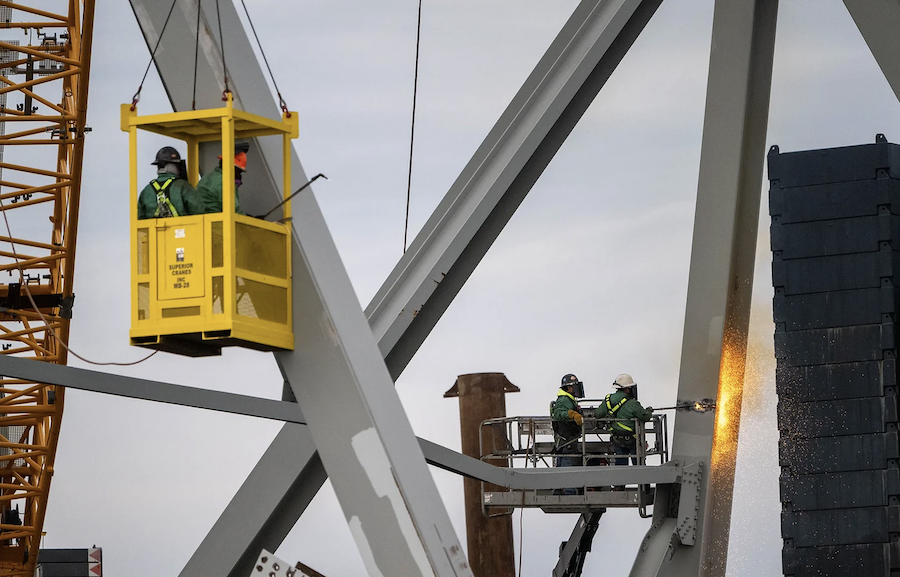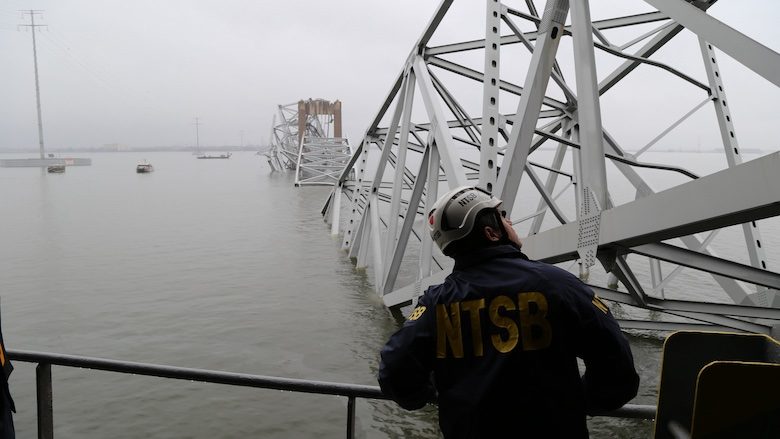
Similar to the mixed company often found on a construction site, tension is mounting between federal officials and the industry’s forensic engineers looking into Minneapolis’ deadly bridge collapse.
While engineers probing the Aug. 1 disaster are anxious to reveal their findings to colleagues maintaining the nation’s aging bridges, federal officials are just as eager to keep them quiet until the government releases an official report.
The federal team, including Northbrook, Ill.-based Wiss, Janney, Elstner Associates Inc., officially the state’s investigator under a $2-million contract but now a federal collaborator, says it will leave the Minneapolis area by the end of November to shift into analysis mode.
As a result, transportation engineers around the world may have to wait another year to learn how to prevent such an accident. The National Transportation Safety Board says in a brief statement issued late Oct. 23 that it is has “made substantial progress” but is still “in the midst of a complete and thorough analysis.”
Independent forensic engineers working on the probe, however, already have some ideas of what caused the 40-year-old bridge to collapse suddenly. Several sources suggest they are looking at the stress that seized bearings, construction loads, truss corrosion and hot summer weather may have placed on gusset plates, underdesigned from the beginning.
Last week, the Star Tribune reported that investigators were focusing on corrosion, summer heat, broken roller bearings and three 1/2-in. to 1-in.-thick gusset plates at the southern end of the bridge at locations L9, U10 and L11. The paper did not identify its forensic sources, claiming they spoke on the condition of anonymity.
Soon after the collapse, NTSB said it observed problems with gusset designs and paving loads. The New York Times reported that WJE’s team was the first to discover problems with gussets after reviewing the 40-year-old bridge's design drawings. The Times sourced NTSB. Neither NTSB nor WJE have confirmed this story.
Other evidence suggests that problems at the southern end, where the gussets in question were located, played a part. That end appeared to fall first in an Army Corps of Engineers surveillance video of the accident, and collapse photos indicate that construction was staged there.
In late September, when ENR last visited the collapse site, investigators were sorting through bridge parts at Bohemian Flats, a park downstream of the site. They were looking at pieces of the main truss and floor trusses, which were arranged on the lawn like an airplane crash reconstruction. Also laying near the trusses were corroded bearing assemblies. Numerous state inspections cited ongoing problems with corrosion and broken roller bearings.
Forensic investigators involved in the probe have declined to talk to ENR about the collapse until NTSB releases its report, expected mid-to-late 2008. They cite a confidentiality agreement the federal agency recently forced them to sign.
Some are clearly upset. One investigator reached last week called the gag order “a disservice to the engineering community,” before hanging up the phone.
Meanwhile, the probe is quietly shifting into analysis mode. The agency is still "meeting with persons who were on the bridge at the time of the collapse" to "refine" load estimates, says Mark V. Rosenker, NTSB chairman, in the Oct. 23 statement.
Witnesses are now reviewing a diagram of the I-35W bridge, with details of vehicles, people, equipment and materials staged there just prior to the accident. Data will be plugged into a computer model to run failure scenarios, NTSB says.