| + click to enlarge |
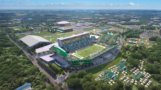
Tunnel would pass near south facade.
(Image: Sagrada Família)
|
Custodians of one of Spain’s greatest landmarks, Barcelona’s Sagrada Família cathedral, are drumming up local opposition to government plans for a high-speed railroad tunnel to be built within meters of its piled foundations.
As the cathedral, with characteristically melting profiles, nears the end of its extended construction, its builders fear that driving the tunnel, or its vibration when in use, my harm the building.
Planned by the central, regional and city governments, the roughly 11-meter-dia bored tunnel is routed to carry a new high-speed line under the city between revamped stations about 5.5 kilometers apart.
With memories of a city metro tunnel collapse a few kilometers away just over two years ago, the planners chose a route to minimize passing below buildings, says a spokeswoman for Administrator de Infraestructuras Ferroviarias. ADIF is the state railroad company which will procure the tunnel.
But the cathedral’s chief architect, Jordi Bonet, wants a different route. “The concern is that nobody can say there is zero risk,” says one of his officials. “This is a building with (U.N.) World Heritage listing…it’s to be here forever.”
Until now, the debate about the tunnel route has been muted so the cathedral builders are keen to raise public awareness of their fears. A final decision on whether to follow the contentious route is months off, says ADIF’s spokeswoman. The design includes various measures to protect the cathedral, she adds.
The twin track tunnel, as planned, will run some 25 m below ground under the water table in a layer of sand and weak clay. Its crown will be over 8 m below the surface, and some 6 m to one side of perimeter piles helping support the south facade, the last still under construction.
Between the tunnel and cathedral foundations, the government plans to build a separating wall of 1.5-m-dia contiguous piles, passing a few meters be-low the tunnel soffit. The design firm INTECSA-INARSA, S.A., Madrid, is the government technical adviser.
In the absence of guarantees against ground movements, the cathedral builders are concerned about possible structural damage as its enters its last decade under construction. With initial designs by architect Antoni Gaudí, the cathedral’s construction began formally in 1882.
|