 |
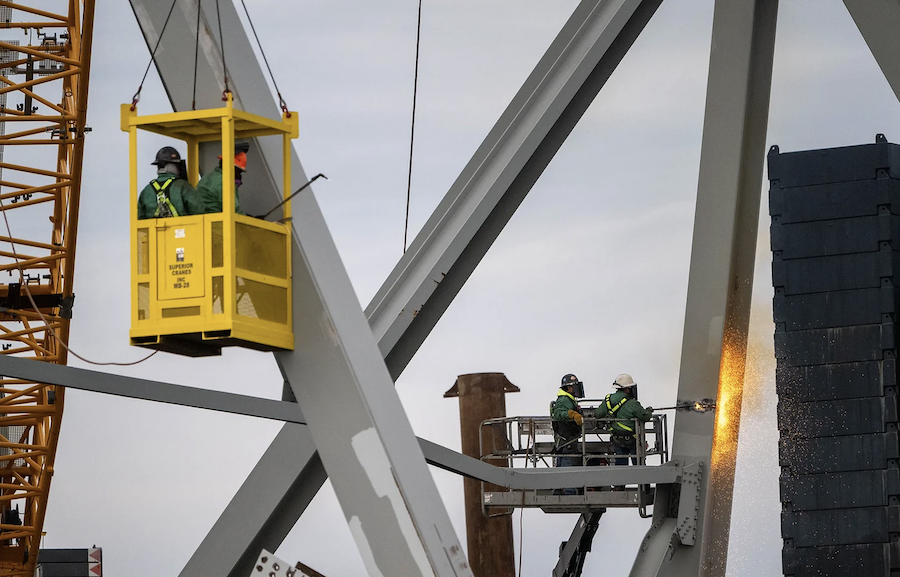
| DISCONNECTED
Separation of slabs from the wall have raised questions
about how needed ties were made. (Photo by Richard Korman
for ENR) |
Missing or improperly
made connections between the collapsed floor slabs and a stranded
wall that eerily remained standing over debris have become
another focus of the probe into the Oct. 30 collapse of a
section of an Atlantic City, N.J., casino garage that killed
four workers, ENR has learned.
Few project participants or observers
would speak on the record. The shear wall at the Tropicana
resort has subsequently been demolished because of concern
it would collapse but sources familiar with the investigation
say its pieces have been carefully examined and stored.
The collapse occurred during concrete
placement on the eighth level of the garages end section.
Missing connections would partly explain why the wall remained
standing, with some structural mesh hanging from it and forms
still attached at its top level. That kind of deficiency also
could have contributed to instability that, along with other
possible mistakes in building the garage bay such as inadequate
shoring or too little cure time for concrete, opened the way
for the collapse, sources say.
The folded slabs still hinged at
one end have become signature images of the accident, but
investigators also are examining the place where the floors
and wall separated. "Something terrible happened at the
one line," where the floors and wall pulled apart, says
one source.
The project was being constructed
with the widely used filigree wideslab method, in which precast
forms combine with cast-in-place concrete to create a composite
structure. The method saves time and money, say proponents.
Stephen DeSimone, principal of
the garages structural designer, DeSimone Consulting
Engineers, New York City, says the floor-to-wall connection
was properly designed. "Theres rebar indicated
on my drawings" tying the two elements together, he says.
"Its too early to speculate whether its put
in or not."
But others involved in the project
claim that rebar tying the floor slabs to the wall, or dowels
projecting from the wall that would have connected to the
floors, appeared to be missing in preliminary reviews of the
accident scene.
"A lot of people see that
there isnt any [rebar] there and wonder whether it is
a cause of collapse and whether it has become a point of contention,"
says one source. Poor shoring and other factors at the site
may have provided the trigger, while slab-to-wall connections
played a secondary role. "Did it exacerbate things? It
may well have," he says.
 |
|
Source: Mid-State
Filigree System; Boca Evaluation Services
|
Another contractor who worked on
the project claims that no significant rebar ties the wall
to the floors. "The wall worked, but there was no connection
to the floors," he says.
Missing or inadequate floor-to-wall
connections fit the emerging picture of the project as it
rushed to meet a March 2004 opening date. The 2,400-car garage
was a key part of the $245-million Tropicana expansion, the
biggest project in Atlantic City in a decade. The pressure
to move faster was felt all over the site, people on the project
say, and patience and materials often were in short supply.
The big rush came after the heavy winter weather subsided.
"The past months were very intense," says one contractor.
Exactly what changes or decisions
were made in the field by the contractors staff and
what design details and shop drawings were created and reviewed
by members of the project team remain unclear. "Were
not making any statements," says an employee who answered
the phone at Fabi Construction Co., Egg Harbor Township, N.J.
The projects main concrete contractor, Keating Building
Corp., Philadelphia, has also declined to comment on the possible
cause and has cautioned against speculation.
Interest in the shoring was boosted
by workers who reported seeing shoring poles bowed or bent.
An executive with a shoring subcontractor engaged on the project,
Peri Formwork Systems Inc., Baltimore, says his company was
not involved with the part of the building that failed. "We
were not shoring the area that collapsed," says Harvey
Evans, Peris chief executive officer. "Fabi used
its own equipment under the filigreed wideslabs." He
declined further comment and Fabi officials couldnt
be reached.
Concerns about whether shoring
was involved have been elevated by accounts of an accident
that occurred on part of the project almost one year before
the disaster. In October 2002, three workers fell 30 ft when
a concrete section in a walkway across the street from the
garage broke apart. Eugene McDermott, executive vice president
of Mid-State Filigree Systems Inc., Cranbury, N.J., claims
the mishap was caused by a missing line of shoring. Mid-State
Filigree supplied the precast pieces to the Tropicana project,
including the garage.
The U.S. Occupational Safety and
Health Administration proposed fines against Fabi and Keating
in connection with last years accident. Penalties concerned
a lack of fall protection. Fabis proposed fine of $8,375
has subsequently been reduced to $3,375, according to OSHA
records. Along with shoring, a series of problems involving
connections and responsibility for details now appears to
be behind the recent collapse.
|