Search
ENR Content Purchase Questions View Cart My ENR Content My ENR Account
NEWS
Buildings
Cost Indexes
Education
Environment
Finance & Business
Power & Industrial
Information
Technology
International
Construction Technology
Construction
Week

Transportation
Safety & Health
Workplace
Washington
Observer

Corrections

-advertisement-

-advertisement-


power & industrial
DISASTER
Explosion Sets Off Aging Pipe Debate
Deck: Investigators consider "water hammer" caused by heavy rains as trigger for rupture
By Jack Buehrer
 
AP
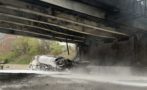
Midtown Manhattan blast showered debris near Grand Central Terminal.

New York City officials are still investigating the cause of the July 18 steam pipe explosion in Midtown Manhattan, but a specialist in the analysis of steam pipe corrosion says there may be no reason to believe that the incident means the city's 105 miles of aging steam mains pose an imminent danger.

The explosion spewed rubble and debris into the air a block east of Grand Central Terminal, with a plume of steam billowing from the pipe at Lexington Avenue and 41st St. Samples from the debris tested positive for asbestos. It was the first blast of its kind in Manhattan since a steam pipe ruptured in the Gramercy Park area, killing three, in 1989. Police blamed last week's blast for the death of a woman who suffered a heart attack, as well as various injuries and tens of millions of dollars in damage to the area.

The explosion has led to widespread questioning of New York City's aging infrastructure and whether New York and other metropolitan areas are vulnerable to similar, and more frequent, disasters. Most of the New York City's carbon steel steam pipe system was installed in the 1920s.

Associated Press - (APTN)
Jul. 19, 2007. 09:47 AM EST
Those who were nearby when a steam pipe exploded in New York Wednesday were confused at first about what happened, some thought it was perhaps a terrorist attack. (July 19)

But such conjecture is both premature and overblown, according to Robert Thornton, president of the International District Energy Association, a steam industry group that recently honored New York's steam network, owned and operated by Consolidated Edison, as its "System of the Year."

"It's not helpful to talk about the age of the city's infrastructure at this stage of the game," he says. "If you look at the miles of [steam] pipe in New York City, and the years of operation it's had in this industry, you have to see this as a unique, extraordinary situation."

Con Edison assumed ownership of the city's underground steam system during the 1950s, when it absorbed the former New York Steam Corp. The steam, while formerly used to operate elevators, now powers turbines that make electricity at Con Edison plants before being piped to about 1,800 customers in Manhattan, who rely on the steam power for heat and air-conditioning.

Any notion that last week's rupture is a signal that the city's steam system is crumbling is unrealistic, says John Gray, a Toronto-based energy industry consultant with a specialty in analysis of steam pipe corrosion. "Carbon steel piping doesn't break down or get brittle as time goes on like cast iron does," he says. "When it's only one incident for over 100 miles of piping, it's an unusual thing. My main thing is finding out exactly what caused it. Did it corrode from the inside or the outside? Was the piping defective? We don't know that yet."

The city's Office of Emergency Management has been coordinating the cleanup, repair, and asbestos-testing efforts since the explosion. The ruptured pipe is believed to have been wrapped with asbestos insulation, which as still in use at the time the system was constructed. Con Edison is responsible for covering the cost of repairs. The blast opened a 25 x 15-ft crater in Lexington Avenue, which was still closed between 40th and 42nd streets on July 24.

Officials at the utility, which also operates electric and gas systems in the city, are awaiting approval from OEM on both asbestos abatement and reconstruction plans. "We're still days away from having the site thoroughly accessed," says Robert McGee, a Con Edison spokesman. "They're proceeding very carefully." OEM has ordered hand-washing of some of the buildings around the site to prevent possible spread of contaminants, McGee said.

Water Hammer

Possible causes for the rupture of the pipe could include "water hammer," the result of condensation inside a steam main, possibly caused by heavy rains in the city in recent weeks, according to both McGee and Thornton.

"We haven't eliminated anything as a possible cause yet," McGee says.

"Obviously, this incident will be thoroughly analyzed, and we'll develop the forensics to explain what might be done to prevent this from ever happening again."


- advertisement -


If you would like to read more articles like this
click here to subscribe

- advertisement -

 
- advertisement -


Purchase 2007 ENR Top Lists online
(free to ENR subscribers)


All ENR Top Lists downloads include charts, at-a-glance, rankings, market share data and more.

terms of use | privacy policy | advertise | about us | site map

© 2008 The McGraw-Hill Companies, Inc.
All Rights Reserved
Content Map