SEEING
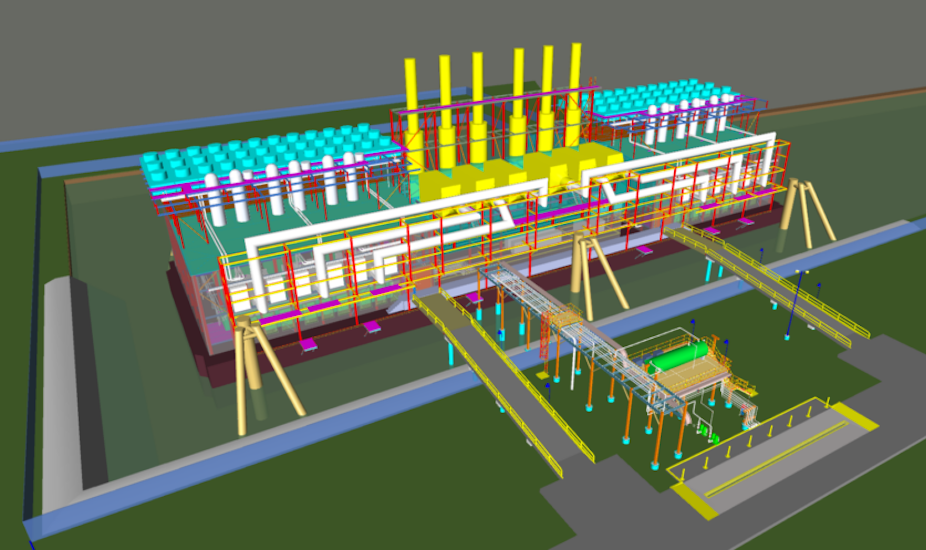
THE LIGHT Converter transformer will strengthen
transmission grid.
(Photo courtesy of ABB Inc.)
As the first anniversary
of the 2003 Northeast blackout approaches, projects and programs
to improve reliability are under way. But experts warn that
the 46 recommendations of a joint U.S.-Canadian task force
designed to improve system reliability fail to address what
one source calls the basic problemof serious underinvestment
in the grid.
Make reliability standards
mandatory and enforceable, with penalties for noncompliance,
reads the first recommendation of the U.S.-Canada Power System
Outage Task Force, released in April (ENR 4/12 p. 12). But
the provision to do that is embedded in President Bushs
comprehensive energy policy legislation, passed by the House
but frozen in the Senate. And without mandatory reliability
standards, utilities have little incentive to toe the line,
says Aneesh Prabhu, an electric utility analyst at Standard
& Poors.
Despite harsh criticism of Akron-based
FirstEnergy Corp. in the blackout report, its stock price
recovered from a massive drop in less than four
weeks, Prabhu says. A downgrade of FirstEnergys corporate
credit bonds last December resulted more from the utilitys
troubled 925-MW Davis-Besse nuclear plant than from the blackout,
he says. The state public utility commission swings a bigger
stick on reliability issues. If the commission says
reliability is poor, youll see an immediate impact on
stock prices, Prabhu says.
The reports recommendations
focus on the three Tstools, training and
trees, says Clark Gellings, vice president of energy delivery
systems for the Electric Power Research Institute, Palo Alto,
Calif. Tools includes software to observe the
grid and procedures for control systems. Training of system
operators and effective vegetation management are the other
two solutions that receive attention in the reports.
But even if these problems are
solved, the grid is a disaster waiting to happen,
Gellings insists. Trimmed trees would not have prevented the
blackout. If the trees hadnt gotten them, you
would have had a voltage collapse, he says.
If 20 people push you one
foot to a cliff, the last one pushes you over, and thats
the one that gets the blame, Gellings says. The basic
problem about which observers have complained for years
remains underinvestment in the grid, he says. Investment today
is at the lowest level since the Great Depression.
Alison Silverstein agrees. The
senior energy policy advisor to the chairman of the Federal
Energy Regulatory Commission and a co-chair of the outage
task forces electric system working group, acknowledges
the role of the three Ts. But, he says, Theres
a fourth Ttransmission assets. As a long-term thing,
we certainly need to get back to investment.
advertisement
...
Gellings also points to systemic
issues. For example, Where are incentives to put
in voltage support? he asks. The New York Power Authority
recently installed a state-of-the-art, $48-million, convertible
static compensator in its Marcy Substation, for which it didnt
get a dime, he notes.
The way the laws are today,
theres no way you can charge anybody for using
a transmission line, says Robert McCorkle, project manager
for ABB Inc., Raleigh, N.C. Even if utilities could recoup
capital costs, many lack project-management staff. I
see nothing being done, he says.
Lack of system visibility is another
problem. Operators are unable to observe the system dynamically.
Currently available energy-management-system software operates
with a 50-second lag. On a grid that in effect operates at
the speed of light, that is not providing timely information.
You cant buy the technology yet, says Gellings.
Illustrating the problem is a cyber-timeline
from the blackout report detailing a sequence of communications
and data-management breakdowns that left FirstEnergy operators
blind to cascading events. In essence, it shows that a combination
of human errors and software malfunctions can leave operators
flying blind and...