 |
Moderator
Scott Shuster debates BIM's strengths and weaknesses with
panelists at
Construction for Technology conference
(Photo by Elaine Silver ENR) |
Starting
in October, when fiscal year 2006 begins, all AEC firms dealing
with the General
Services Administration will have to include a building
information model (BIM) as part of their work proposal. Stephen
Hagan, who heads GSA's Project Knowledge Center, said, as he
started off the provocative first topic, "To BIM or not to BIM:
Owners, Contractors, Engineers and Architects Discuss the Software
That Could Change Our Industry" at Hanley-Wood’s new
Technology for Construction Executive Forum in Las Vegas
on January 18, 2005.
The event, chaired by ENR consulting
editor and event moderator Scott Shuster, began with a nine-person
panel discussion mining the realities and challenges of BIMthe
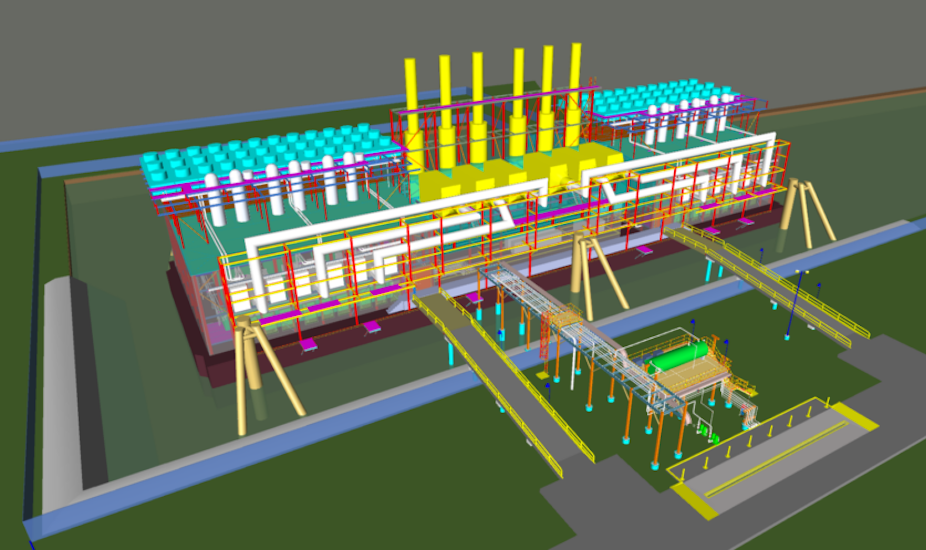
3 and 4D building models embedded with detailed specific information
about a construction project. It is, arguably, a technology
that is poised to change the way projects are built and the
way the project players related to each other. The panel included
representatives from three of the major BIM vendors, Autodesk,
Bentley
Systems and Graphisoft
as well as successful BIM users and BIM skeptics.
Hagen threw out his challenge
to the construction industry by saying that his organization
is not looking for new a technology, but rather for an efficient
way to solve a serious business problem. GSA has $12 billion
in active projects. "Too many are not on time and not
on budget," Hagen said. Mark Dietrich, an architect with
Burt
Hill Kosar Rittleman Associates, Inc.
said that BIM addresses the business issue by allowing
him to anticipate problems that need to be solved ahead of
time.
But Ray Barnard, chief information
officer with Fluor
Corp. is not quite ready to embrace BIM. Recalling what
he calls the "ERP fiasco," Barnard says that without
any quantifiable return on investment and without customers
saying that they are willing to pay for it, he doesnt
see BIM really taking hold for another six or seven years.
The panel agreed that interoperability
loomed large in BIMs long term success. Huw Roberts,
Bentley Systems Director of Global Marketing said that "Youre
never going to have our project on any one platform but that
the access to the information is the fundamental factor to
the long term success of BIM." A recent
study by the National Institute of Standards and Technology
(NIST) put annual inadequate interoperability costs at
$15.8 billion per year in the United States capital facility
industry.
The other major factor is the interaction
between the team members. Amar Hanspal, vice-president of
building collaboration systems at Autodesk predicts that BIM
will follow project collaboration systems which, he says "Is
growing 40-50% each year."
The real value of BIM, says contractor
Jim Bedrick, director of systems integration at
Webcor Builders is the ability to collaborate between
architect, builder and major subcontractors, leading to better
value for the owner. He sees the BIM model as having long
term implications for the owners ability to operate
and maintain the facility after the construction hand-off.
Detailed modeling gives the owner easy access to critical
building information. Hagan would like to see the AEC community
create added value for the owner by specifically building
a BIM model just for operations and maintenance purposes.
Following the BIM panel, construction
industry research Martin Fischer, director of Stanford Universitys
Center
for Integrated Facility Engineering (CIFE) confirmed with
hard data that utilizing 3D and 4D modeling at the appropriate
early stages in the design and construction process results
in significant building efficiencies and cost savings. For
example, he cited in one project, "usable square footage
increased 20% in the same building footprint because of better
modeling. Dr. Fishers complete presentation can be found
here.
In the final session, three chief
information officers talked about their placed in their companys
hierarchies and how they get their jobs done under the microscope
of cost conscious directors and low construction profit margins.
Each of the three works for very different types of companies
yet had similar philosophies that concentrated on finding
value for their companies using technology.
"Our use of technology is
now viewed as strategic to growth," said Patrick Thompson,
CIO of the Shaw
Group. Thompson was brought into Shaw three years ago
to help align and consolidate Shaws many new acquisitions
technologies. He succeeded in reducing costs by $60 million
dollars. At the EMCOR
Group, CIO Joe Puglisi said he balances new technology
needs and costs by requiring the users to provide data that
the new acquisition will reduce costs and create more business.
Angelo Privetera, CIO of
HDR Inc.
says he is careful to put a project management system in place
to train the people who will support a new IT project. He
says, "People still dont know how to fully use
Outlook, something thats been on their desks for years."
|