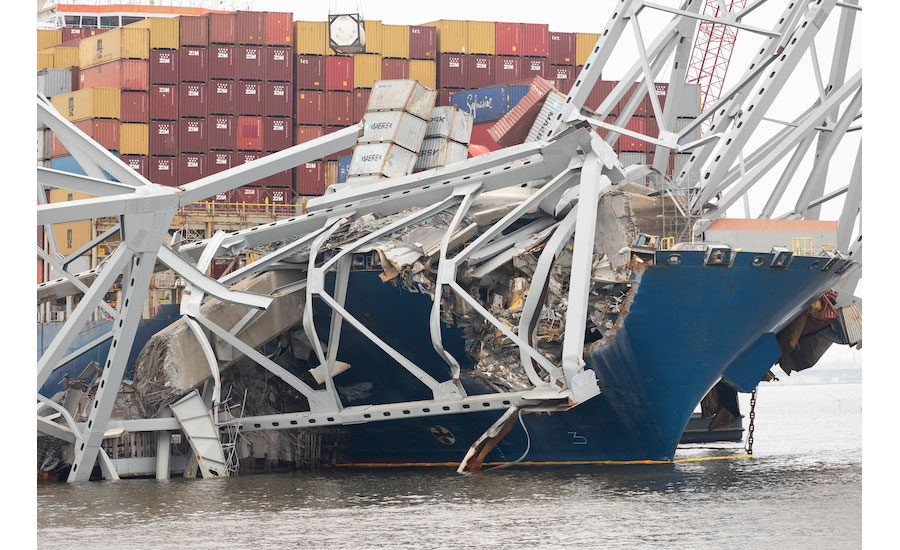
Blast test showed that a single structural steel column without seismic detailing can survive a 4,000-lb bomb blast.
Structural-steel boosters are on the defensive about the draft standard for green building design. The American Society of Heating, Refrigerating and Air-Conditioning Engineers Inc. has no place developing a standard that includes structural material selection, says the American Institute of Steel Construction Inc. AISC also thinks the committee writing Standard 189.1, being developed by ASHRAE, the Illuminating Engineering Society of North America and the U.S. Green Building Council, is not diverse enough.
“They’ve exceeded their purview and their scope of expertise—for which ASHRAE is American National Standards Institute-accredited—by establishing prescriptive requirements for construction materials,” said John Cross, a vice president of the Chicago-based AISC, at its steel conference in Nashville on April 2-5. The draft, called the Standard for the Design of High-Performance Green Buildings Except Low-Rise Residential Buildings, “adversely restricts” a design professional’s freedom in framing-material selection, said Cross at the meeting, which drew 3,800 attendees.
AISC claims materials beyond concrete are not represented on the standard’s committee. “It was not constituted in a balanced manner under appropriate ANSI consensus protocol,” said Cross. “We also believe the committee lacks expertise in the area of construction materials, particularly as they relate to framing systems,” he added.
Kent Peterson, ASHRAE’s president and vice president of P2S Engineering, Long Beach, Calif., responded to AISC’s concerns: “ASHRAE’s technical guidance is well-respected both in and out of the building industry, and this is due to the fact that our standards process is above reproach. Our process is fair and open, involving all affected and interested organizations or groups to the greatest extent possible. The project committee ensures that each comment submitted through the provided public-review process is recorded and seriously considered by the committee.”
AISC has commented twice, most recently during a second public-review period that ended on April 7. ASHRAE hopes to have the standard, which is designed to become part of model building codes, issued by year’s end.
To make its case, AISC says a typical structural steel frame provides an 11% credit toward the overall recycled content of a building, under the voluntary, yet popular, LEED green-building rating system developed by USGBC. A concrete frame may provide a 1% to 2% credit, with its reinforcing steel providing an additional 5% credit, says AISC. “The proposed standard will limit the contribution for any material to 5%,” said Cross. “The result is that structural steel gets capped at 5%, while concrete still gets its full credit and the 5% credit for steel,” thanks to its rebar content.
AISC also objects to the draft allowing the recycled content of concrete’s cementitious portion to be used as the recycled content of the entire concrete mix.
In another area, the steel group is trying to increase performance data on structural steel. Toward that end, AISC underwrote a $70,000 blast test to investigate the behavior of a brick-clad, wide-flange column subjected to a 4,000-lb bomb, similar in size to the one used on the Alfred P. Murrah Federal Building in Oklahoma City. Results were only recently released, though the test was in 2006. Cladding was destroyed and the column deflected and deformed but did not fail, reports Karagozian & Case, the Burbank, Calif., firm that devised the test.
“No local fractures were observed...indicating a significantly ductile behavior of the materials,” said K&C. The test showed that a steel column, even without seismic detailing, “won’t collapse,” said Charles Carter, AISC’s chief structural engineer.