 |
| CHANGE
SEEKERS Task force's Carrato (l.), Engler, Holland. |
The American Institute
of Steel Construction Inc. predicts that, thanks to electronic
data interchange, in 15 years at most, two-dimensional design
and shop drawings will be relics of a bygone era, pushed aside
by three-dimensional models. AISC is pushing hard to catalyze
this paradigm shift, starting with the steel sector. But like
David going against Goliath, it has its work cut out for it.
Resistance to change in the way buildings are delivered, especially
from architects and even structural engineers and construction
managers, is palpable.
"With the steel sector leading
the way, we hope that 3-D models will eventually replace traditional
2-D drawings as contract deliverables," said Gabe Coleman,
AISC's director of information technology initiatives, at
the Chicago-based group's North American Steel Construction
Conference, April 2-5, in Baltimore. The meeting had 2,350
fabricators, engineers, detailers, erectors, suppliers and
educators in attendance. Coleman predicts that the paradigm
shift will take five years for steel and another five or 10
years for the total building package.
The vision for the future is one
in which the owner or developer of a building owns a complete
project database, including the 3-D model, shared by designers,
builders and facilities managers through the service life
of a building.
While it may take more than a decade
for EDI to totally permeate the building sector, change in
the steel sector is well along. Yet even with steel frames,
AISC is beginning to see the bigger picturethe need
to get the owner and architect on board, not just the structural
engineer. The institute is planning to reach out to their
representative groups through a new task force created to
develop an EDI business model for steel.
"Because of the changes in
technology, we can make a fundamental change to the work process,"
said Mark V. Holland, task force leader and chief engineer
for fabricator Paxton & Vierling Steel, Omaha, at a session
on electronic data interchange (EDI). "The sharing of
the model is the backbone of the change," he added.
The first step, however, is to
to develop contract language for the exchange of 3-D models
as contract deliverables. The language developed will be incorporated
into the code of standard practice in the AISC's 2005 Unified
Manual of Steel Construction.
"Business models don't support
EDI," said Don Engler, task force member and vice president
of international operations for BDS Steel Detailers, Mesa,
Ariz. "We haven't figured out the proper business model
with the architect on board. That's the "real impedance"
to this in the commercial sector, he adds, and one of the
problems the task force plans to tackle. Its first meeting
is slated for late spring.
"AISC is hitting the upstream
side," said Peter J. Carrato, task force member and principal
civil engineer in the Frederick, Md., office of Bechtel Power
Corp. "There is a wide-open area for using this in procurement
and construction," he adds, predicting it will be more
common in the future. "We're feeling our way through
it, but it's easy in Bechtel's engineer-procure-construct
arena because you don't have architects and contractors to
deal with."
The resistance is not only from
the architect and contractor. "The problem is educating
the existing work force," says Ivan Jivkov, senior designer
with civil-structural engineer, Hatch, Montreal.
Regardless, Carrato thinks that
"we're only scratching the surface with the power of
these tools," which he says add so much value to the
project.
Proponents say that using 3-D modeling
and EDI on a project can save time and money while increasing
the quality of the end-product.
The EDI process works if the engineer
can export the 3-D analysis model into the design model, which
it then shares with the fabricator for connection design and
detailing. The detailed model is then exported upstream to
the designers for approval. It then goes back to the fabricator,
which uses the model to drive computer-numerically controlled
equipment. The model can also be exported into the fabricator's
management information system software for resource planning
and other business. The steel erector also uses the model
to produce the erection sequence.
The schedule is shortened because
design and detailing overlap, steel can often be ordered earlier,
the shop drawing phase is eliminated and the model approval
phase takes less time.
An EDI project using design-build,
which steel experts agree is currently the best delivery system
for EDI, can take almost 50% less time from preliminary design
to the start of steel erection than a 2-D, design-bid-build
job, according to AISC. There are also savings in the 3-D
model approach using design-bid-build, report sources.
Click
here to view chart
Potentially, sharing of a 3-D model
reduces requests for information, the time and expense involved
in tracking them and the time lost waiting for answers. "Some
50% of a project's time is spent on questions about incomplete
information," said Chris Moor, North American sales manager
in the Atlanta office of Tekla Inc., which produces the Xsteel
design and detailing software used on Chicago's Soldier Field
football stadium now under construction.
"People in the industrythe
whole supply chainstill don't understand what they can
achieve" with shared 3-D models, added Moor. "With
the transfer of a 3-D model the communication is so much improved."
Firms like Bechtel and Fluor have
been using 3-D models for engineering, procurement and construction
for years. In the commercial buildings sector, say sources,
development of a 3-D approach requires a radical shift in
the work flow, especially between the architect and the structural
engineer but even between the fabricator and the design team.
Click
here to view chart
To create the model in the first
place, engineers need to get accurate dimensional, orientation
and geometric data from the architect during design development.
It's not easy to get. "If you force design to very specific
dimensions early on, it is hard to modify it in 3-D,"
said Anthony O. Montalto, an associate with architect Wood
& Zapata, Boston, which is working on Soldier Field. "3-D
begins limiting the architect's palette."
Even for steel buildings, there
are so many bugs to work out of the business model. One big
question is which entity "owns" and is responsible
for the model. Another is which entity is in charge of the
model's care and feeding throughout the project. "We
need a new entity to manage the model," says Sid Dickerson,
senior vice president in the Irving, Texas office of Hirschfeld
Steel Co. Inc., Soldier Field's fabricator. He suggested calling
this entity a steel construction manager. The deliverable
would be the electronic equivalent of maintaining a record
set of documents, says Dickerson.
 |
| NUTS,
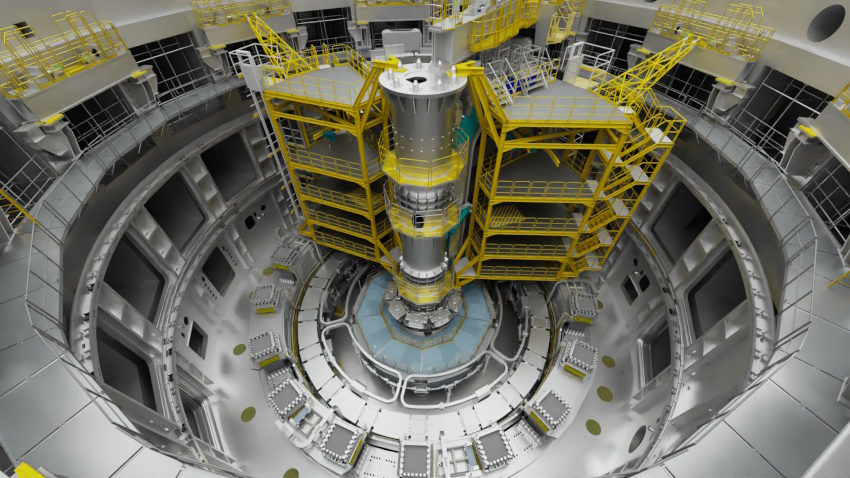
BOLTS, BEAMS Detailed 3-D models show complete
frames. |
Lanny J. Flynn, principal in charge
of design-build for structural engineer Putnam Collins Scott
Associates, Tacoma, Wash., thinks the way to save time with
the 3-D model approach is for the structural engineer to take
responsibility for connection detailing. On a 270,000-sq-ft
high school project in Tacoma, the fabricator was awarded
the contract on or about Jan. 24, and steel erection is already
about a third complete, he said.
AISC is on the launch pad of its
second big push toward EDI. The first, which began in 1999,
was an effort to get analysis, design and detailing software
developers, including Tekla and its competitor, the Gaithersburg,
Md.-based designData, which produces SDS/2 software, to adopt
a uniform standard so that the different analysis, design
and detailing packages could "talk" to each other.
The so-called CIMsteel Integration Standards/2 (CIS2) is now
established as common translator.
The tools are there, says Coleman.
The next step is to convince the members of the building team
to use them.
|