Investors
and Voters Are Willing To Pay To Pave U.S. Highways
The
Interstate system enters its 50th year with highway construction
poised for change
1/16/2006
...project and seeing how it turns out
as a potential solution, says Craig Eddy, senior transportation
engineer for VHB, which is leading the streamlined environmental
impact study. Click
here to view map
Last year, Chicago closed on a
99-year lease of its Skyway toll bridge. A team led by Macquarie
and Cintra, a Spanish private developer, paid Chicago $1.83
billion. The whole world is talking about it,
says Jack Hartman, executive director of the Illinois State
Toll Highway Authority.
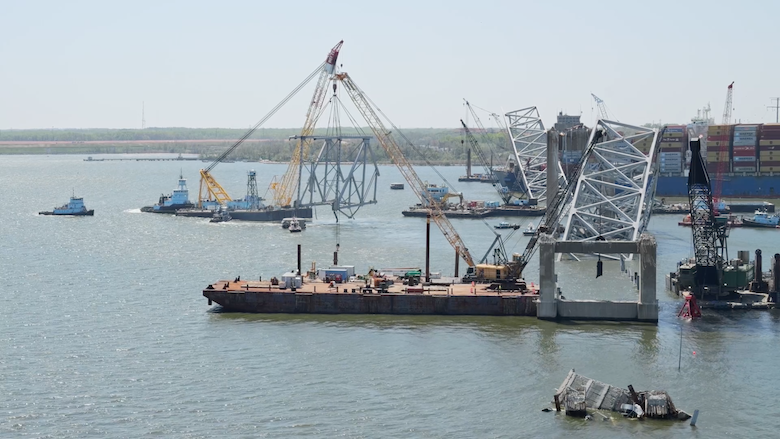
Toll Bridge. Washington
states Tacoma Narrows Bridge is being built using
design-build project delivery.
Christopher Voyce, director of
Macquaries U.S. group, notes potential similar opportunities
for managing existing New Jersey and New York roads, and in
California, if the $107-billion plan of Gov. Arnold Schwarzenegger
(R) is approved by voters and legislators. The plan proposes
1,200 miles of new highway lanes with 550 miles of carpool
lanes that could include extra capacity on a toll pay basis
(see
related story).
In pursuing opportunities to build
new roads, private investors will look for contractors and
engineers with an ability to design the project and
optimize long-term maintenance at minimum cost, Voyce
says. That doesnt mean the investor wants to minimize
quality, he adds. Efficient investment is a goal, but the
investor does not want to end up with an underperforming road.
The private sector is there to provide a service and
attract users to the road. Users generally have a free alternative,
he points out.
Magnus Andersson, acting executive
vice president of Skanska Infrastructure Developments
U.S. arm, argues against the concern that privately developed
road jobs may mean less work for some firms. Its
a way to create more projects, he says. Adds Skanska
USA Civil Inc. project development leader William H. Allen:
Design-bid-build is still the cornerstone. But we are
seeing a lot more PPP and design-build jobs coming to the
fore. The challenge is picking the right opportunity.
Shifting the risk in highway building
to the private sector changesbut doesnt decreasethe
public agencys role. A state will continue to
have oversight of the road. If the private sector misbehaves,
there are sanctions in the agreement, says Macquaries
Leslie. Moreover, when an agency builds and runs the road,
the public cant do much beyond complain,
he says. But if its a private developer, the agency
acts on behalf of the public.
PPP is at heart about private businesses
providing public services, says Ignacio Barandiaran, leader
of Arups PPP technical advisory practice in the Americas.
Tolling is the preferred method of revenue, because it directly
links the private entitys performance with customer
usage. But PPP isnt always about tolls, he adds. In
Canada, the government pays the private operator based on
how well it fulfills road performance parameters such as volume
flows and lane availability.
Texas DOT is taking a fresh
approach to private development for the Trans-Texas Corridor.
Cintra, in joint venture with Zachry Construction Corp., has
a comprehensive development agreement. It includes a $6-billion
investment to design, build and operate a four-lane, 316-mile
toll road between Dallas and San Antonio as the initial segment.
That includes a $1.2-billion payment to the state. C-Z is
also refining the master development and financial plan. When
C-Z gives the DOT a proposal, we can let them build it or
we can put it out for bid, says Michael Behrens, TexDOT
executive director. Click
here to view map
Jim Riley, officer-in-charge for
Kansas City-based HNTB Corp.s Ohio office, sees a growing
role in acting as a DOT representative in private deals. Every
DOT has its minimums and maximums in design standards,
he says. Private investors will come in and pick the
minimums. It becomes a negotiation.
Innovative Project Delivery
These trends only add to the evolution of alternative funding
and project delivery. Hal Kassoff, senior vice president with
Parsons Brinckerhoff, New York City, notes that the
need to make money by private investors is just a bit of a
shift from the need of states to repay debts when using
tolls for Guaranteed Anticipated Revenue bonds or Transportation
Infrastructure Finance and Innovation Act loans, known as
TIFIA. And some states, like Washington, have been using tolls
to pay for road and bridge work for years. There, bonds so
far have financed 14 bridges and have been paid back with
tolls. The largest is the $849-million Tacoma Narrows Bridge,
also a design-build job.
Under design-build, engineers already
work for the contractor rather than the owner. That will continue
under PPP. In turn, whether PPP or not, projects will depend
more on improved ways of delivery and on tolls.
For example, the Illinois toll
agencys use of design-build contracts and performance-based
specifications is streamlining construction. It outsources
program and construction management, and keeps tight quality
control through ISO 9001 certification. This prompts
vigorous processes, ideas and solutions, says Sharif
Abou-Sabh, senior vice president of program manager HNTB.
At the $2.5-billion Woodrow Wilson
Bridge project, Virginia and Maryland have taken partnering
to new levels. Their DOTs adopted special partnering provisions
that set out a discrete process for field decision-making,
says Larry Anderson, contracts manager with the projects
general engineering consultant Potomac Crossing Consultants.
An internal website collects feedback from all parties on
project issues. Deadlines are specified for DOT staffers to
respond to contractor questions.
Overall, the traditionally adversarial
relationship between contractor and engineer is losing steam.
People need to try partnering again, with a full toolkit,
says Anderson. They cant just hold a meeting or
workshop and say they did it.
It is fitting that, thanks to advanced
partnering, the first half of the Wilson bascule main span
carrying I-95 and I-495 is scheduled to open this yearthe
50th anniversary of the Interstate.
Gives readers a glimpse of who is planning and constructing some of the largest projects throughout the U.S. Much information for pulse is derived from McGraw-Hill Construction Dodge.
For more information on a project in Pulse that has a DR#, or for general information on Dodge products and services, please visit our Website at www.dodge.construction.com.
Information is provided on construction projects in following stages in each issue of ENR: Planning, Contracts/Bids/Proposals and Bid/Proposal Dates.