Specified
Sequence. Temporary towers on either side of the
new permanent bridge tower (in gray) were reused at each
vertical support. (Photo courtesy of Golden Gate Bridge
Highway and Transportation District)
...foundations were built for the temporary
towers. "We incorporated the temporary foundation into
the permanent retrofit to avoid waste," says Marvin Young,
principal at Jees firm.
To install isolation bearings between
the viaduct superstructure and substructure, the contractor
had to jack the road deck one-quarter inch while the bridge
was open to traffic. Project officials say the process has
been routine. "Jacking a live bridge...is like watching
grass grow," says Rich Zito, Shimmick-Obayashi project
engineer. But he admits "if something were to go wrong,
it could go very wrong."
Assembly Line. Contractor
works on pylon exterior plating simultaneously from five
levels. (Photo by Michael Goodman for ENR)
Strengthening the concrete pylons
that support the ends of the Fort Point Arch has been far
from routine. The task is necessary because movement from
new energy dissipation devices installed at the base of the
arch are grounded through pylons, says Young. The pylons have
only minimal reinforcement and lack tensile capacity, says
Kuang Yak Lim, a senior project manager with HDR Engineering
Inc., Oakland, who had been part of Jees department
at Sverdrup.
To accommodate those additional
forces, as well as the pylons own inertial forces, engineers
designed a "sandwich" system that adds steel plates,
varying in size from 38 in. to 11
4 in. thick, on the inside and outside
faces of the existing concrete pylon walls. Seams between
plates are welded and high strength rods are threaded through
the assembly. Grout is pumped between the plates and existing
concrete.
The plating operation extends 187
ft above pylon foundations, but the contractor worked on only
20-ft-tall sections, maintaining roughly the same level of
completion on each face and each pylon.
Because plating involves removing
several inches of concrete cover on the exterior and demolishing
interior concrete diaphragms, "all [pylons] have to stay
at roughly the same stage since you dont want one more
stiff than another," explains Cocotis.
The process has proved tricky because
the typical exterior plate is 10 x 30 ft and weighs some 20,000
lb. "These are substantial pieces of steel," says
Zito. On the lower half of the pylon exterior, the contractor
used a custom-designed, self-climbing scaffold. Workers have
the ability to work on the scaffolds five levels simultaneously,
so the plating process is "almost more like a factory
assembly line than construction," says Cocotis.
Continuity. Lim,
Jee and Young have been involved from the start. (Photo
by Michael Goodman for ENR)
For the upper half of the pylons,
the contractor found a single-level window washer platform
that is lighter and more easily deployable. The multi-level
scaffold remains in place as a staging platform for the work
higher up, says Zito.
On the interior, contractors are
using a mast climber and a series of winches and cables to
maneuver plates. Although those plates are narrow and tall,
about 10 x 20 ft, they are still difficult to move within
the approximately 26x36-ft pylon. "We couldnt just
drive up with a crane," says Zito.
The contractor expects to complete
plating by the end of this month. After sand blasting and
epoxy coating the first 100 ft of the pylons, crews will pour
a concrete cover over the exterior steel, replicating the
original formwork pattern.
Work on the arch between these
two pylons includes strengthening and replacing steel members
and installing new energy dissipation devices. Engineers devised
a custom-made but straightforward friction form of the device
they say offers several advantages over off-the-shelf viscous
dampers typically used on bridges.
The new device can fit into limited
space, will not leak and does not need a specialty supplier
for fabrication or maintenance. The damper, similar to those
sometimes used in bracing systems for buildings, is made up
of steel and aluminum bronze plates. A significant quake will
deform "sacrificial" plates but they are easily
replaced, says Lim.
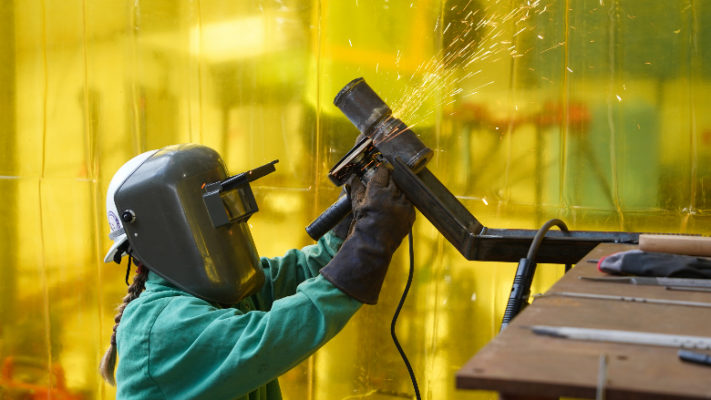
Suited Up. Painting
depends on weather conditions. (Photo by Michael Goodman
for ENR)
Four-Day Week
The archs position directly above
Fort Point, which is open to tourists on Fridays, Saturdays
and Sundays, limited work to just four days per week. Restrictions
have been especially tough on painting subcontractor Long
Painting Co., Kent, Wash., whose work depends on the weather.
Atmospheric and surface conditions
must be monitored constantly since paint cannot be applied
when the steel temperature is above the dew point, says Scott
Clark, Long project manager. "We can get all geared up,
and the fog can come booming in," he says. "It is
difficult to maintain an optimal flow of work." Wind
also is a factor. Working inside the painting enclosure is
difficult, especially during summer, when gusts are common.
"The tarp is like a sail. It beats the crap out of a
guy," says Clark.
On top of a limited work schedule
and unpredictable weather, the painter, along with the steel
erector, have had to deal with other challenges, including
coordinating with each other and with engineering documents
that specified the sequence of joint removal and installation.
In a very selective fashion, members are disassembled, paint
is removed, and the exposed steel is primed before new joints
are installed, says Ronald Paz, division manager for the West
Coast office of Shakopee, Minn.-based steel erector Dannys
Construction Co. Inc. "There is no real rhythm,"
adds Clark.
advertisement
...
To facilitate work, the erector
installed steel decking suspended from wire rope below the
roadway on the viaduct and on three different levels in the
arch. It also installed a "stairway to heaven,"
a stepping steel channel system used to reach work at the
base of the arch. "Easy access is the key to productivity,"
says Jack Geer, Dannys project sponsor.
The retrofit is scheduled for completion
by March. About $12 million worth of additional repairs and
painting, to be paid for with leftover contingency, will be
completed about a year later.
District officials now are seeking
$160 million in federal and state funds for the overall projects
final phase on the north anchorage house and pylons, and the
suspension span. The work will be released in two bid packages
in spring 2005 and 2006. Officials also are examining options
for hardening the bridge against terrorism. "We want
to make certain that the seismic work will not make the bridge
more vulnerable in case of an attack," says Bauer.
For more information about the seismic
retrofit project and the Golden Gate Bridge, see the Golden
Gate Bridge Highway and Transportation District website at www.goldengatebridge.org.
Gives readers a glimpse of who is planning and constructing some of the largest projects throughout the U.S. Much information for pulse is derived from McGraw-Hill Construction Dodge.
For more information on a project in Pulse that has a DR#, or for general information on Dodge products and services, please visit our Website at www.dodge.construction.com.
Information is provided on construction projects in following stages in each issue of ENR: Planning, Contracts/Bids/Proposals and Bid/Proposal Dates.