 |
| ARRIVED
China is first to build commercial maglev trains; U.S.
engineers want to emulate. |
Chinas bold
move to build 30 kilometers of magnetically levitated high-speed
guideway between Shanghai and its new Pudong Airport in three
years has resulted in a system of trains moving up to 431
km per hour. It is being hailed as a success, but with engineering
challenges that U.S. proponents are taking to heart.
Chinese officials took the giant
step to build the worlds first commercial application
of the technology after a 2000 visit to Transrapid Internationals
test track in Bremen, Germany. Shanghai Maglev Transportation
Development Co. Ltd. (SMTDC) was formed to lead the effort
to build all structures within three years. The estimated
$1.2-billion project included two stations and fabrication
of some 2,551 girders, most 24 meters long and weighing 175
tons.
Key to the effort was the fast
production of specialized machines that fabricated precast
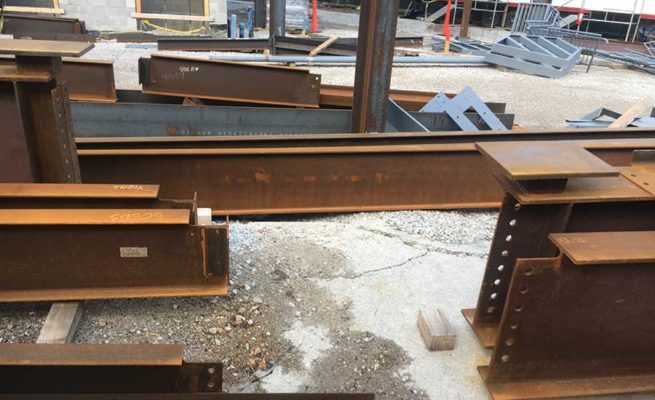
concrete girders and fitted their edges with milled steel
flanges. The maglev systems stator packs, which contain
the electromagnetic cables that propel the trains, are attached
to the brackets. Every 1 m of guideway carries 14 m of cable.
Continuous steel box beams comprise eight sets of switches.
Neumarkt, Germany-based Max Boegl
developed a single hybrid steel-and-concrete beam for installation
at the German maglev test facility in 1999. "We got a
call that the Chinese decided on a hybrid beam," says
Ludwig M. Schoell, vice president for Max Boegl USA Inc.,
Roswell, Ga. "We flew to China to negotiate a transfer
of technology to them."
That occurred in November 2000,
and by April 2001 the first fabricating machines were headed
to a new 1.1-milelong manufacturing shop in Shanghai.
Project officials say the learning
curve was challenging. For example, Chinese batch plants had
to improve their mixes to meet the 8,000-psi requirements
for the beams, says Schoell. Engineers also avoided fabrication
of 350-ton double-length beams first specified for two 40-m
river crossings. Instead, Chinese engineers used a 6-m-long
steel girder to bridge the distance between two standard length
concrete sections, says Lin Guo Bin, special assistant to
the SMTDC general manager. Engineers also designed adjustable
support bearings to accommodate soft soils along the site.
In a recent presentation at a Transportation
Research Board session in Washington, D.C., Wu Xiang-Ming,
SMTDC project chief, said other key challenges included temperature-based
deformations and concrete creep. "The existing technology
needs improvement and optimization," he said. "The
propulsion needs newer components of power."
Shanghai officials say German maglev
technology is still under consideration for a high-speed rail
line linking Shanghai to Beijingas is steel-on-wheel
high-speed rail technology. The former "would need modifications
if it were to be extended to Beijing," said Wu. "Weve
handed documents to Transrapid, and they are improving those
issues." Japanese maglev technology is still being developed
and is apparently not in the running.
J. Christopher Brady, president
of Transrapid-USA, Washington, D.C., says "we are pooling
resources with possible universities to look at new types
of guideway." He adds that computer simulation to address
thermal issues will be needed. Transrapid is involved in several
U.S. maglev attempts, including Baltimore, Pittsburgh, Las
Vegas-to-Anaheim and Chattanooga-to-Atlanta.
Schoell says his firm also is learning
from the Shanghai job and is working on guideway improvements.
"Our precast concrete beams can be milled to a precise
shape and then our steel attachments are cut by lasers to
extremely fine tolerances to achieve the necessarily tight
specifications," he says. Walter Antlauf, Max Boegl general
manager of TRI Guideways, says the Shanghai job has already
led to new Chinese contracts.
 |
| SPEEDING
TRAIN Train
propelled by magnets through one of Shanghai's two stations.
|
U.S. engineers are working on their
own types of girders. Karl Frank, director of the maglev guideway
research center at the University of Texas, Austin, is working
with the California-Nevada High Speed Rail Commission and
Hirschfeld Steel Co. Inc., San Angelo, Texas, on versions
such as a 150-ft hybrid span with flared bottom flanges. He
says the hybrid would weigh less than the German spans and
have fewer temperature and load deflections.
For the Anaheim-to-Las Vegas route,
currently in preliminary engineering, "a light and flexible
steel superstructure is the ideal solution for shear deformations,"
Frank says. He has been testing a 31-m trapezoidal steel box
girder, 2 m deep, that would accommodate seismic displacement.
With 3,300 lb of fabricated steel for 1 mile of guideway,
"this is a tremendous opportunity for the steel bridge
community," he says.
In a trip last fall to Shanghai,
U.S. delegates took the eight-minute ride. "The biggest
lesson learned," says Arnold Kupferman, maglev program
manager for the Federal Railroad Administration, "is
that we really ought to have one."
(All photos courtesy of
Transrapid)
|