 |
Highway lanes and light-rail route will be added to the
congested I-25 corridor.
(Photo by Michael Goodman for ENR) |
As Denver-area transportation
officials debated how best to move people through the increasingly
congested Interstate 25 corridor, mass transit advocates dug
in their heels for a light-rail line. Highway advocates pressed
for more lanes. The planners ultimate decision to fit
a rail line into an expanded highway corridor accommodated
both sides and thrust Denver into a two-pronged project that
may be the example for others in the growing region.
Branded with Jurassic Park flair,
the $1.67-billion design-build project dubbed "T-REX"
(Transportation Expansion Project) is rolling along despite
state budget woes that scaled back roadwork by $800 million
and careless night drivers (ENR 10/29/ 01 p. 14). The smoothest
part has been construction. Under the supervision of design-build
veterans, the job is 50% complete and on schedule for completion
two years ahead of the state Dept. of Transportations
originally planned 2008 opening. It is founded on a multisource
funding plan, coordination among scores of agencies and firms
and a massive public outreach program.
Southeast Corridor Constructors,
a joint venture of Peter Kiewit Sons Inc., Omaha, and
Pasadena, Calif.-based Parsons Transportation Group, is expanding
the 14-mile stretch of I-25 between downtown Denver and the
Denver Tech Center to the south from six lanes to eight and
10. It cannot shut down lanes during the day. Another two
lanes will be added to three miles of I-225 to the east. Overall,
eight interchanges and 13 bridges will be refurbished.
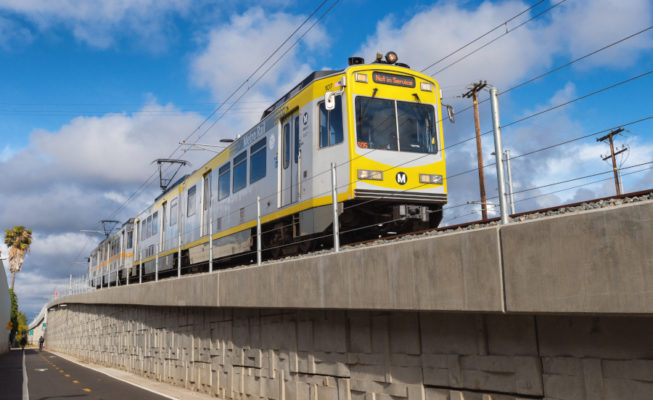
On the transit side, the team is
building 19 miles of double-track light rail and 13 stations.
The rail will travel alongside the southbound I-25 lanes and
down the I-225 median.
"This is the first time theres
been truly combined highway and transit at this level,"
says Randy Pierce, project manager for Carter & Burgess,
Fort Worth, providing owners construction oversight
for T-REX. Without design-build, which allowed for both fast-track
work and bond funding, "this would take 20 years otherwise,"
he says.
 |
|
Contractors Murphy, transit agencys Clarke
and CDOTs Warner discuss job. (Photo by Michael
Goodman for ENR) |
Getting design-build legislation
coincided with political support, funding and a grassroots
effort in three counties and several cities. "We were
blessed with good timing," says Larry Warner, T-REX project
director. In 1999, voters approved two bond initiatives for
the project. Gov. Bill Owens (R) signed a law that let the
state borrow against anticipated federal funds and the legislature
passed bills allowing CDOT to issue revenue anticipation notes
for funding, design-build, increased private sector participation
and landowner tax breaks.
No one questioned the need to expand
capacity along the corridor, built for 180,000 daily vehicles
and now carrying 230,000, says Warner. A C&B-led study
concluded that both highway and light rail were warranted,
and CDOT and the Regional Transportation District joined forces.
Offering both "led to success on the environmental impact
statement," says Warner. "There was little public
comment."
Local jurisdictions pledged $30
million. The Federal Transit Administration contributed a
$525-million Full Funding Grant Agreement in 2000 to the $879-million
light-rail portion, with RTD and local matches funding the
rest. The $795-million highway work is funded from existing
highway taxes, bonds and federal money. Some 200 rights-of-way
acquisitions have been done for less than the budgeted $100
million.
In 2001, SECC underbid its competitor
by $186 million and pledged to finish the job 22 months earlier
to boot. That suited project officials, who first researched
other big design-build jobs such as Salt Lake Citys
I-15 and New Jerseys Hudson-Bergen light rail. "I-15
was successful in many ways," says Pierce. "We are
trying to improve on that."
So are the I-15 veterans now working
in Colorado. "Were learning from past experiences
and developing new controls and processes," says Bill
Murphy, SECC project manager, who worked on both I-15 and
Californias San Joaquin toll road for Kiewit and Parsons
design-build joint ventures. For I-25, Parsons is an equity
partner, he notes. "Weve developed a mutual respect,"
Murphy says, which helps contractor and designer to address
issues more swiftly.
More than 20 task forces for specific
construction jobs, such as retaining walls, bridges or drainage,
meet weekly as needed, with appropriate agencies and locals
as members, says Jim Klemz, SECC design manager. Design moved
swiftly, thanks to 5-day review turnarounds for submittals,
he says. Now, design is complete and most of 320 designers
from a team that includes HNTB, DMJM+Harris, Jacobs and 30
others have left.
Unlike I-15, where schedule topped
all priorities, I-25 emphasizes minimizing public inconvenience,
notes Murphy. But both priorities factor into the contract.
Liquidated damages are assessed at a set cost for each lane
mile, with amounts tied to different segments of highway and
light rail. The maximum penalties for various segments are
$50 million.
There are smaller fines for opening
the highway late after overnight closures. SECC paid $24,000
in two cases where it reopened lanes late due to difficult
bridge demolition, says Doug Brannan, SECC deputy construction
manager.
 |
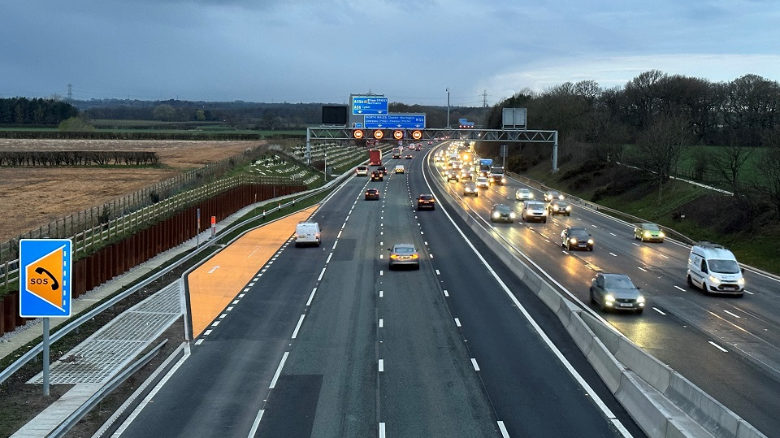
| An
information campaign keeps drivers aware of changing lane
closures and promotes safety. (Photo by Michael Goodman
for ENR) |
The contract includes an insurance
program where the owner and contracting team will share whats
left over from about $9 million saved for such issues as claims
and accident coverage. There have not been any worker deaths,
but in April 2002, an improperly rigged crane setting barriers
on I-25 just north of the I-225 interchange toppled onto the
northbound lanes. Two cars were crushed and three people injured.
Local subcontractor Front Range Barricade had subcontracted
the work to Absolute Crane Service, which was suspended and
paid a settlement of $4,500, says Occupational Safety and
Health Administration spokesman Brad Baptiste.
Since then, a drunk motorist has
crashed into a construction truck, injuring two workers and
killing himself. Most accidents that account for the 20% increase
in night-time accidents on T-REX are minor and attributable
to driver error, says Barry Erlandson, SECC traffic control
designer. "The biggest challenge is retraining the familiar
motorist," he says. "Commuters get on autopilot...they
dont read the signs."
Crews now check daily for blown-over
signs and orange barrels, faulty striping and other issues,
says Erlandson. "We brainstormed with local cops about
reducing speeding," he says. That includes a media campaign
with gas station signage, bumper stickers on project vehicles
and increased patrols.
Daytime accidents decreased 3%
last year. Klemz adds that detection monitors set up every
one-third of a mile monitor traffic volume that is updated
every minute to the project Website, www.trexproject.com.
An incident review manual coordinated with 30 agencies helps
guide a 5-minute response time for road incidents, notes Murphy.
"What were seeing is
typical in any major construction project, and thats
an increase in minor traffic accidents," says Capt. John
W. Lamb, Denver police traffic operations division. "On
this project, [the roadway] is changing weekly."
Key to the fast schedule was swift
mobilization. "We had 300 designers on board within a
month" after winning the bid, notes Murphy. "We
did a lot of scheduling up front." The team erected the
site office within weeks, with CDOT and SECC employees separated
by a floor. Crews work two nine-hour shifts, five days a week,
and many summer Saturdays, says Brannan.
Contractor quality management includes
"inspect and test" of specs, down to the tint of
a precast panel. C&Bs Pierce adds that owner compliance
auditors, teamed with Toronto-based Delcan, refer to a database
of contract specs using hand-held computers with which they
can file reports instantly.
Crews are drilling rows of up to
54-in.-dia caissons to depths of about 60 ft for 35-ft-high
retaining walls along the Narrows, I-25s northernmost
four miles. Where needed, precast concrete panel noisewalls
are erected, etched with images of local wildlife.
 |
| New
19-mile light-rail route includes flyovers, tunnels and
13 stations. (Photo by Gregg Gargan/Colorado DOT) |
Along with nearly 200 utility relocations,
the team revamped the Narrows drainage system. Designed
to handle a 100-year flood, its components include a 13-ft-dia
bored tunnel, several box culverts and basins, and collectors
of 84-in. and 92-in.-dia pipe, says Brannan.
Work on the 6-mile southern segment
calls for snaking the light-rail route through a five-level
interchange with E-470, a toll road built to funnel traffic
east of I-25, and toward Denvers airport. required 25
retaining walls up to half a mile long and up to 20 ft high,
says DMJM+Harriss Bob Clevenger, segment design manager.
There are no at-grade crossings between rail and road.
So far, some $40 million in change
orders have been added to the job. CDOT asked SECC to rebuild
two overpasses that had been contractually optional. The longest
bridge is a new 2,000-ft-long steel girder span carrying traffic
from I-25 to I-225. Bridges are either steel or precast concrete.
David Evans and Associates Inc., Portland, Ore., used Cyrax
laser-scanning technology to survey 24 bridges in 40 days.
 |
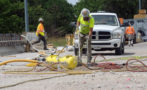
Crews
work day and night
(Photo top left by Michael Goodman for ENR, right and
bottom by Gregg Gargan/Colorado DOT) |
The rail line includes seven flyovers,
but SECC value-engineered two others into 300-ft-long cut-and-cover
tunnels, saving about $2 million, says Rick Clarke, T-REX
deputy project director. The design had called for bridges
that soared 100 ft high over the I-25/I-225 interchange, and
"we werent crazy about it," Clarke says. Crews
now are beginning to lay 80-ft segments of track. Most steel
is recycled from Denvers old Mile High Stadium.
Work on all stations has begun.
All have a 350-ft-long x 35-ft-wide platform and a canopy
shelter. Design began before all land was acquired, but based
on community demand, "we ended up customizing each one
to create 13 distinct stations," says HNTB architect
Doug Loveland. All but one have park-and ride lots. Three
four-level precast concrete parking structures are also being
built.
SECC Light Rail Manager Tim Mackin
notes that new track paralleling I-25 in the northern segment
will dip 25 ft into a trench for a major station below grade.
Transit-oriented development is planned for the site. Siemens
has a $90-million contract to build railcars powered by 750-volt
overhead wires.
The local office of M.A. Mortenson
Co. has a $32-million contract for a maintenance and control
center. The system will connect to Denvers downtown
light rail and carry 33,000 riders, while highway capacity
will increase by about 50%.
Pleased with the project, CDOT
has begun an environmental impact study for a Denver-Boulder
link that would emulate T-REX.
|