|
It is the eighth-busiest
U.S. airport in terms of plane traffic, but Minneapolis-St.
Paul International Airport also is near the top of the list
for ongoing construction--especially tunneling.
 |
| MUCKY
Equipment, materials and muck disposal formed constant
procession. (Photo courtesy of HNTB) |
Some $3 billion worth of new terminal,
runway, tunnel and station work has been plugging along for
seven years, says Gary Warren, director of airside development
for the Metropolitan Airports Commission. "We've been spending
$1 million a day since 1996," he says.
One notable highlight of all that
work lies within level layers of soils filled with boulders,
air voids, water and other elements sure to give tunnel contractors
sleepless nights. A tunnel boring machine with earth-balanced
pressure components has just completed carving twin 7,300-ft-long
tunnels for an 11.6-mile Hiawatha light-rail route that will
connect the airport to the Mall of America and downtown Minneapolis.
Unstable limestone, stubborn glacial till and other obstacles
have assured the project's place as one of the region's most
difficult earthwork jobs ever.
Planes roared overhead constantly
as eight muck cars traveled the 5% grade up out of the bowels
of Minnesota earth, carrying some 95 tons of mashed-up soils
and mud from the 500-ton, 4,000-hp TBM's last 5-ft push. Some
70 ft below Minneapolis-St. Paul Airport, a pair of construction
workers placed and drilled seven puzzle-like precast concrete
segments in rapid procession to form a lining ring of the
19-ft-dia light-rail tunnel. They did this almost 3,000 times.
The crews are still working on
a major station and cross-passages for a slated completion
in early 2005. Working three 8-hour shifts a day, the joint
venture of Tokyo-based Obayashi Corp. and Litchfield, Conn.-based
Johnson Brothers Corp. tunneled as far as 130 ft a day.
 |
| TEAMWORK
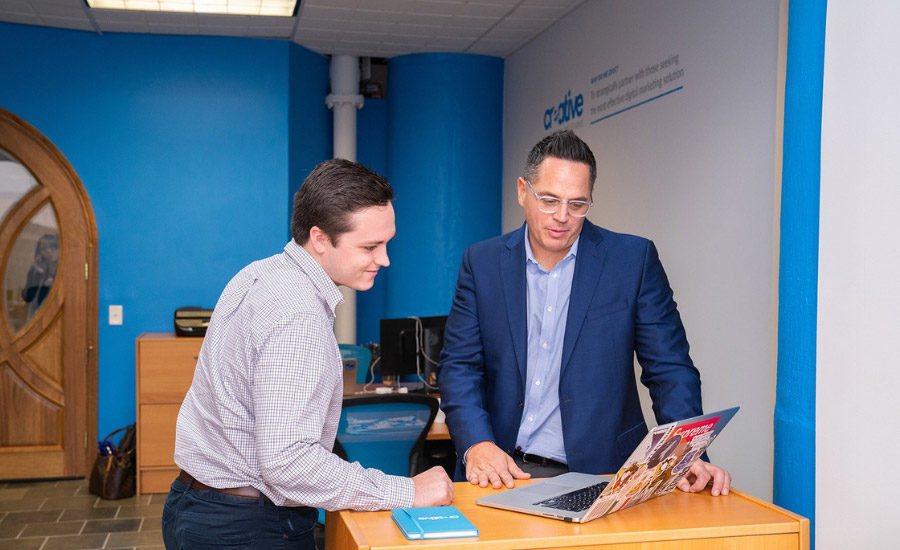
HNTBs Rich Johnson, Obayashi/Johnsons Paul
Zick and airports Pat Mosites hashed out tunnel
issues.(Photo courtesy of HNTB) |
Public opinion "forced us to come
up with a way to build tunnels without opening up the surface,"
says Richard M. Johnson, project director for HNTB, Kansas
City, designer for the light-rail tunnel and five other tunnels
at the airport. HNTB worked with a design schedule of 11 months.
"We would've liked two years," Johnson says. Two types of
construction methods were offered to give contractors flexibility
in biddingtunnel boring with earth-pressure-balanced
methods or a combination of boring and mining. Obayashi and
Johnson opted for the TBM/EPB method with cut-and-cover sections
in its $110-million contract.
Six teams prequalified for the
job, but only two of them submitted bids. MAC disqualified
the apparent low bidder, a joint venture of Frontier Construction,
Traylor Brothers Inc. and Shea Construction Inc., because
it bid as a limited liability corporation, says Johnson. A
federal judge supported MAC's decision on appeal, so Obayashi/Johnson
won the job.
MAC used a geotechnical baseline
for risk analysis of potential claims, with the design report
as a reference. The contract documents also called for deductive
bid items, escrow bid documents and a dispute review board
only for differing site conditions-related claims, says Hugh
Caspe, national tunnel director for HNTB. "Using deductive
bid items has worked well over the last 10 to 15 years in
the tunneling industry," he says. Click
here to view graph
Although design-build contracts
are used for the rest of the light-rail route, MAC officials
decided on design-bid-build project delivery for the tunnel.
"Our position was that with the potential risk, including
two runways, roads, a flight center, we were not comfortable
with design-build and losing the control we felt we needed,"
says Denny Probst, MAC director of landside development. "We
think it was a good decision."
DIGGING IN. The joint venture
rented the German 6.5-m-dia Herrenknecht TBM and hit a learning
curve. "The machine has been easy to operate," says Paul Zick,
project manager for the contractor. But the geology is another
matter. A glacial till layer up to 10 ft thick lies on top
of weathered limestone about 25 ft thick and 3-ft-thick shales
that hold in water. A sandstone layer begins about 60 ft below.
In areas where rivers wore away the limestone cap, stability
became an issue.
A 500-ft-long buried valley, where
sandstones transition to silts, included boulders that got
in the way of the TBM. HNTB shifted alignment of the tunnels
to avoid boring below an active runway atop the valley. A
movable zone of restricted access is applied to minimize air
traffic in sensitive areas. The contractor soaked dry sandstone
with foam and other chemicals, but material caked inside the
TBM cutterhead, says Zick. "We lost some thrust because of
the varied soils," he adds. A couple of sinkholes--up to 670
cu yd worth--caused ground loss and voids below the limestone
cap.
The TBM's mixed-use face had 42
disks, with cutting foam and a copy cutter extending 2.75
in. radially. Zick says worn-out disks were replaced more
than 100 times. Eight ports lubricated the TBM with bentonite
and a probe extended up to 150 ft ahead to check for obstacles.
The EPB component adjusted rotation and conditioned the muck
to ease settlement issues.
Zick estimates that some 2,000
cu yd of steaming, heated muck was excavated daily. Consolidation
and compensation grouting solidified the soils or fills subsurface
voids "so that the TBM [could] sink its teeth into it," says
Johnson. Above ground, computerized gauges monitor soil settlement
to aid with the grouting operations. Many of these are perched
on a flight center sitting atop the tunneling operations.
A conveyor system traveling 400
ft per minute, 24-ton locomotives and eight muck cars cruised
in and out the tunnels, which are strung with utility lines
including a 13.8-kv power cord. The precast panels are made
of 8,500-psi concrete and were placed by the TBM's articulated
ring erector. It took about 30 minutes to erect one ring section.
County Concrete Corp., Marathon, Wisc., precast the segments.
When the TBM broke through the
end of the southbound tunnel in April, 3.5-ft-dia concrete
columns used as temporary supports sat at the end to greet
it. The team broke through on the northbound tunnel on Oct.
26.
Despite round-the-clock work in
the buried valley section, the team fell about 100 days behind
schedule, but has made up all but 26 of that, says Zick.
MAC allowed the joint venture to
put the TBM on vehicles and transport it across the airfield
to the north portal rather than dismantling it, Warren notes.
Although this required midnight use of the airfield a couple
of nights, it saved about two weeks of work, he says.
Cut-and-cover box sections connect
the bored tunnels at either end. The southern section is 445
ft and connects, in turn, to a 230-ft "boat" section. That
is a box culvert with precast concrete slabs that act like
a boat sitting in water, under hydrostatic pressure, says
Johnson. The 300-ft north cut-and-cover box section connects
to a 740-ft boat section that lies about 250 ft from a runway.
The contractor submitted a value-engineered
proposal to use shotcrete and rock bolts for cross passages
ranging from 18 to 40 ft, connecting the two tunnels. Using
this method in lieu of cast-in-place should save about $90,000,
says Zick.
The Lindbergh Terminal Station,
located just north of the midpoint of the tunnels, is a 30-ft-high,
60-ft-wide, 500-ft-long cavern 66 ft below grade. Crews are
dropping excavation from the station down to muck cars in
the tunnel below through shafts 4 x 8 ft. Temporary supports
of rock bolts, shotcrete and meshing will hold up the station
while excavation continues down to the tunnel level, says
Dan Webb, a project engineer with HNTB. Rock-bolted precast
panels 10 in. thick and about 30 tons each will line the station
walls. The completed 30,000-sq-ft station will have a 290-ft
center platform and connect to an automated people mover going
into the airport. With its 110-ft-high roof, the station will
resemble "a mini-Metrodome," says Pat Mosites, MAC tunnel
project director.
FUTURE. When Obayashi/Johnson
and its 10 subcontractors complete its contract, another consortium
will take up a $291-million design-build contract to place rail
and electrical components and the on-grade portions of the 11.6-mile
route. That team is led by Watsonville, Calif.-based Granite
Construction Inc. and includes Pasadena, Calif.-based Parsons
Transportation Group; Maple Grove, Minn.-based C.S. McCrossen
and Morristown, N.J.-based Edwards and Kelcey. Although there
are no major claims, Obayashi/Johnson's contract has grown by
about $1 million due to issues such as extending the southern
boat section by 400 ft, says Zick. There are varying late penalties
up to $25,000 a day, depending on the milestone. Zick says about
$80,000 is under discussion.
MAC is almost done with $95 million
worth of work in other tunnels--four vehicular tunnels and
a pedestrian tunnel, also designed by HNTB. They add up to
1,600 ft and lie under active runways and taxiways, built
to withstand plane loads up to 1.3 million lb, says Johnson.
The cut-and-cover reinforced concrete tunnels will provide
access to an airport area that will be locked in by a new
$520-million, 8,000-ft-long north-south runway to be built.
The last of the tunnels will open in two years.
|