|
On a recent ride
down Interstate 95 southbound in Springfield, Virginia Dept.
of Transportation spokesman Steve Titunik's vehicle passed
through the tangle of looping overpasses and underpasses that
connect with I495 and I395. A tractortrailer
loomed abruptly up from the merging I495 Capital Beltway
lane, inches from Titunik's vehicle. "That's what this
project is going to fix," Titunik said.
 |
| (Photo
courtesy of the HNTB Corp.) |
The project, named the Mixing Bowl
for its loopy geometry, has been no picnic for its contractors,
designers and the financially strapped VDOT. But VDOT officials
and the Mixing Bowl's engineers and contractors are valiantly
pushing ahead with the work of overcoming more downtoearth,
nuts and bolts challenges on the job.
"This is the longest,
most challenging project in my career," says Larry Cloyed,
VDOT assistant resident engineer. He maintains that some of
the reported bumpup in the project's overall cost to
about $650 million is a natural result of adjusted rates for
inflation and uncertainty of initial engineering estimates.
Also, a $28million congestion management program developed
as the project matured added to the original estimatea
program VDOT considers well worth the money. Cloyed concedes
that setbacks in ongoing contracts "have an overall impact
on the budgetpotentially significant." Officials
remain optimistic that the megaproject will be completed in
2007 for a total of eight years, not 14 as originally envisioned.
 |
| ACTIVE
Work must not interfere with 4000,000 daily vehicles.
(Photo courtesy of the Virginia Department of Transportation) |
The Mixing Bowl is one of Virginia's
few major highway projects that have pushed onward despite
state budget woes that temporarily froze some jobs (ENR 4/8
p. 16). Others include the Woodrow Wilson Bridge, embroiled
in a bidding drama, and several notable ones in Richmond (see
accompanying sidebars). But the Mixing Bowl felt some budget
impact. Jorge Martinez, project manager for Bechtel Infrastructure
Corp., VDOT's construction inspector, says that Bechtel's
part of that work force decreased from 70% to 20%, leaving
the core field presence to Bechtel's jointventure partner,
The Dewberry Cos., Fairfax, Va. "We've reduced our presence
in the field and focus more on controls, claims and litigation,"
he says.
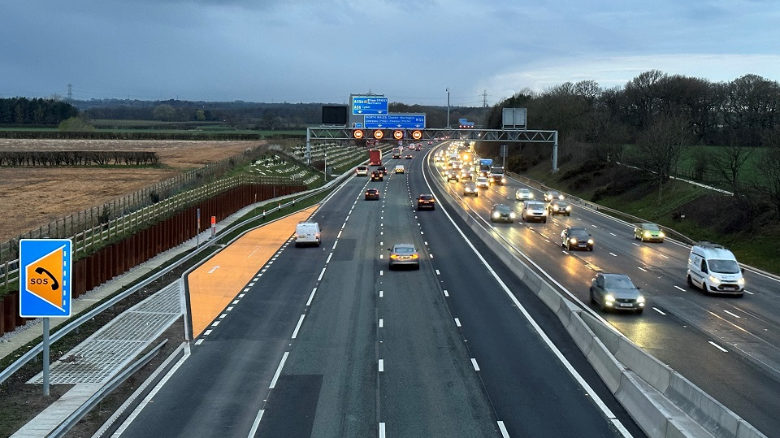
Every day, 430,000 vehicles pass
through the Springfield Interchange, where I95, 395
and 495 come together. Studies showed the interchange logged
179 accidents in a twoyear period, making it the most
dangerous spot on the 64mile Capital Beltway. The project
will add about 50 new bridges and widen I95 to 24 lanes
in that stretch.
HNTB Corp, Kansas City, started
preliminary design in 1993, says Paul Templeton, HNTB chief
of highway design. "We had 12 concepts" for what
to do with the route in the beginning, he recalls. Suggestions
included sinking I95 underground, reminiscent of the
Boston Central/Artery project. "This [chosen design]
was No. 12," he says. The mission is to eliminate the
weaves with improved local roads, highoccupancy vehicle
lanes and improved ramps. "It's like building three projects
in one," within existing rightofway, he says.
Martinez notes that the controversial
project received lots of "doom and gloom" media
coverage. Templeton concurs, saying "the first predictions
were that traffic was going to collapse" as the first
two major contracts of the sevenstep program began in
1999. Those contracts, awarded to Shirley Contracting Corp.,
Lorton, Va., for a total of $90 million, entailed building
15 new bridges and widening four miles of arterial roads at
I95's intersection with Route 644, just south of the
I95/395/295 interchange. Shirley completed the work
nearly a year ahead of schedule, netting a $10million
bonus, and now is working on Phase 4 (ENR 5/14/01 p. 14).
VDOT has been tackling the doom
and gloom with an extensive outreach programa Website
(www.springfieldinterchange.com), newsletters, a hotline and
a wellvisited project store in the Springfield mall.
Titunik says he receives an average of 30 calls a day and
has gotten "thousands of emails."
 |
| FLYOVER
New ramps will ease interchange transitions. (Photo courtesy
of the Virginia Department of Transportation/Tom Saunders) |
But delays and cost increases on
Phases 4 and 5 due to obstacles such as an abutting railroad,
site conditions and design disputes may push back the sixth
and seventh contracts from their scheduled bid dates this
summer. Cloyed notes that Phases 4 and 5 were at one point
made a single contract in order to speed up the project. They
were split again in order to control the costs and scope,
but complications ensued. About 1,900 ft of sewer line overlaps
with the $57million Phase 5, where Lane Construction,
Meriden, Conn., is working. When the one contract was split
into Phases 4 and 5, "it forced Lane to start work wherever
Shirley wasn't going to be," says Cloyed. "But the
sewer segment was not on Shirley's critical path."
VDOT paid for extra shoring
formwork for Shirley, which brought in a subcontractor to
work on the sewer. The fix added $90,000 and four months to
the Mixing Bowl program.
Also, "we were not particularly
successful on these contracts using the A+B method" of
company selection, says Cloyed. "To best serve the owner,
one must be fairly sure there is minimal risk...we hadn't
foreseen some of these issues."
Shirley is 60% complete on the
$117.2million Phase 4 contract, after a November 2000
start, says Chuck Smith, Shirley contract manager. "Demolition
has begun in preparation for a key 4,400ft bridge made
of steel beams, on average 125 ft long and resting on caissons
up to 40 ft deep, that will carry westbound I495 traffic
into I95 southbound. But the piers abut active tracks
carrying 100 trains daily, and Shirley is dealing with a moving
fivehour window of availability that now has shrunk
to three. Discussions continue with railroad companies.
 |
| RAIL
TROUBLE Active tracks posed challenge to contractor.
(Photo courtesy of the Virginia Department of Transportation/Tom
Saunders) |
About 150,000 cu m of unstable
clay was hauled out and 300,000 cu m of fill brought in. Mechanically
stabilized earthwalls reach as high as 70 ft and cover 14,000
sq m. Shirley also is using drilled piles and tiebacks with
castinplace paneling, while avoiding sensitive
woodlands that limit excavation.
"We had some disputes
[with designers] over what the wind load force was on the
tiebacks and how deep the foundations should go," says
Smith. "They agreed to move the soundwalls behind the
retaining wall" rather than mounted on top, he adds.
A lack of room for threaded rod required a second row of tiebacks,
adding to delays. For some soundwalls, VDOT is using "whisper
walls," an 11yearold system utilizing recycled
rubber tire chips, supplied by Concrete Precast Systems, Va.
Cloyed estimates that Phases 6
and 7, worth some $90 million to $120 million of work, will
be bid in early 2003 instead of this summerstill enough
time to make a 2007 completion.
|
Pocahontas
Parkway Evokesand Makesa Bit of History
Traveling
between richmond's southern and eastern counties used
to require skirting a wide valley that separated Interstate
95 on the west and I295, a northsouth connector
to Richmond Airport, on the east. But the new eastwest
Route 895 is about to cut that time in half.
"It was a 23minute
ride to go 500 ft before," observes Jeff Caldwell,
Virginia Dept. of Transportation spokesman. "This
splits the river crossing length by a half." With
895, drivers have a direct route between Chesterfield
County, eight miles south of Richmond, and Henrico County
across the James River.
 |
| Parkways
version of the James River Bridge. (Photo courtesy
of the Virginia Department of Transportation/Tom
Saunders) |
An innovative effort by VDOT
and a joint venture also slashed the time it would have
taken to build Route 895, officially dubbed the Pocahontas
Parkway, by some 15 years under a normal budget process.
While VDOT has faced criticism, shrinking budgets and
now new leadership, its conception of the state's PublicPrivate
Transportation Act has resulted in the successful completion
of a crucial capital city connector.
Most of the parkway will
be open on schedule May 20, with some of the eastbound
bridges due to open a month late and the westbound bridges
due to open about six months behind last month's original
completion date. Some of the liquidated damages of $25,500
a day will end up being assessed. But "even late,
it's less than 50 months, where if VDOT had done it
traditionally, it would be 72 to 84 months," says
Herb Morgan, president of FD/MK LLC, a firm created
by Fluor Daniel and Morrison Knudsen (now Washington
Group), which is the privatesector owner/partner
with VDOT.
The large constructors previously
had teamed up on Denver's E470 toll road, and
brought that experience east, where Fluor Daniel took
the lead. "We're our own entity," says Morgan.
"We have our own books, and our own bills."
Once the Virginia legislature passed the PPTA in 1995,
FD/MK promptly put in a proposal for Route 895. Three
years of financial and contractual negotiations passed
before the first concrete was poured. FD/MK took care
of all environmental permits, rights of way and utility
issues. "The state had one guy," notes Morgan.
"Its only investment is $9 million for environmental
impact study and an $18 million State Infrastructure
Bank loan, which was paid back."
In all, $27 million of the
$324 million project cost came from public funds and
FD/MK sold bonds for the rest. It has 28 years to pay
back the bonds and the contractor also is providing
a fiveyear warranty on the road.
FD/MK reduced environmental
impact from 40 to 32 acres, built 70 new acres of wetlands
and preserved another 181 acres.
The contracting team is led
by a joint venture of Miamibased Recchi America
Inc. and Glen Burnie, Md.based McClean Contracting
Co. for bridges and Lynchburg, Vabased W.C. English
Construction for highway work. They must navigate a
maze of utility work including dealing with power lines
and petroleum pipelines, plus a plume of contaminated
groundwater. They also are rebuilding three utility
towers and lowering them by 20 ft to remove them from
airspace for the nearby airport. In all, utility issues
cost approximately $9.5 million, says Morgan.
Among the 8.8mile connector's
15 new bridges, the queen is a 4,765ftlong,
balanced cantilever river crossing that boasts North
America's thirdlongest castinplace
structurea 673ft clear span. This $110million
section of the parkway was a designbuild contract,
says Fred Parkinson, project manager for designer Parsons
Brinckerhoff, New York City. The high clearance of 150
ft was due to Port of Richmond marine traffic.
The precast dual box girders
weigh 35 tons each, with pier segments up to 60 tons.
The hollow trapezoidal girders, at 41ft depths,
rest on 20ftdia caissons socketed 5 m into
rock. Some 1,600 precast approach spans are tapered
to match the curving ramps. Curves can reach up to 350
ft in radii. A new mass concrete mix was devised for
the pours, reaching 4,350 psi. It may be used on other
projects.
There are 8,000 cu yd of
concrete in each of the two foundations, plus 2,500
tons of rebar, says Dave Wesson, VDOT project manager.
Adds Parkinson, "They could hold up an aircraft
carrier."
A smaller bridge, named after
local Civil War hero Powhatan Beaty, required a 33ft
cut on a job that is mostly fill, says Wesson. Since
that took it below a water table about 20 ft deep, crews
built an underdrain system there.
The new fourlane highway,
which will sport 240,000 tons of asphalt paving, is
expected to carry 24,000 daily vehicles initially, with
an eventual rampup to 50,000. Drivers will pass
through a shiny new toll plaza equipped with Smart Tag
technology that will automatically send speeding fines
to any vehicle passing through at more than 55 mph.
FD/MK helped push the idea of a $1.50 tolled connector,
with a public awareness campaign explaining that savings
will occur in distance as well as timeup to 8
miles. As for publicprivate financing, VDOT's
Wesson notes that, ideally, "we'd never go back
to a conventional type of project."
|
|
Interstate
95's James River Bridge Boasts Big Concrete Units
Many
bridges cross the james river in virginia and several
of them are simply called "James River Bridge."
But the new twinstructure, milelong bridge
carrying Interstate 95 commuters north into downtown Richmond
boasts the largest concrete units.
Archer Western Contractors
Ltd., Ft. Lauderdale, Fla., had a simple, but Herculean,
task: replace a bridge span a night. This meant positioning
two cranes on the existing bridge to hold old sections
in place while cutting the span away. Then the cranes
lifted a precast concrete unit (PCU) averaging 88 ft
long, 23 ft wide and 120 tons into place with a 2in.
tolerance.
 |
| Precast
concrete units come in big packages. (Photo courtesy
of the Virginia Department of Transportation/Tom
Saunders) |
The crew had 11 hours each
night to get the PCU installed or face a minimum fine
of $5,000 for every 15 minutes past 6 a.m., notes Michael
Schwartz, VDOT project engineer. The delays happened
twice. "One time they were there after 6:30,"
he says. But crews hit the learning curve in a hurry;
by the end of the job they trimmed the process down
to seven hours. Early completion bonuses for the June
deadline could make up for the fines, Schwartz adds.
There are always some complications
that weren't expected," says Bob Lofling, project
manager for Archer Western. For example, in an old truss
section, bolts unexpectedly threaded into concrete made
the old bridge sections harder to lift.
VDOT could not afford a total
replacement of the 1950sera bridge, which was
designed to carry 45,000 vehicles daily but now carries
triple that amount. Designer URS Corp., San Francisco,
determined the most economical option was to repair
the substructure and replace the 102 spans.
Archer Western won the A+B
contract by bidding for a 179night schedule rather
than 208. The contractor had worked with Pasadena, Calif.based
Parsons Corp.'s bridge division on modification of new
bridge segments. "The original contract plan was
to come in and set things down in form, and castinplace
the longitudinal joints," says Jim Bergeron, Parsons
regional bridge engineer. "We designed a matchcast
option....They can posttension laterally with
no castinplace work." The team also
saved time by increasing the size of the PCUs, reducing
the number of installations.
Archer Western began precasting
the spans in 2000 just south of the site, matched them
longitudinally and erected them side by side to make
up the full width of the span. "We were casting
two segments a week in a 24hour operation,"
says Schwartz. Around 7 p.m., a segment was taken to
the site. Then, two or three old bridge segments were
cut out. By 3 a.m. to 5 a.m., the crew could drop in
the new pieces with no pouring needed.
Schwartz
says VDOT has 11 other bridges that might undergo the
matchcast PCU method.
|
|
A
Warrantied Highway Unfolds Swiftly in Richmond
 |
| Route
383 piers grow fast under designbuild. (Photo
courtesy of the Virginia Department of Transportation) |
"The
easiest way to tell if we're on schedule is that if
you call this number next summer and someone besides
me answers the phone, we're not doing so good,"
jokes Jim Ewart, project manager for the joint venture
of Koch Performance Roads, Wichita, and APACVA,
Richmond. But so far all looks well: The $236million
designbuild project to build a 17.5mile
extension of Route 288 extending west and north on the
outskirts of downtown Richmond is more than halfdone
with less than half the 29month schedule passed
and zero injuries to boot. That's good news for a team
with $25,000 a day in potential late completion fines.
Koch/APAC's team is leading
69 contractors on the job, which includes 25 bridges,
$40 million in storm drainage and 116 wetland sites.
Koch is providing a 20year warranty to the Virginia
Dept. of Transportation for road maintenance and APAC
assumes responsibility for the wetland permits. The
team originally submitted a proposal in 1999, with the
contractual risks resting on VDOT. "We opened our
arms and said, Give us the risk,'" says Ewart.
 |
| Highway
crosses virgin land. (Photo courtesy of the Virginia
Department of Transportation) |
The third contract to be
let under the PublicPrivate Transportation Act,
this portion of Route 288 completes a highway belt circling
Richmond and dissected at the north and south edges
by I95. It would not otherwise have been done
until 2006, says Kent Heppe, project manager for CH2M
Hill Cos., Denver, subcontractor to APAC. "This
will save $47 million and three years," he adds.
CH2M Hill leads a design team including Earth Tech,
HDR Inc., TriplettKing and Reid Structures, among
others, and provides quality control.
There are seven interchanges,
one sporting an 80fthigh, mechanically stabilized
wall abutment to shorten ramps over I64, says
Heppe. The crown jewel is a bridge over the James River
being built by Traylor Bros. Inc., Evansville, Ind.,
in a subcontract to Chester, S.C.based United
Contractors. The bridge sits on shafts drilled to 40
ft deep and stretches 3,500 ft long and 50 ft high over
the 200ftwide river. The $31million
structure, a combination of prestressed concrete and
steel girders, is months ahead of schedule, says Ewart.
The north bank of the site
is abutted by railroad tracks and an overhead platform
protects an historic granite arch culvert from cranes.
On the other side of the river lies an archeological
dig. Further south, graves are being exhumed to make
way for the route, says Heppe. Extreme variance in soil
conditions and "more stormwater ponds than on any
other job in my life," added to the challenges,
says Ewart.
|
|