|
It
may be that the only thing faster than a laser scanner these
days is the pace of change in the laser scanning industry.
"Its moving quickly toward
more speed and accuracy," says Michael R. Frecks, head
of the 3D service department at Lamp, Rynearson and Associates
Inc., engineers, surveyors and planners in Omaha. "The
hardware and software are rapidly getting new tools and development."
 |
| RETROFIT
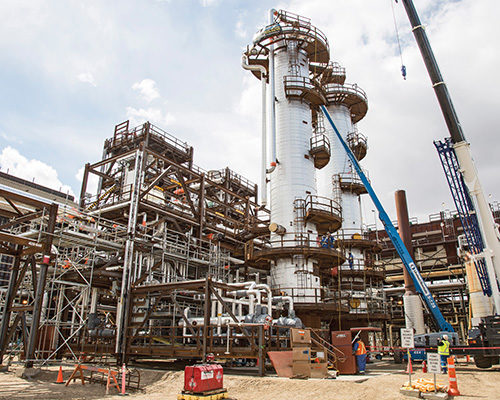
Laser scanning made new equipment for Detroit power
plant a clean fit. (Photo courtesy of WGI Laser Scanning
Services) |
LRA has used a variety of products
since it began offering laser scanning services more than
two years ago. "They all have their strengths and weaknesses,"
Frecks says.
"The biggest changes are in
getting the information to the end-user faster and cheaper,"
says Greg Lawes, a manager at Washington Group Laser Scanning
Services, Princeton, N.J. "The way to do that is through
less processing so the end- user can use the point cloud directly."Washington
uses laser scanning to assist complex retrofits, such as the
insertion of a huge selective catalytic reduction unit into
a 10-story Detroit Edison boiler building that is just wrapping
up.
"We're also seeing a proliferation
of new scanner companies, while existing companies are coming
out with new models that collect larger volumes of points
and denser clouds of data. Data management is becoming more
of an issue," Lawes says.
Eric Hoffman, CEO of Quantapoint
Inc., Pittsburgh, another scanning service firm, agrees that
scanning is in a state of rapid change. "Certainly the
technology is getting better. It almost has to, given the
early state of the industry," he says. Hoffman's "existing
conditions documentation service" company also builds,
but does not sell, its own very fast scanning equipment.
Until recently, most scanners have
used pulsed lasers, which emit rays like bullets from a machine
gun and record the time of flight between emission and return
to locate surfaces.
Alternatively, continuous wave
lasers emit a beam with constantly changing amplitude. Each
reflection from a point has an amplitude signature that also
reveals time of flight. Quantapoint's laser uses continuous
wave technology. It also uses a spinning mirror lens that
sweeps the beam over a wide field of view, capturing virtually
everything within 100 meters at the rate of 125,000 points
per second, missing only what lies directly below the scanner.
But Quantapoint is facing new challengers
in the speed derby. The iQsun scanner, from iQvolution AG,
Ludwigsburg, Germany, collects 200,000 points per second at
50 meters. It can can paint a sphere 360û horizontally by
320û vertically in 160 seconds. The device is being tried
on a few projects in the U.S. now and will be marketed starting
in October, says Thomas Satterley, director of business development
for the U.S. in Richboro Pa.
But high resolution and speed are
not always the best tools for the job, says Geoff Jacobs,
vice president of marketing at one of the other stalwarts
in the business, pulse-laser maker Cyra Technologies Inc.,
San Ramon, Calif.
Pulse scanners often can collect
data at longer ranges and up to 10,000 points per second.
Most have narrower fields of view, although MENSI Inc., Norcross,
Ga., has a new pulsed 360û laser with a wide field that weighs
about 25 lb and can be controlled by a personal data assistant
(PDA).
Cyra's Jacobs contends that the
smaller point clouds typical of pulse lasers, rather than
being a disadvantage, often are more useful than the massive
point clouds from high-speed scanners. "I call them dumb'
scanners. Everything is at high resolution," Jacobs says.
"The users have a very big problem managing the data.
All scanners are ridiculously fast. The challenge has been
to extract useful information." Jacobs says the answer
lies in better software and smarter scanning methodology.
"Be selective," he advises.
When scanning, software for Cyra's
Cyrex scanners lets them be "addressable," Jacobs
says. They can be told to capture fine detail from specific
parts of a scene, and coarser detail elsewhere. "You're
just capturing the areas you really care about," he says.
Nebraska's LRA has used Cyrex scanners
on projects, such as recording highway overpasses and scanning
the faces on Mount Rushmore.
Quantapoint's Hoffman agrees with
the smart scanning approach. "A lot of it is taking time
to understand what the customer wants to do," he says.
A typical plant retrofit job may have 2000 tie-ins and may
have 300 scans, he says. But by knowing in advance what designers
need, Hoffman's crews can shoot to make data navigation as
easy as possible. "When you deliver half a terabyte of
data to people, you had better be able to help them find their
way around it," he says.
Quantapoint's software can take
a designer to a particular flange and define it to help design
a connection. "We have tools to grab that pipe, give
slope and orientation, center point and diameter. That substantially
improves efficiency," Hoffman says.
 |
| OVERPASS
CLEARANCE Nebraska's LRA scanners deliver as-builts
quickly. (Image courtesy of Lamp, Rynearson and Associates) |
Cyra's cloud management software
also lets users select a low level of detail for navigation
so computers don't have to grind through millions of points
of data just to cruise the image. The newest version of Cyra's
Cyclone cloud processing software also has filters that can
automatically remove extraneous detail, such as shrubs, trash
cans and cars, to clean up files for projects such as digital
terrain models. Jacobs says that alone can reduce computer
processing time dramatically.
But many say the most significant
advances in usability come from new tools that let CAD operators
work directly over point clouds from within their design programs.
Cyra's CloudWerx plug-in, for example, opens point-cloud views
in Bentley's Microstation or Autodesk's AutoCAD software,
so users can see objects as templates and avoid conflicts,
without first having to interpret the clouds into models.
"That knocks down a big barrier," Jacobs says.
Another software advance is starting
to rock the scanning industry with a new way of dealing with
terabytes of 3D data. LASERGEN software, from BitWyse Solutions,
Boston, automatically and rapidly creates CAD-ready 3D models
from laser scan data, without ever actually touching the data.
The software preserves the original point cloud, but masks
it with an automatically generated modeling layer that uses
a sampling technique to vastly speed up view processing. Users
instantly can check interferences between the CAD and laser
design data while they are placing pipe, equipment or structural
shapes.
"Their software makes our
data look great," says Quantapoint's Hoffman. "You're
not trying to fit cylinders to points, not trying to decide
whether to model the one-inch lines or handrails and structures.
All that stuff is in there. It is very useful, and now we're
starting to see engineering companies embrace it."
"They're very forward-thinking
people," agrees LRA's Frecks.
|