 |
| TOUGH
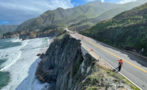
TERRAIN Concrete viaducts span mountain valleys
but slope stabilization and reinforcement has been difficult.
(Photo by John J. Kosowatz for ENR) |
For
centuries, Croatia's geographic location as a flash point
between East and West has made the small Balkan country a
battlefield. Culturally tied to the West and often dominated
by the East, independent Croatia is looking in both directions
to tap its undeveloped coastline and a lucrative tourist industry
that could fuel its struggling economy. The first step is
to speed access to the coast through an ambitious multibillion-dollar
motorway that will replace a snake's tail of narrow, two-lane
roads winding through the tough Klek mountains.
A joint venture of U.S. contracting
giant Bechtel Group Inc., San Francisco, and Turkish heavyweight
Enka Construction & Industry Co. Inc., Istanbul, is now
pushing the road's largest segment, a $990-million, 189-kilometer
toll road, through unstable mountainous terrain littered in
places with unexploded ordnance and abandoned mines left over
from Croatia's latest conflict, its 1991-95 war to separate
from Yugoslavia. When completed, the road will link Zagreb,
the capital, with the coastal city of Split, and eventually
Dubrovnik farther down the Dalmatian coast.
Primarily a gigantic earthmoving
job, Bechtel/Enka has spent nearly $200 million alone on heavy
equipment to move some 98.3 million cu meters of earth and
fill and clear and grub 946 acres of land. Thirty-four bridges,
all precast concrete, will take vehicles around mountains
and over spectacular, undeveloped valleys. The project is
loaded with geotechnical and logistical challenges, compounded
by cultural differences and wariness between Turks and Croatians
that goes back centuries. Forging some 2,400 Croatians, Turks
and Americans into an efficient roadbuilding work force has
been as much a challenge as cutting the road, says Jack Hume,
Bechtel project director. "This job has got just about
everything," says Hume, a 25-year veteran with the firm
who took over the project in 2000.
Despite its European location,
the sprawling jobsite traverses a remote and largely undeveloped
area, dotted with small villages connected by aging, narrow
roads. It begins at Bosiljevo, south of Zagreb, slicing further
south to Sveti Rok, and is a key section in a trans-European
road network connecting Croatia to Western Europe. Conceived
during the Dayton Accords, it is funded through the U.S. Export-Import
Bank and administered by the Croatian Roads Authority, which
also is responsible for obtaining rights-of-way. Design is
by three Croatian firms. Click
here to view map
Bechtel began work in 1998, shortly
after signing a contract with the public works ministry, and
is on track to finish in 2004. The first northern 44 km are
nearing completion. As the job moves south, the first work
camp, at Ogulin, is clos-ing down and a second, at Gospic,
already houses 500 workers. Another 200 are based at a former
munitions factory along the route. Hume says the work force
will peak at 3,000 before the construction season ends in
November.
All construction sites are dangerous,
but the project's route through the former front lines of
the Croatia-Yugoslav war and an abandoned munitions factory
make the motorway especially risky. Hume stepped up an aggressive
safety and training program after he found himself in the
middle of an abandoned minefield during an early site visit.
"It scared the hell out of me," he says.
 |
| HAUL
New road will remove bottlenecks in Croatia (Photo by
John J. Kosowatz for ENR) |
Workers are briefed on the dangers
and are forbidden to walk outside of the alignment's boundaries,
marked with rope. Anyone doing so risks being fired. Although
the government removed 99.6% of all known mines before the
job began, Bechtel started its own risk-reduction program
and hired former Croatian army munitions experts to seek out
the remainder.
Officials mainly are concerned
with antipersonnel mines that explode and scatter metal shot.
As the alignment moved south, teams working with explosive-sniffing
dogs laid out a grid, advancing about 200 m per day, says
Elvir Had¯zihalilovic, the team's leader. The government
was called in to remove and dispose of any explosives that
are found.
A Kevlar-protected Caterpillar
D-9 dozer then scrapes off the top 35 centimeters of soil,
about the depth at which mines were placed. The D-9's big
blade and the Kevlar panels along the side protect the operator.
Munitions experts say the D-9 by itself provides the most
efficient removal effort. When it finishes, heavy earthmoving
equipment follows, the bulk of it Caterpillar. The dogs and
D-9 recently finished clearing the entire alignment and crews
are working at more than 80 locations along the route.
The job has suffered one construction-related
death, but a strict safety and training program is paying
off. Hume reports the job now is at 160 days and 3 million
man-hours without a lost-time accident. To accomplish that,
project officials started with the basics. "Teaching
safety is challenging," says one official. "The
Croats have no history of safety" and Muslims place their
faith in Allah. "We had to build safety into two cultures
where it was nonexistent," he says.
Because
there are no safety requirements under Croatian law, about
65 superintendents were brought in to teach workers Bechtel's
safety program, turning a bus into a mobile training facility.
All workers must wear hard hats and safety glasses and those
working on structures must be tied off with a full body harness.
Rigging plans for lifts of over 10 tons are calculated beforehand
and hand signals have been standardized. Workers also have
been taught key terms and phrases in three languages, Croatian,
Turkish and English.
Since
signing the contract in 1998, the contractor has had to adjust
quickly to major changes in alignment. Originally planned
to run from Croatia through Bosnia, the alignment was rerouted
west through Croatia when the two governments could not agree
on a border crossing. Bechtel, which submitted its original
proposal without a clear design, now is working on a completely
different alignment.
A 40-km segment between Zagreb
and Sisak was to start next year but is held up over environmental
concerns for underground water supplies. A 13-km segment linking
Bregana at the Slovenian border to Jankomir, outside of Zagreb,
was finished in 2000. The entire route will have conduits
for fiber optics. Drainage includes concrete lagoons to prevent
spills or contaminated water from entering pristine streams.
Bechtel/Enka's route is divided
into six subsections, the first two nearly completed. Portals
at the 5,800-m-long Mala Kapela tunnel are now being prepared
by Italian contractor Coopconstruttori, Argenta, under a separate
contract (see map.) Bechtel/Enka's section ends at Sveti Rok.
The last portion to Split was awarded to a consortium of local
firms, which started work last spring.
Hume has crews working 12-hour
shifts, six days a week, to take advantage of good weather.
Crews already are pushing south from the Mala Kapela portal
toward Licko Lesce, 12 months ahead of plan. Further south,
between Licko Lesce and Sveti Rok, workers are moving 40,000
cu m of earth per day.
The region's peculiar geology of
soft limestone, called karst, has been especially troublesome.
Numerous fissures and 47 caverns have opened during excavation
and even during scraping and compaction. Some were deep enough
for spelunking staff geologists to investigate. Each requires
a customized fix but often are covered by spreading the motorway's
foundations.
 |
DANGER
Alignment abuts war-torn villages not cleared
of explosives .
Dogs sniff for mines followed by armored dozer. (Photo
by John J. Kosowatz for ENR) |
Slope stabilization has proven
to be difficult, especially within the deeper cuts. "We've
got every type and method you can use," says Mike Peachey,
the project's engineering director. Besides shotcrete, rockbolts,
stone and wire mesh, a composite product of mesh and matting
on which grass can be grown is being used. But the fixes are
costly. The venture already has racked up $1.3 million in
added costs for reinforcement and stabilization, says Chuck
Farber, the project's prime contract manager.
Most bridges are founded on rock
with spread footings but a few utilize caissons. Most use
standard 40-m-long precast girders. Crews were launching two
beams in 9 hours on upper segments.
Project management is divided between
Bechtel and EnkaHume's Turkish counterpart is Özger
Inalwith local engineers integrated into the structure.
As the biggest game in town, Croatian subcontractors have
flocked to the motorway. About 70% of the work was sublet
and procurement is done in-country, when possible. But subs
are playing by the joint venture's rules. In the end, the
motorway's greatest legacy may be training the local work
force in modern and ethical practices.
|