 |
|
LOOMING
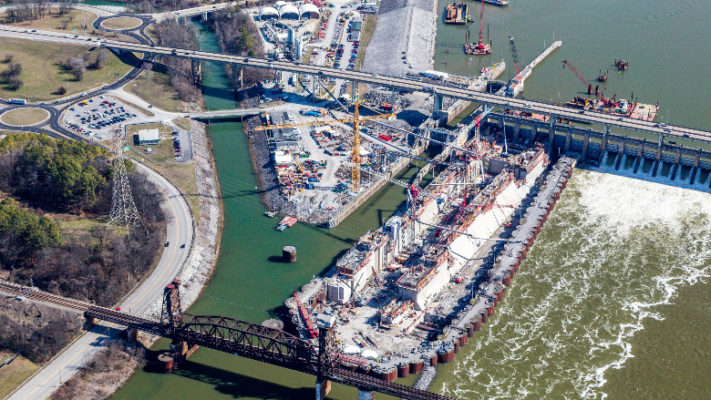
Flue-gas desulfurization is beginning to move into the
market as SCR installations are coming to an end. (Photo
courtesy of Babcock Power Environmental Inc.)
|
Before the Enron
and WorldCom debacles and subsequent telecom meltdown, the
outlook for new powerplant construction had engineering and
construction firms juiced about their future. But scandal,
a slumping economy and prolonged anxiety about war in Iraq
have short-circuited any near-term hope for sector expansion.
If there is a silver lining for power engineers and contractors,
it's in the pollution-control retrofit market. One consultant
predicts the U.S. flue-gas desulfurization market will top
$20 billion over the next decade. That may be high, but even
the most bearish analysts peg the market at $13 billion to
$14 billion.
As long as powerplants burn coal,
there will be a market for scrubbers to remove sulfur dioxide
(SO2 ) and other emissions controls. The U.S. Environmental
Protection Agency reports that coal will continue as the predominant
energy source for the next 20 years. Coal use will continue
to grow, although not at the same rate as natural gas, says
Jeffrey Holmstead, EPA's assistant administrator for air and
radiation. New powerplants are more likely to be fueled by
cheaper, cleaner burning natural gas, and renewables, he says.
Coal currently fuels about 50%
of U.S. generation. President Bush's pollution control policy,
the so-called Clear Skies proposal, shows coal will still
be smoking through 2020, but will slip a few percentage points
as new gas capacity comes on line.
Clear Skies would fit best available
control technology (BACT) on about 85% of coal burning capacity
by 2020. As the program's emissions caps phase in, bigger
powerplants would install scrubbers and other controls to
limit emissions of oxides of nitrogen (NOX) and other pollutants
in the first few years. By 2020 almost every plant bigger
than 200 Mw will have controls, he says. "If you're looking
at (SO2 ) or NOx, you're going to put in the most expensive,
but most efficient, technology at the largest emitter,"
says William Spangle, vice president for services at the Washington
Group Inc.'s Princeton, N.J., power division.
Clear Skies, reintroduced in the
House and Senate in late February, would reduce emissions
of nitrogen oxides, sulfur dioxide and mercury using a market-based,
cap-and-trade approach. Holmstead says EPA is "optimistic"
that Congress will pass a multipollutant bill "this year
or early next year."
Clear Skies' opponentsboth
Democrats and some moderate Republicansare also pushing
for curbs on carbon dioxide. One such measure is sponsored
by Sen. James M. Jeffords (I-Vt.), the senior minority member
on the Environment and Public Works Committee. He calls the
Clear Skies plan "corporate regulatory relief."
Jeffords cites evidence that "more people are dying from
powerplant pollution every year than from homicides or drunk-driving
accidents."
Many environmental groups also
believe Clear Skies does not go far enough. Clear Skies "is
not a realistic option," says David McIntosh, an attorney
specializing in clean air issues for the Natural Resources
Defense Council, Washington, D.C. Sooner or later, carbon
dioxide emissions will be regulated, NRDC says. The message
to powerplant owners and operators: Negotiating emissions
caps will be more productive than spending time and money
to lobby against regulation.
EPA's order for states to execute
their State Implementation Plans (SIP) accounts for "the
vast majority of demand for [selective catalytic reduction
technology]," says Carl Weilert, air-pollution control
manager for Burns & McDonnell, Kansas City. SCR technology
injects ammonia into flue gas, and passes through a catalyst
where NOx and ammonia react to form nitrogen and water vapor.
"There's a lot of SCRs under construction," probably
more than 150, he estimates. Existing compliance deadlines
are May 2004, but Clear Skies would extend the SCR boom because
the bill calls for further NOx reductions beyond 2008, notes
Robert Giglio, director of Livingston, N.J.-based Foster Wheeler
Corp.'s research center.
"Costs have been much higher
in general than everybody expected, including EPA," says
Weilert. Actual costs have been about double EPA's estimate
of $60 to $80 per kilowatt of generation at the source, he
says. "It's actually more difficult to install on an
existing plant than it was expected to be because of the place
the SCR has to reside in the gas-flow path." A contributing
factor has been a tight labor market that resulted from the
requirement to complete so much construction in a short period
(see bottom story).
Now, the flue-gas desulfurization
(FGD) market also is growing, says Tony Licata, environmental
systems customer relations director at Babcock Borsig Power
Inc., Worcester, Mass. In contrast to SCRs, scrubber construction
costs have fallen. FGD equipment installed in the mid-1990s
to comply with the Clean Air Act Amendments of 1990 cost more
than $200 per kw of installed generation, says Weilert. Average
FGD costs now run in the range of $150 to $200 per kw. "Technology
developments have made them less expensive," he says.
Click
here to view chart
"There's a very substantial
market there, but it will be less than EPA has projected,"
says Licata. He sees a $13-billion FGD market, covering 80,000
to 90,000 Mw, in contrast to EPA's estimate of 160,000 Mw
costing $25 billion. That's because uneconomic units will
be retired; others can comply by switching fuels, says Licata.
In 2010, under the existing clean
air amendments, sulfur emission allowances will be cut to
46% of today's standard, doubling the installed scrubber base,
says Weilert. Clear Skies would accelerate that. "If
the Clear Skies Act were passed today, utilities would have
incentives to install FGD at the earliest possible time because
of the way allowances will be structured in 2010," he
says. With early reduction credits, "Units burning Eastern
bituminous would have the most incentive to scrub and scrub
early," he says.
Burns & McDonnell is expecting
air-pollution control to be its largest energy-related business
for the near term because of the "severe overbuilding
in [gas-fired] combined-cycle plants," says Weilert.
But the fluid state of emissions
regulations is frustrating. "Ambiguity is driving the
market crazy," says Michael Perry, Black & Veatch
senior vice president and director of air quality programs.
Owners are demanding regulatory certainty before proceeding
with huge investments. Many players won't enter the market
until new regulations are passed.
"States are getting tired
of waiting for the feds to come up with a law," Perry
warns. Massachusetts has ordered its older coal-burners to
clean up or shut down. This could be problematic for several
utilities with weak balance sheets, says Chris Larson, vice
president of business development for the Stone & Webster
power division of the Shaw Group, Baton Rouge. On the other
hand, North Carolina's aggressive stance pushed Duke Power
to hire a joint venture of Stone & Webster and technology
vendor Alstom Inc. to backfit 12 units at six plants. The
10-year, $1-billion engineer-procure-construct program is
now in preliminary design, with work scheduled to start by
year-end, says Larson.
Industrial plants contribute fewer
emissions than powerplants, and many rely on emission credit
trading rather than capital improvements, says Paul Eisen,
Northeast regional manager of BE&K/Terranext, an environmental
subsidiary of BE&K, Birmingham, Ala.
Emission controls now focus separately
on offending emissions. But construction is expected to begin
next month on a commercial-scale plant to demonstrate the
feasibility of multipollutant control.
Engineering is 60% complete on
an Electro-Catalytic Oxidation (ECO) unit developed by Powerspan
Corp., New Durham, N.H., to treat 50 Mw-equivalent of flue
gas in a four-stage process from a 156-Mw generating unit
at FirstEnergy Corp.'s R.E. Burger powerplant near Shadyside,
Ohio. Market partner Wheelabrator Air Pollution Control Inc.,
Pittsburgh, is contractor for engineering, procurement and
construction of the $17.2-million Burger demonstration unit.
ECO oxidizes pollutants using a
high-voltage discharge in flue gas exiting an elecrostatic
precipitator and collects byproduct for fertilizer. A pilot
plant reduced NOx by 90% based on typical inlet conditions;
(SO2 ) by 98%; mercury by 80 to 90%; and PM2.5, particulate matter,
by more than 95%, says Powerspan spokeswoman Stephanie Procopis.
If construction starts as scheduled
next monthit has been repeatedly delayedthe demonstration
could be operational by year's end, Procopis says. Electricity-generating
companies of Cinergy Corp., Allegheny Energy Supply, AmerenUE
and Ontario Power Generation are members of the ECO Development
Partner Program that will closely watch the results. Some
are preparing to launch full-scale installations, she says.
With a capital cost of $150 to $200 per kw of installed generation,
ECO costs the same as Burns & McDonnell's estimate of
scrubber costs, but does the jobs of both scrubber and SCR
while also removing mercury and particulates.
|
Retrofit Programs
Challenge Ingenuity
By Thomas F. Armistead
LG&E Corp.'s
program to remove oxides of nitrogen is the Louisville,
Ky.-based utility's largest single investment ever,
says Scott Straight, NOx projects director. Begun in
1999, LG&E is performing combustion modifications
on 6,000 Mw of capacity and selective catalytic reduction
retrofits on 4,000 Mw more at a total cost exceeding
$600 million.
Under the best conditions,
adding new equipment to an existing plant is a challenge.
It requires inserting the equipment into space that
already is engineered for maximum efficiency, estimating
cost and schedule often without accurate as-built drawings
and making the new equipment work smoothly with processes
that were designed on the assumption that all operating
conditions were known. Work must be done with minimal
disruption of the plant's ongoing production.
 |
| RUNWAY
allowed ductwork to slide along. (Photo courtesy
of L-Con Constructors) |
Nationwide, retrofitting
powerplants with SCR technology to comply with the Clean
Air Act Amendments of 1990 has proven to be especially
costly and challenging. "Sites tended to be developed
very tightly to begin with," says James E. Templeton,
principal of engineering consultancy Aradia Management
LLC, Southbury, Conn. The locations of the boiler and
stack are set, and an electrostatic precipitator or
baghouse may have been added since the plant was built.
"Typically...since you can't spread out, you end
up going up," he says.
Shoehorning the SCR into
the site is only one of the challenges. At LG&E's
Mill Creek station in Louisville, electric transmission
lines crossing the plant above the location where the
SCR was to be erected had to be relocated at a cost
of "millions of dollars" to make room for
the cranes, says Straight. At the Ghent powerplant in
Ghent, Ky., there was sufficient space for the SCR,
but not for the cranes to set it. The contractor set
piles for the crane pad on a riverbank, then restored
it after completion.
LG&E's contractor for
engineering, procurement and construction of its SCR
program is Alliance Contractor, a joint venture of Duke/Fluor
Daniel, Charlotte, N.C., and Babcock Power Inc., Worcester,
Mass. Alliance next month will start up 450-Mw D.B.
Wilson Unit 1 in Island, Ky., the fourth of nine LG&E
units in the program.
Alliance Project Director
Jerry Bowen says the SCR site at Wilson was congested.
One of the erection subcontractor's two cranes had to
operate a 220-ft main boom and 120-ft luffer in a 70-ft-wide
corridor between the boiler building and the coal conveyor.
Kelley McGill, site manager
for erection sub L-Con Constructors, a subsidiary of
Little Rock, Ark.-based Lexicon Inc., says this was
his company's first SCR project, and its challenges
sparked innovative solutions. One was a runway system
to convey ductwork through the sides of the building
instead of drifting pieces with rigging inside. Bowen
says substituting steel grating for scaffold inside
the SCR during construction saved $100,000.
|
|