 |
| IN
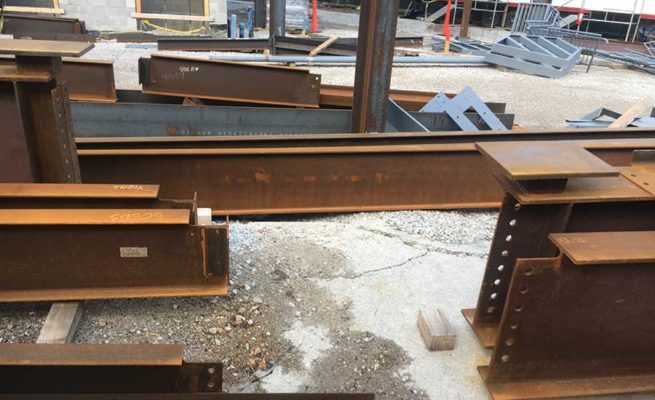
THE CANS Key to the steel-plate, shear-wall core
are large-diameter pipe columns filled with 10,000-psi
concrete. (Photo courtesy of JAJones/Absher) |
At the $215-million
U.S. Federal Courthouse in quake-prone Seattle, the designers
are proving beyond doubt that it's not always a crime to deceive
for appearance's sake. Their "secret" weapon in their cabal
to create a building that sings out liberty and justice but
provides top security and seismic safety is a hybrid shear-wall
core. The system, considered a first, combines steel plates,
braces and beams into cells "guarded" at the corners by giant
steel "cans" filled with concrete. The spine, which has the
pluses of a pure concrete core without its penalties of weight,
mass and a slow work pace, is hailed as the project's unseen
hero.
The architect, calling the 118-meter-tall
tower's slender and lightweight SPSW "creative innovation,"
finds it liberating. Under tremendous budget pressure, "we're
struggling every day to achieve absolutely essential security,"
says Steven McConnell, principal of project architect NBBJ,
Seattle. "The level of innovation and the serious money [the
core] saved meant more public benefits," he adds.
 |
| (Photo
courtesy of Michael Dickter/Magnusson Klemencic Associates) |
The prime security feature that
masquerades as architecture is a main lobby reflecting pool
that, with an infrared security screen, invisibly guards against
intruders. When penetrated, the system locks down the lobby
and alerts security. The prime feature that allowed the architect
to fulfill its federal mandate for a sense of openness in
the public realm is the absence of a heavy-braced or moment-resisting
frame along the "front" half of the building, made possible
by tucking the lateral-load-resisting system into the heart
of the 23-story tower.
"The
core gave the architect flexibility," says Brian Dickson,
project manager for the local structural engineer, Skilling
Ward Magnusson Barkshire (SWMB). "Once the discipline of the
core was set, things became easier," he adds.
Thanks
to the SPSW system, there are no perimeter columns cluttering
the tower's face. This "transparency," which allows floor-to-ceiling
glass, is accomplished through a 7-m cantilever along the
front face and a 2-m cantilever around the corners. It allows
a clear view into the courtroom lobbies, obstructed only by
seven lines of 3.8-centimeter rods. The rods tie the cantilevers
together, which minimizes deflection and vibration.
There's
more. Because the maximum 3.8-cm-thick steel core doesn't
gobble up as much real estate as would an equivalent 0.6-m-thick
concrete core, the architect was able to fit the courtrooms
into the given floor plate.
The
plate core came to the rescue again during design when it
became apparent that the courtrooms, which abut the core walls,
were shy of floor space. No problem. The structural engineer
"shrank" the core footprint to squeeze out that critical space.
The supercolumns stayed put, just outside the core's footprint.
If moved, they would have invaded the elevator shafts and
reduced overturning resistance.
Additionally,
the steel system weighs less than would an equivalent concrete
core, which minimizes the cost of foundations. Concrete's
greater mass means more force would have been exerted on the
building in an earthquake. "You have to resist that," says
Dickson.
The
system's performance in cyclic tests at the University of
California, Berkeley, was also astonishing. The inelastic
drift was measured at 3.3%. That's "significantly" higher
than other comparable systems, says Abolhassan Astaneh-Asl,
the Dept. of Civil and Environmental Engineering's principal
investigator. Drift value for a moment frame may "get to 3%,"
he says. Concrete frames don't get beyond 2%.
Astaneh
had expected the tests, performed on two- and three-story
half-wall specimens, with a supercolumn, to take one day and
last through 20 push-pull cycles. But the tests lasted 2.5
days. One specimen went through 80 cycles; the other, 60.
"It's unbelievable to structural engineers how much drift
these walls could take," says Astaneh.
The
test's long duration put a strain on the actuator, he says.
It slipped 1/8 in. Transducers shut
down the system, which was adjusted. There was reportedly
no damage.
Click here to view renderings.
Another
innovation is a system of steel catenary cables embedded in
floor slabs. They are designed to help the structure resist
progressive collapse if a column is lost. For security reasons,
even before the Sept. 11, 2001, terrorist attacks, GSA instructed
the team to remain silent about the cable system's details
(ENR 6/11/01 p. 7).
But
all are free to talk about the core. Bill Bishop, general
superintendent for the local joint venture contractor, JAJones/Absher,
estimates it was 30% faster to build than an equivalent concrete
core.
Steel
erector Adam Jones, president of The Erection Co. Inc., Arlington,
Wash., calls the system "the thing of the future" for high
seismic zones, despite some fit-up difficulties. "Dollarwise,
it more than holds its own," he says. A steel-framed building
with a concrete core takes about twice as long to build, says
Jones. He adds that an all-steel frame avoids the troublesome
coordination problems between concrete and steel work.
The
owner, the U.S. General Services Administration, is pleased
with design and construction. "We've had several projects
over budget and lots of claims in the past," says Rick D.
Thomas, project manager in the Auburn, Wash., office of GSA's
Public Buildings Service. The courthouse, 58% complete, is
on time and slightly under budget.
NBBJ
claims the 56,222-sq-m courthouse, which includes the 23-story
courtroom tower and an independent nine-level office wing,
is one of the few large-scale and complex jobs in the country
designed using object-based CAD. The architect focused on
sustainability. Public spaces are cooled using energy-conserving
displacement air ventilation, more common to Europe. Courtrooms,
lobbies and offices are designed to maximize daylighting.
Waste is minimized during construction. Steel, concrete and
insulation have recycled content. And NBBJ got the end-users
to agree on a standard size courtroom, which it claims is
a first. This allows standardized spans and stacked courtrooms.
Though
never before used in tandem, the parts of the core system
are not new. The engineer developed the composite supercolumn
for Seattle's tallest building, the 76-story Columbia Center
(ENR 3/15/84 p. 28). The SPSW system was first intended for
a 51-story high-rise in San Francisco but the building never
got off the ground.
In
the system, supercolumns--large-diameter steel pipes filled
with 10,000-psi concretetake gravity loads and resist
overturning forces. Facing SPSWs in the 9.4x 17.4-m core's
short direction and facing braced frames with discrete steel
plates in the long direction resist seismic loads. The SPSWs
include an in-plane backup moment-resisting frame that works
in conjunction with a perimeter moment frame on the north
half of the facade. The frame is primarily for occupant security
as the building line is close to the street.
In
plan, the core looks like a rectangle with a circle outside
each of the corners. SPSWs are framed by wide-flange columns
and beams, with steel plate infill panels. Each wall has an
opening midspan for access into the core. Braced frame walls
are inset 0.5 m from the inside face of the supercolumns and
welded directly to the SPSWs. SPSWs are bolted and welded
to the supercolumns. Pipes range in diameter from 1.7 to 1.1
m.
A
full braced frame was ruled out because the nearly 7-m floor-to-floor
height would have rendered it inefficient. A pure plate system
was also ruled out as uneconomical because of large plate
sizes.
This
SPSW system is not one of the predefined systems in the 1997
Uniform Building Code. It was approved for use under alternate
system provisions, says the engineer. The engineer used an
R factor of 7.5 to design the system, as indicated for special
concentric braced frames.
The
plate wall is not simply a shear element. During extreme loading
conditions, plates will buckle diagonally and then exhibit
diagonal tension-field shear characteristics to resist lateral
forces. This increases shear capacity, which is a benefit.
Supercolumns
are connected to concrete foundations through reinforcing
dowels set into drilled shafts. Core wall columns are connected
through embeds in the concrete.
The
engineer wanted to shed as much core gravity load as possible
to the supercolumns to keep the SPSWs from behaving as columns.
The weight would also reduce overturning forces. To accomplish
this, the engineer specified that crews erect the core and
fill the cans with concrete before welding the SPSWs to the
foundation.
Construction,
set for completion in March 2004, got off to a rough start
in July 2001, mostly due to unanticipated soil contamination.
Thanks to selective overtime and a switch to shotcrete foundation
walls, the team picked up 42 of the 46 days lost in 46 working
days. "We threw a bottoming-out party for the slab-on-grade
pour," says JAJones/Absher's Bishop.
Steel
erection began six calendar days late, on April 1, 2002. Bishop
reports that the core erection was complicated because of
tight tolerances. Some bolted connections had to be switched
to welds. But the design called for specific welds in some
areas and none in others. Therefore, the structural engineer
had to be consulted to make changes.
Steel
was erected two stories at a time using one tower crane, in
a repetitive sequence that began with erection of the 13-m-tall
pipes. Next, crews erected each plate wall, typically in a
single pick, and bolted it to a supercolumn. Crews then erected
the braced-frame walls, followed by the perimeter moment frames,
floor beams and metal deck. While the crew moved to the next
two floors, concrete crews pumped material into the pipes
from the bottom up to avoid interfering with steel work.
To
accommodate column shortening, the bottom of the SPSW was
not welded to the floor beam until the concrete deck topping
was poured eight floors above the plate wall.
The
building was erected at a pace of two floors every five working
days. The Erection Co. completed the job in six fewer working
days than the 91 it had scheduled.
"We
think it is an excellent system," says Jones, that could be
made even better by modifications to the connections. That
would "relieve some of the liability of the fabricator for
fit-up," he adds, by relaxing erection tolerances.
"Skilling's
all for the improvements," Jones continues, saying that the
culture of collaboration and innovation created by John Skilling,
who died at age 76 in 1998, still exists. "They're top of
the line and always have been," he says. SWMB is often called
an architect's engineer. Praise from all corners of the courthouse
reinforces that reputation.
|
In Seismic
Shift, Structural Engineer Drops Skilling Name
Next week,
for the first time since 1955, the Skilling name will
be gone from the door of the Seattle structural and
civil engineer. It's a seismic move for the firm, known
since 1987 as Skilling Ward Magnusson Barkshire, but
consistently referred to as "Skilling."
For many who worked with
John Skilling, who died two years into retirement in
1998, the change is questioned and viewed with sadness.
Why drop the name synonymous the world over with engineering
excellence and the name of the man dubbed "Mr. Skyscraper"
soon after he took New York City by storm 40 years ago
and landed, against "supertall" odds, the World Trade
Center project?
The answer given by the current
chairman and CEO is "tradition." "We're just continuing
what we've always done," says Jon D. Magnusson, Skilling's
protege. "We're changing the name to reflect those who
manage the firm." With Skilling gone and Ward and Barkshire
retired, Magnusson's is the only "active" name on the
wall.
Magnusson Klemencic Associates
(MKA) marks the seventh name for the 80-year-old firm,
which started as W.H. Witt. But will it stand as tall
as Skilling's? The nine shareholders of the 130-person
firm are betting the answer is yes.
Recent accomplishments are
impressive. Clients laud the firm for its ability to
serve, save money and innovate. "We've got to find an
edge, and they help us," says William Moody, principal
in charge of design and construction for The John Buck
Co., a Chicago-based developer that is a repeat client.
The U.S. Federal Courthouse
is a case in point. Another is the Seattle Seahawks
football stadium. There, the contractor says the engineer's
first-ever "floating" roof cut at least $4 million from
the budget. The owner claims it cut $10 million. And
Magnusson's involvement in Seattle's bold New Central
Library, designed by Rem Koolhaus, is "hugely important,"
says Deborah L. Jacobs, the city librarian. "People
trust Jon." At a public meeting of 1,200 people, Magnusson
gave his word that the building, which resembles a giant
and precarious "stack" of books in a steel-net satchel,
would stand up. That cleared the way for approval, says
Jacobs.
Architects also praise SWMB.
"They will creatively engage to see what more can be
wrung out of the intersection between architecture and
engineering," says Jud Marquardt, a partner of LMN Architects,
Seattle, the library's associate architect. "It infuses
their culture."
In addition to changing its
name, SWMB informally embraces a staggered succession
model to help ensure survival. Skilling began grooming
Magnusson in 1976, when he joined Skilling, Helle, Christiansen,
Robertson--three names before MKA. Now 49, Magnusson
became CEO at 34 and chairman when Skilling retired.
In 1992, Magnusson hired
Ron Klemencic and named him president six years later.
Now 40, he says he has five years, tops, to pick his
own successor. Klemencic directs his considerable energies
toward serving clients, and they appreciate it. "I love
working with Ron," says Moody, a repeat customer. "He's
cooperative, direct and personable."
Internally, the firm uses
a sports team model to motivate. Everyone is encouraged
to compete to get on the starting line-up and collaborate
to win the game. Externally, the firm is viewed as aggressive
by its competitors--some even whisper "poaching."
Klemencic calls that "sour
grapes." He then compares what he calls informal value
engineering to a dissatisfied patient seeking a second
opinion from another doctor. In any case, instances
of this are rare, he says, adding apologetically that,
"if the engineer of record were serving the client well,
it would come up even less frequently."
Both Magnusson and Klemencic
have been in the public eye often since the WTC attacks.
On Sept. 11, 2001, national news anchor Peter Jennings
asked Magnusson, on live television, why the 110-story
twin towers fell. Magnusson replied: "You're asking
the wrong question. You should be asking, 'How were
the buildings able to stand up?'"
Magnusson, in grade school
when the project was awarded and reluctant to steal
anyone's thunder, first suggested Jennings interview
Leslie E. Robertson, the WTC's project manager and engineer
of record. But he was unavailable so Magnusson went
on the air. His reluctance to speak out soon diminished,
after he realized that many were rushing to make change
without establishing need. "I want to make sure we're
doing things that create real safety, not just make
changes that mislead people into a false sense of security,"
he says. He has given more than 100 talks on the subject
so far.
Klemencic, as chairman of
the Council on Tall Buildings and Urban Habitat, is
on the same soap box. Since the attacks, he has given
84 interviews and is "constantly" fielding questions
about the future of tall buildings.
In the past 10 years, SWMB
doubled its size and revenue. It is still growing, and
recently opened a Chicago office, not for production
but to "better serve clients."
To outsiders, Magnusson and
Klemencic present a united front. They may share purpose,
but not velocity. "I want to go 100 mph and Jon wants
to go 30," says Klemencic. "He knows the tortoise-and-the-hare
story better than I do."
Whatever the speed, it's
clear "MKA" is making its mark, says Marquardt. Yet
he still calls the name change "gutsy."
|
|