 |
| MODEL
AUDITORIUM 4D visualization tool sequenced steel
erection. (Photo courtesy of Warren Aerial Photography
Inc.) |
It's a classical
music palace named for the king of cartoons in the film capital
of the world. It has a 15-year history that reads like a Hollywood
dramawith budget busts, fits, stops, restarts, cast
changes and rewrites. But that's not why the contractor for
the 293,000-sq-ft Walt Disney Concert Hall donned a producer's
hat and commissioned an animated "documentary" about
the job. It was more because, if the star of the show is a
description-defying building designed true-to-formless by
Frank Gehry, then a moving picture is worth a million words.
The exuberant architecture would
have been daunting enough. But the new $274-million home for
the Los Angeles Philharmonic, set to open in the fall of 2003,
has exacting seismic and acoustical demands. "I don't
think there is a single component that is not challenging,"
says Jim Yowan, project director for the Los Angeles office
of M.A. Mortenson, the general contractor-construction manager
for the roughly $200-million job.
Something had to be done to engage
the subcontractors, who were overwhelmed by the job. Convinced
that previewing is believing, Mortenson decided to tiptoe
into the fourth dimension of computer modeling and marry the
building's curvilinear, leaning and swooping geometry to the
planned schedule. The output is an animated 4D CAD visualization
tool that plays out the construction sequence. "Instead
of printing out large flow diagrams" to communicate how
to construct, "we were able to play a movie," says
Derek Cunz, Mortenson's project manager.
The effort has pushed the project
into the vanguard of computer-aided construction. "The
scale of the application is, to my knowledge, unprecedented
in the world of buildings," says Martin Fischer, director
of Stanford University's Center for Integrated Facility Engineering,
Stanford, Calif.
Based on Fischer's suggestion,
Mortenson hired Stanford doctoral student John Haymaker to
create a 4D model of the most complex components using Walt
Disney Imagineering software licensed by Mortenson. It took
four months to model the skin, a curvilinear structure and
the auditorium interior and ceiling.
 |
BIG
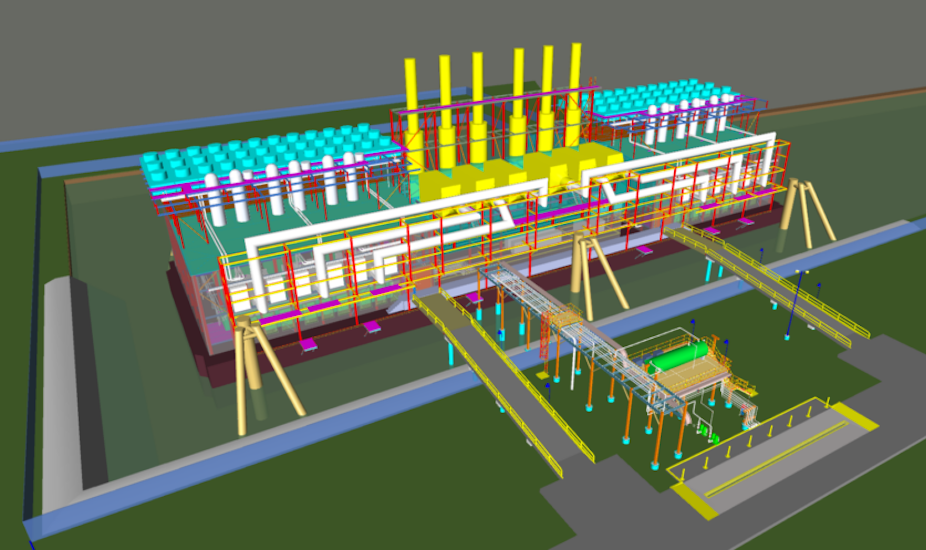
SQUEEZE 3D CAD model shows (above) ductwork snaked
around steel in hall's upper reaches
(above left).
(Photo by Michael Goodman for ENR, Illustration courtesy
of Mortenson) |
Mortenson used the model to comprehend,
confirm, communicate, coordinate and troubleshoot. The tool
helped find logic busts in the schedule while there was still
time to adjust. It verified constructibility and checked work
flow, access and hoisting. And it helped educate Mortenson's
team. But primarily, it was shown at monthly coordination
meetings to preview the next 90 days of work. After the model's
mid-2000 "premiere," the subs uncharacteristically
lingered for 90 minutes, chatting about the job. Mortenson's
general superintendent, Greg Knutson, was "blown away"
by that, recalls Fischer, who attended the first showing.
Harry Adams, project manager for
Cerritos, Calif-based electrical sub SASCO, says the model
is "very helpful, especially coordinating with other
trades." It "lets me know where I need to be,"
adds Gino Capra, general foreman for Martin Brothers/Marcowall
Inc., the Gardena, Calif.-based plaster-drywall contractor.
Not everyone is as enthusiastic.
Dennis Demmert, project superintendent for Glendale, Calif.-based
mechanical sub ACCO, says the 6,000 hours budgeted for detailing
ballooned to more than 20,000, and there were hundreds of
requests for information (RFIs). The model also was heavy
on structure but didn't show "how physically to get ductwork"
sections through the forest of steel during installation,
he says.
 |
| JUMBLE
Dense frame handles strange shapes, seismic loadings.
(Photo courtesy of Warren Aerial Photography Inc.) |
The model isn't perfect, but it
is apparently on target. "We are following the schedule
to the T,'" says Knutson, and the job is on course
for an April 2003 completion. Then, Mortenson will turn the
facility over for six months of commissioning.
The 4D model may have been helpful
but the 3D CAD model, developed to avoid drawing thousands
of details and to relate one installed building system to
another, is considered absolutely indispensable. "The
contractor has more information to assist in building this
project than probably on any other in the history of architecture,"
says Terry Bell, Gehry Partners' project manager.
Capra agrees: "Everything
is driven by CATIA. It allows us to be creative."
 |
| SHORED
BY 4D Erector got to preview south wall erection.
(Photo courtesy of Herrick) |
Frank Gehry has said many times
that 3D CAD is the key to his brave new paperless world of
building. In Gehry's world of sculptural forms, the architect
reigns over the rest of the construction team by controlling
the CAD model. Toward this end in 1990, he hired partner Jim
Glymph to bring 3D CAD into Gehry's Santa Monica, Calif.,
studio.
The concert hall was the first
guinea pig. But the architect was way ahead of his time. While
his shop painstakingly digitized surfaces, nearly everyone
else down the line functioned the old way. "It was ill-organized,"
says one consultant involved in the early exercise.
That was then. In 1994, the project
stalled. By the time it restarted in 1997, computers had infiltrated
construction. Gehry's jobs are still not paperless. But most,
like the reborn concert hall, are hybrids, with construction
documents that contain drawings and a CAD file.
Toward a paperless end, Glymph
envisions a team-shared project platform that centralizes
all data, allowing instant feedback for fabrication, material
quantities and more. The system would recognize objects and
their attributes, and be able to work across the Internet.
The firm is currently working with IBM and Dassault Systemes,
developer of CATIA, the 3D program Gehry uses, to evaluate
an "intelligent" package specifically for buildings.
The concert hall complex, a full-block
addition to the Music Center of Los Angeles County, consists
of eight elements above grade and a 70- x 58-ft theater below,
cut into a parking garage completed in 1995. On city land,
the facility will be county owned and operated.
The concert hall is formed by a
three-dimensional braced frame in structural steel that bears
on the structural concrete garage. The frame contains nearly
11,000 tons of steel and more than 11,000 pieces, almost all
different. The connections join as many as 10, usually dissimilar
members. "It's very dense," says John A. Martin
Jr., president of the job's local structural engineer, John
A. Martin & Associates Inc.
Martin selected a braced frame
as the most efficient and economical, under the circumstances.
The behavior of a braced frame is more predictable in a quake
than a more-limber moment frame, he says. But a braced frame
delivers much higher instantaneous loads back to the ground,
in this case through the garage. "We have what appears
to be substantial bracing because we wanted to distribute
the forces as much as possible" over the garage's top
slab, Martin says.
Even so, the engineer had to reinforce
portions of the slab and some garage columns and their foundations.
 |
| FLARED
North wall, with cantilever, was trickiest to erect. (Photo
courtesy of Herrick) |
Though some see the braced frame
as a "brute-force solution" that has had a negative
impact on the trades that followed the steel, Martin is pleased
with it. "It solved our lateral load problems,"
he says, and fit into the garage structure.
The clunkiness is in part attributed
to the project's storied past. In 1988, Gehry won a design
competition for the concert hall without having completed
any project of this scale. Completion was set for 1996. Dworsky
Associates was the local executive architect and CBM Engineers
Inc., Houston, structural engineer. The local general contractor
was Concert Hall Builders, a three-firm joint venture including
Peck/Jones.
By November 1994, with the garage
almost finished, the hall's design 90% complete and steel
fabrication about to begin, the cost of the fast-tracked job
had escalated $50 million, to $260 million. The Walt Disney
Concert Hall Committee then pulled the plug on the job. When
it was revived in 1997, Gehry had promised to redesign the
building with primarily a stainless steel skin, not limestone
cladding. And under threat of withdrawal, he had been given
his first role as executive architect. "We want to do
our own construction documents" and "control our
own destiny," says Craig Webb, Gehry Partners' concert
hall project designer.
But the building code had since
changed as a result of the area's 1994s Northridge earthquake,
which rattled confidence in special moment-resisting frames.
The nonrepetitive moment frame had become too costly, thanks
to a new code stipulation that moment connections had to be
laboratory tested. A structural redesign was in order. Gehry,
knowing extensive coordination was necessary, wanted a local
engineer, says Edward J. Burnell, president of Walt Disney
Concert Hall I Inc., the development manager formed for round
two.
CBM was given the option of opening
an L.A. office or taking responsibility for garage changes
and serving as a consultant to Martin on the hall. Neither
course was acceptable, says P.V. Banavalkar, who retired from
CBM in 1999 and is currently a vice president with Carter
Burgess, Houston.
There were other changes. After
a two-year preconstruction phase in 1997, Mor-tenson signed
its lump-sum, at-risk contract in late 1999 (ENR 12/20/ 99
p. 16). And the job was no longer fast-tracked.
 |
| CONFUSION
Except for box columns, it is tough to tell shoring
from steel. (Photo courtesy of Herrick) |
The redesign of the hall was done
in the first nine months of 2000, concurrent with the retrofit
of the garage. This included reinforcing, cutting into the
top slab and two post-tensioned slabs below it for the theater
and beefing up the slab for crane paths.
Martin considers the amorphous
elements the most complicated in the facility. Trying to hit
a theoretical point in space, given allowable tolerances,
was "very challenging," he says. "The process
of thinking in 3D is not just a philosophy but a state of
mind."
Framing for the preconcert hall
(Element 3), the founders' hall (E-8) and even the conductor's
suite (E-6) with ribs in the horizontal plane is reminiscent
of the rib-stiffened reinforced shotcrete shells of Gehry's
Experience Music Project in Seattle (ENR 2/28/00 p. 76). Pipe
sections provide lateral bracing.
The lobby area (E-4) is also curvilinear.
It is framed from 8- and 16-in.-square straight tubes that
primarily resist lateral loads. Its 2-ft-square built-up box
members and up to 30-in.-deep built-up ribs create 3D curved
trusses. The north end is framed by sloping 30-in. deep built-up
ribs. The atriums (E-2 and 5) bracket the auditorium. They
are framed by sloped wide-flange columns in a semicircular
shape.
The 238- x152-ft auditorium is
a warped box. It has flared walls, up to 130 ft tall, and
a flattened-V roofline, doubly pitched 14°. The south
wall leans out 17° from the vertical. The other three
walls lean 6°. The roof slab, 14 in. of concrete on metal
deck, is supported by nine dissimilar trusses that span up
to 140 ft east to west. The extra-thick slab is mostly for
acoustical isolation. Built-up box columns, typically 2 ft
but up to 30 in. square in the plane of the leaning walls,
support the trusses.
E-7 forms a platform that transfers
loads from other elements to the garage. It has a regular
frame, though some columns slope at their bases to line up
with the garage grid. At the south end, E-7 rises above grade
to house the orchestra's offices.
 |
| ELEMENTAL
Steel frame is true to surface geometry of eight elements.
(Photo courtesy of Warren Aerial Photography Inc.) |
To fabricate steel for the project,
the steel contractor used two of its own facilities and six
others, in an effort to keep fabrication ahead of field work.
Nearly 80% of detailing was done
using a 3D model-based platform called Xsteel, recommended
by Gehry prior to contract award, says Roger E. Ferch, vice
president of steel contractor Herrick Corp., Pleasanton, Calif.
The platform offers a more direct link to CATIA than a 2D
system and permits the transfer of data in both directions.
For example, CATIA starts with a steel wire frame. Xsteel
then provides it with member shapes and dimensions, which
was helpful to Mortenson and the design team.
The warped box was the most difficult
element to erect, says Ferch. Within that, the trickiest part
was a 40-ft cantilever on the upper half of the north wall.
Otherwise, steel erection was relatively simple, though the
EMP-like elements did require internal table-like shoring
against which the ribs leaned temporarily, he says.
Work started at the south wall
by erecting an engineered shoring tower, which bore on E-7
framing, to cradle the leaning columns until appropriate connections
were made. The 121-ft-tall tower consisted of two A-frames
at the base, 72 ft apart, connected by horizontal members.
Continuing up from each "A" was a vertical member.
Three flat, horizontal trusses, each 133 ft long, spanned
between vertical members like ladder rungs, and cantilevered
beyond them. The columns went up in three pieces, the top
of each set against a rung.
Shoring for the 120-ft-tall north
wall consisted of 100-ft-tall supports at the corners with
two mid-wall supports that broke the wall into thirds. A triangular
support, some 50 ft tall, supported the base of the cantilever's
column, which like the wall leans out 6°.
 |
| PRODUCERS
Mortenson's Knutson (l.), Yowan, Greg Funk. (Photo by
Michael Goodman for ENR) |
East and west walls were simpler. Some columns gained support
from E-2 and 5, which went up concurrently with the box. Another
was guyed to a previously erected structure.
The first steel was erected
in July 2000. Using a 300-ton crawler crane, Herrick set a
portion of E-7 above the theater, for south wall shoring.
The crane then moved north, inside the box. Six months into
the work, a 170-ton mobile crane started E-6 and the balance
of E-7. E-3, 8 and 4 followed. Later, a 50-ton hydraulic crane
erected interior steel. Primary structural steel cost $2,500
to $3,000 per ton.
Mortenson insisted on 100% fall
protection above 6 ft on the entire project. But because of
the shapes, conventional fall protection systems, designed
to hook onto flanges, wouldn't work on a majority of members.
Mortenson and Herrick came up with a system that involved
detailing fall protection cable attachments on the shop drawings
so field personnel could install cables on the beams. Two
people fell during the project and were restrained by the
system, says Mortenson's Knutson. There have been no deaths
or major injuries, he reports.
Mortenson and Herrick also devised
a scheme to check positioning of the steel. In the shop drawing
phase, target positions were identified on selected pieces.
In the shop, target locations were center-punched on the member
and in the field, crews placed a reflective target over the
punchmark. That allowed the surveyor, using a high-tech transit
with its own database containing X-Y-Z coordinates for each
piece, to know when the piece was in its correct position.
 |
| SWEEPING
Steel frame considered most complex in U.S. (Photo by
Michael Goodman for ENR) |
Steel was substantially erected
by late last year, with a "miniscule amount out of tolerance,"
says Mortenson's Yowan. Final connections of major members
involved field welding, finished earlier this year. The job
was done on time, says Ferch, but with over 2,000 RFIs.
No one will comment on changes,
extras or claims on the steel or any part of the project,
saying the information is confidential.
he skin followed the steel. The
surface will eventually contain 160,000 sq ft of panels and
40,000 sq ft of glazing. Of 6,100 panels, only 2,100 are the
same.
The panel system was designed and
detailed using CATIA and then fabricated using computer numerically
controlled equipment driven by the CATIA model. It is the
most complete use of CATIA on the job, says the architect.
We decided to spend a lot of energy
on design so everything is in the model," adds Marzio
Perin, engineering manager in the Los Angeles office of Permasteelisa
Cladding Technologies. That saved a lot of time in the end,
he says.
 |
| THIN
SKIN Curtain wall supplier-installer used 3D CAD
the most. (Photo by Michael Goodman for ENR) |
The panels are installed on a secondary
frame anchored to the primary frame. Layout of anchors is
controlled by a field instrument, called a total station,
that provides X-Y-Z coordinates for a point interfaced with
custom software that sets the anchor according to information
received from CATIA. Workers then bolt secondary frame members-metal
studs or aluminum channels containing CNC shop-drilled bolt
holes-to the anchors. Crews adjust the studs according to
the layout in the CATIA model. Next, workers bolt girts, which
support the panels along their lower edge, to the secondary
frame. Girts also have CNC shop-drilled bolt holes. Girts
are adjusted left and right, again following the CATIA model.
Position is checked by the total station. Finally, crews install
panels.
The skin is only 50% complete,
yet the building is already a landmark. New York has the Statue
of Liberty, Rome has the Coliseum and Paris has the Eiffel
Tower, says Burnell, hoping that the Walt Disney Concert Hall
will replace the "HOLLYWOOD" sign as L.A.'s icon.
|