|
Architect William
McDonough claims he first heard about Ford Motor Co.'s $2-billion
makeover of its River Rouge production plant in Dearborn,
Mich., on May 4, 1999, the same day that Ford CEO William
Clay Ford Jr. called a press conference to announce that McDonough
would lead the design team. Picking McDonough, a wry Charlottesville,
Va.-based iconoclast who preaches environmentally benign,
sustainable design, was a bold move for the automaker. McDonough
believes in not only fundamentally altering buildings, but
also changing the way things are made, to make the planet
a better place.
 |
MASTER
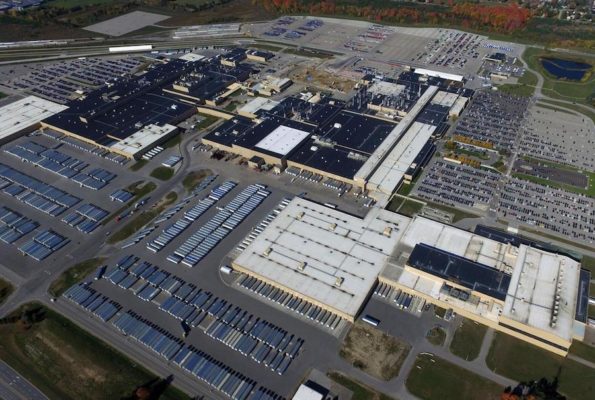
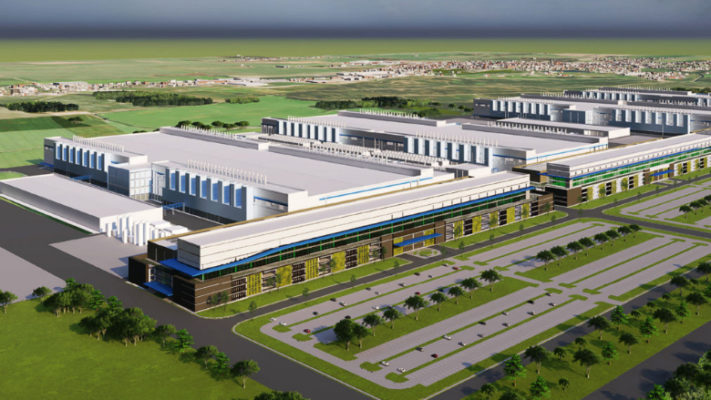
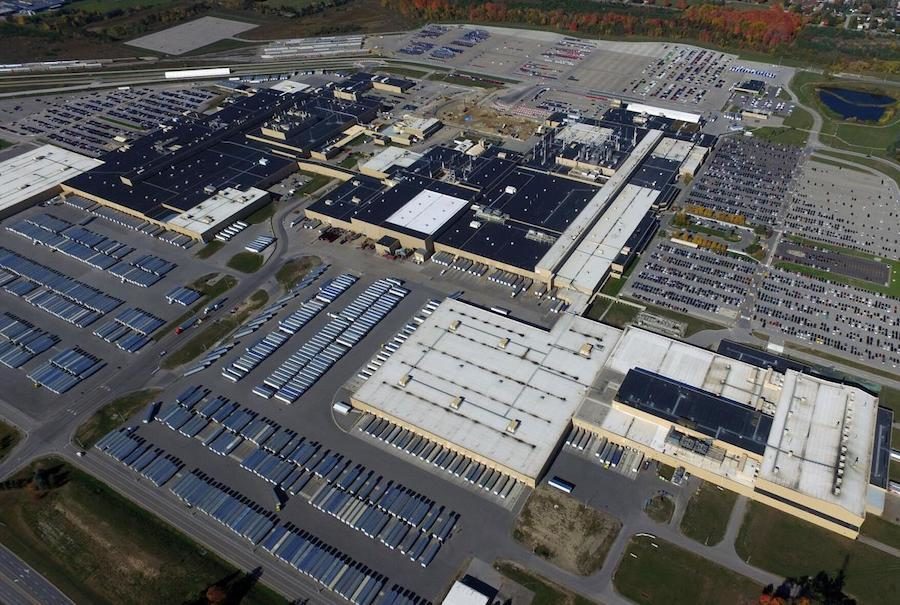
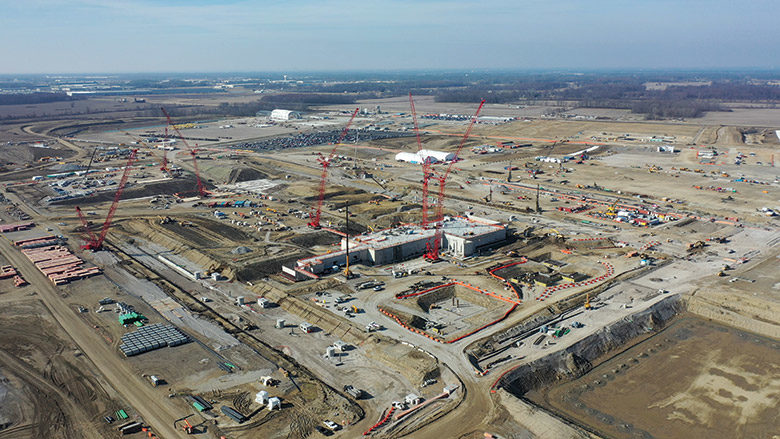
PLAN Complex covering 1,100 acres will have a 20-year
buildout, but
stormwater system is already in place. (Rendering courtesy
of Ford Motor Co.) |
River Rouge is Ford's flagship
plant, where Henry Ford bought 2,000 acres nearly a century
ago to implement his vision of streamlining mass production.
By the1930s the Rouge had grown into the world's leading automobile
manufacturing center. Parts and supplies moved within the
complex on more than 100 miles of railroad track. At its peak,
the work force numbered more than 100,000.
William Clay Ford Jr. first began
thinking of the makeover in 1997. Henry Ford's great-grandson
and Ford's chairman at the time, "Billy" Ford has an environmentalist
bent that often put him at odds with the company's corporate
leaders. Still, he is the family's choice to lead Ford into
the 21st Century and Rouge is where Ford wants to begin.
In all, 1.7 million sq ft
of buildings over approximately 1,100 acres will give the
carmaker the ability to produce a wide variety of models at
the same siteeventually, a car and a truck side by side.
The goal is to build a modern, versatile assembly line that
will produce vehicles efficiently, profitably and safely,
in an environmentally friendly manner.
 |
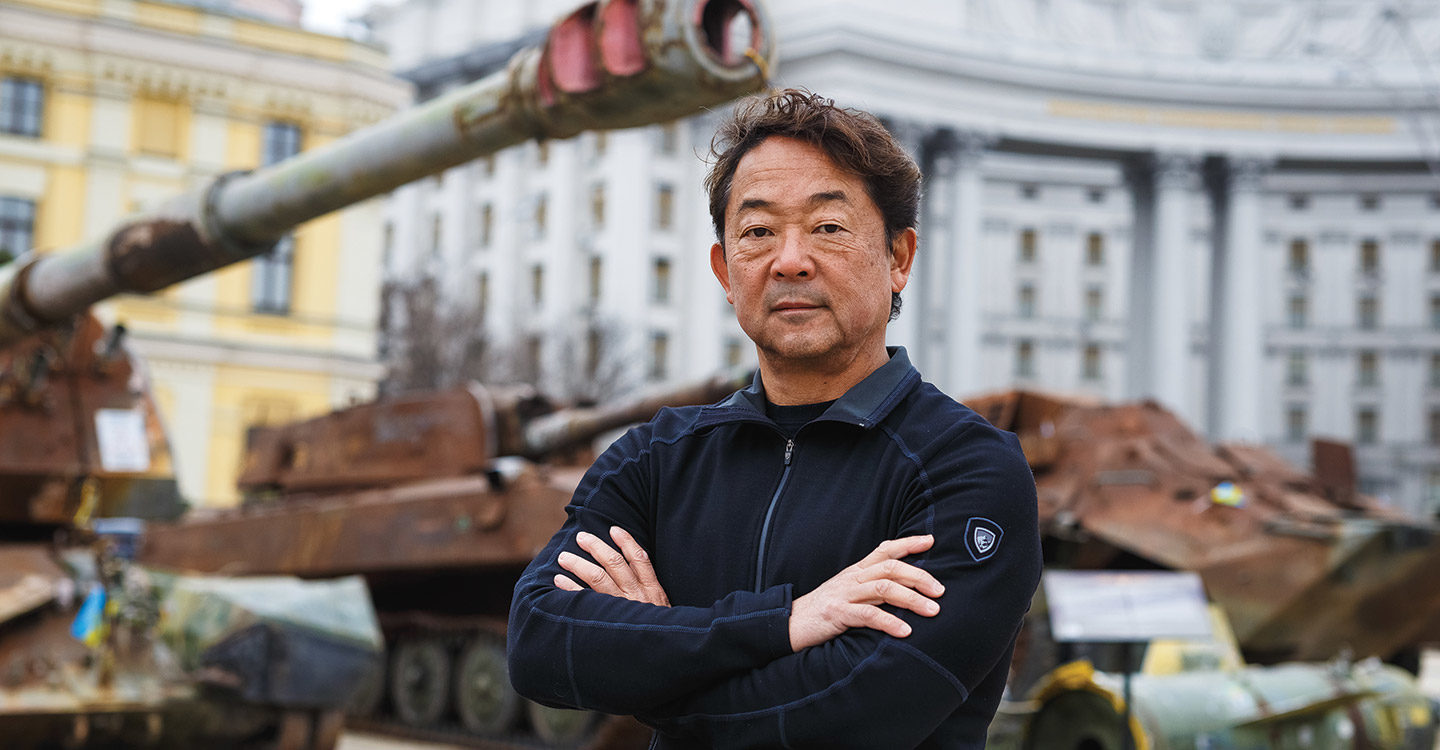
| GREEN
TEAM From left: Kroczolowski, Richardson, McDonough
and Haller. (Photo by Janice L. Tuchman for ENR) |
Some 10 acres of roof will literally
bear McDonough's "green" influence (ENR 4/29 p. 61). Covered
with soil and planted in sedum, a low-maintenance per- ennial,
the organic roof is designed to provide insulation and never
need painting. Gutters are unnecessary; the plant cover filters
rainfall and snowfall.
The entire site is engineered to
treat stormwater naturally. Permeable surfaced parking areas
and engineered swales will force runoff through plant-based
filtration to remove contaminants. Stormwater returning to
the Rouge River should meet Clean Water Act standards, says
William A. Kroczolowski, project architect for team member
ARCADIS Giffels.
The realities of manufacturing
have forced McDonough to scale down his initial concept. "I
envisioned an opportunity to make some sort of grand architectural
statement. But it quickly became apparent that with our budget
there was no room for anything too grandiose. This is, after
all, an industrial site and function drives everything. Still,
I think that we are very much on track for the original goal
of creating a 21st Century manufacturing environment that
respects the earth, air and water of the site."
Though McDonough comes from outside
the Detroit norm, other first string players are all veterans.
Ford project manager James L. "Jay" Richardson II has worked
for the company for 28 years. To lead design and construction,
Ford tapped the Michigan-based offices of two firms with long
track records in the automotive industry: ARCADIS Giffels
LLC, Southfield, and Walbridge Aldinger, Detroit.
 |
| BIO-BUILDING
Organic cover filters contaminants, insulates. (Photo
courtesy of Ford Motor Co.) |
When McDonough suggested using
a cavernous workspace covered by fabric, instead of steel
or concrete, "We pointed out how much weight the overhead
crane system would bear," says Kroczolowski. Fabric structures
would not handle the loads. Instead of a massive room with
a 500-ft span, work space will be a series of 50x50-ft bays
configured in an L-shape covering 735,000 sq ft.
But McDonough did foster a collaborative
approach. "Everything was on the table," says Richardson.
"There was no such thing as a bad idea. Bill McDonough got
us to think in terms of what he called a sustainable triangle.
Everything would be tested to see how it fit within the triangle:
as a business case, on an environmental basis and in a social
sense, or for the effect on people. We'd balance the business
case against the environmental cost and use the social effect
as a tie-breaker."
The stakes are high. Ford, already
embroiled in legal battles over Firestone tires fitted to
its SUVs that may be tied to rollover accidents, is under
intense pressure. The company lost $5.5 billion in 2001, prompting
Standard & Poor's to downgrade Ford's long-term debt.
(Like ENR, S&P is a unit of the McGraw-Hill Cos.)
But Ford, who became CEO in 2001
at 42, is staying the course. He says Ford will make $7 billion
in operating profit by 2005 and has not cut back on his plans
for the Rouge. The paint shop, a 330,000-sq-ft structure,
was commissioned in October 2000. It can accommodate every
Ford model except two of the larger vans and SUVs.
Other energy-efficient measures
include daylighting and jumbo heating, ventilation and air
conditioning units in the assembly plant. Ten 25x100-ft "monitors"
admit natural light and 10 big HVAC units handle a load that
would traditionally fall to 40 to 50 smaller units, according
to Haller. "Temperatures in big spaces tends to fall within
different strata. These units can heat and cool the air by
layers. It's much more energy-efficient," he says.
The assembly plant design features
three activity levels: shipping/receiving, assembly and employee
activities. Administrative offices will be on the mezzanine
level, in an effort to break down barriers between management
and labor.
Detroit's next generation of workers,
Richardson says, will use "smart" tools that can rapidly change
output and configuration to meet market demands. Adjustable
conveyors and ergonomic tools are scheduled to be fitted into
the assembly plant and the 250,000-sq-ft storage and retrieval
system building early next year.
Ford is as competitive as ever,
and will continue to be, says Richardson. The Rouge reconstruction
incorporates ideas that the company expects the other automakers
to implement. "As Bill Ford says: It's not about ownership,
it's about leadership," says Richardson. Target date for completion
of the first phase is June 16, 2003, to coincide with Ford
Motor Co.'s 100th anniversary.
|