|
A newly rehabilitated
terminal with intermodal connections serving passengers on New
York Citys Staten Island Ferry is a crucial economic linchpin
for Staten Islands redevelopment. It also may be the first
intermodal transportation hub to qualify for Leadership in Energy
and Environmental Design certification by the U.S. Green Buildings
Council. Its designers are applying for silver certification.
The refurbished and expanded 190,000-sq-ft
St. George Ferry Terminal was officially unveiled May 20,
but the local office of construction manager Skanska USA will
continue with an additional $12 million to $15 million worth
of work. The New York City Economic Development Corp., acting
for the citys Dept. of Transportation, recently allocated
the extra funds for security-related cameras, fencing and
other items, says Dick Clemenzi, Skanska project director.
Skanska began its $120-million
contract in October 2001 by rebuilding the 16,100-sq-ft main
waiting room while 60,000 daily passengers continued to use
it, says Clemenzi. Crews worked atop a temporary roof of steel
beam-supported plywood and cement to build the new curved
steel roof, increasing the ceiling elevation from 24 ft to
as much as 36 ft. The new roof is slanted to catch angled
rays of the sun in winter while shielding the interior from
the worst of the suns rays in summer.
The century-old brick, concrete
and structural steel building received new terrazzo flooring
and structural extensions about 80 ft to the north. The extensions
include new outdoor terraces, enclosed hallways and a curved
40-ft-high curtain wall, 208 ft long x 100 ft deep, of aluminum
and glass that allows waiting passengers to view the Hudson
River. The extensions add some 8,000 additional sq ft of retail
space to the existing 12,000 sq ft for such amenities as a
new restaurant.
 |
| Brightened.
Expanded Staten Island terminal features glass walls instead
of brick. |
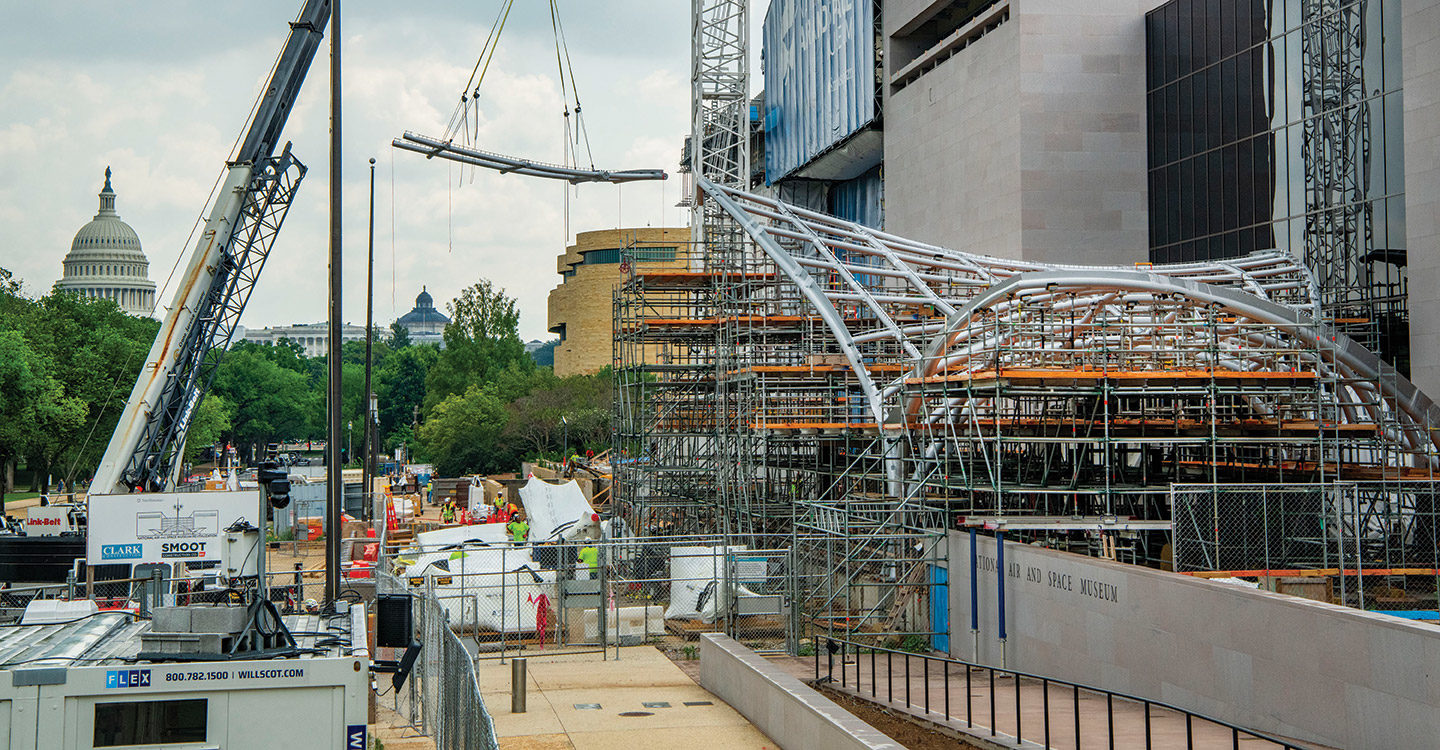
The centerpiece is a new 84-ft-tall,
320-ft-long white steel arched canopy supported by 10 cantilevered
columns on the terminals new north terrace, serving
as a gateway for visitors. "The objective was to make
this a destination, not just a terminal," says Kenneth
Drucker, design director for architect Hellmuth, Obata + Kassabaum,
New York City.
Eve Michel, senior vice president
of the economic development agency, says LEED-certifiable
elements include collection of rainwater to reduce runoff
and irrigate 18,000 sq ft of vegetation on an ancillary buildings
roof, with milkweed planted to attract monarch butterflies.
Marine biologists reintroduced 100 oysters to an artificial
bed around the slips to naturally clean out boat emissions.
The renovation also improves intermodal
connections. "The circulation has been rationalized so
that its not all at one congestion point," says
Michel. Personal vehicles drop passengers off at a re-landscaped
lot leading to a new south lobby. New hallways and walkways
connect bus, light rail and taxi passengers to the terminals
west entrance. A new staircase from the north terrace leads
visitors to a minor-league ballpark.
(Photos courtesy of HOK/Adrian Wilson)
|